
F&B Reinstatement Cost Singapore: 2026 Budgeting and Compliance Guide

Your security deposit isn't just a line item on a balance sheet; it's often the vital capital needed to fund your next chapter. Yet, many restaurateurs find this final sum withheld because they didn't anticipate the true f&b reinstatement cost Singapore in 2026. It's a common frustration to realize that "returning the unit" involves far more than just clearing out tables and chairs. Between specialized grease trap removal and restoring complex gas lines, the technical demands of a commercial kitchen can quickly drain a budget if they aren't planned for with precision.
We know that closing a chapter is already a high-pressure time. You deserve an honest, straight-shooter assessment of what it takes to meet mall management’s strict after-hours requirements and SCDF fire safety codes. This guide provides a clear breakdown of the factors that drive restoration expenses. We'll walk you through the essential compliance checklists for SFA and building management. By the end, you'll have a practical roadmap to ensure a dispute-free handover that protects your business's hard-earned assets.
Table of Contents
Understanding F&B Reinstatement Costs: Why Restoration Goes Beyond Hacking
Primary Cost Drivers: Restoring Kitchen Exhausts, Grease Traps, and M&E Systems
Budgeting by Complexity: Why Square Footage Is a Misleading Metric
Navigating Mall Management Guidelines and SCDF Fire Safety Compliance
Ensuring a Dispute-Free Handover with a Reliable Reinstatement Partner
Understanding F&B Reinstatement Costs: Why Restoration Goes Beyond Hacking
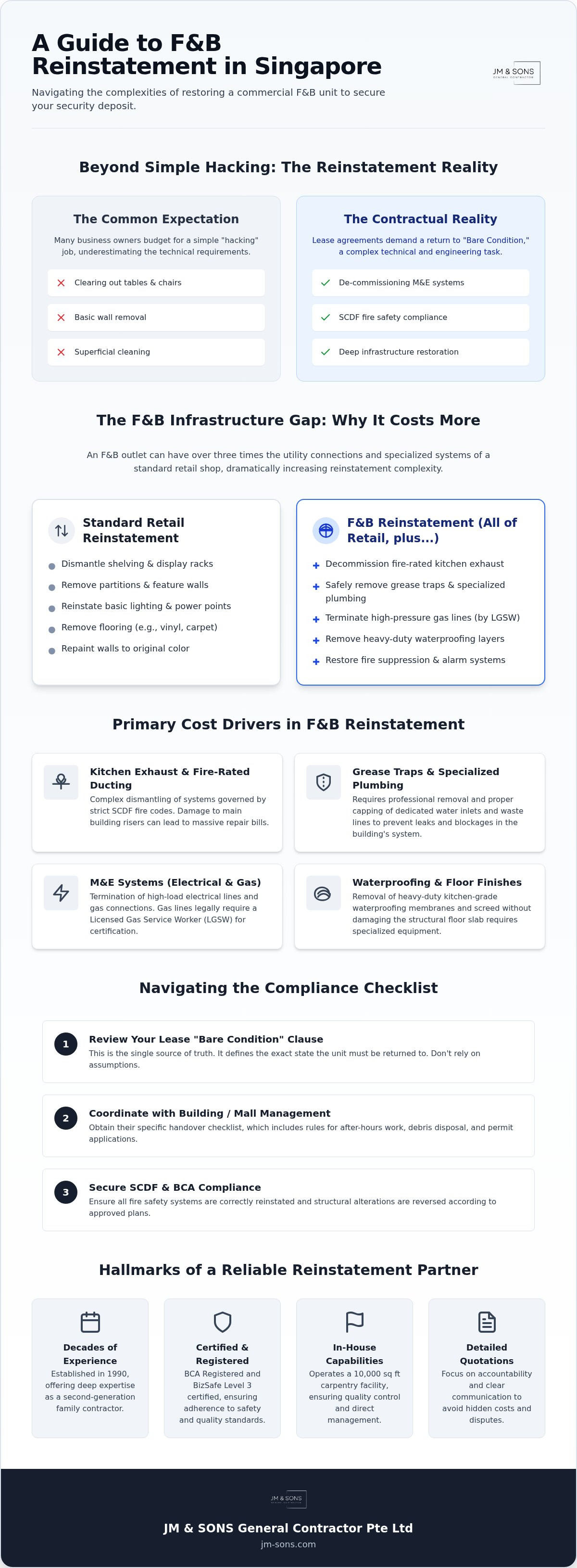
Closing a restaurant in 2026 involves much more than just handing over keys. It's about returning the space to the "Bare Condition" specified in your contract. While many owners view this as simple "hacking," the reality is a complex engineering and coordination task. Failing to account for the true f&b reinstatement cost Singapore often leads to a painful surprise: the landlord withholding your security deposit due to an incomplete or non-compliant handover. Understanding the f&b reinstatement cost Singapore is about recognizing the gap between surface-level cleaning and deep infrastructure restoration.
The complexity of kitchen de-commissioning is where most budgets fail. Unlike an office where you might just pull up carpet tiles, a restaurant involves heavy-duty waterproofing and specialized plumbing. Removing these layers without damaging the building’s structural integrity requires a contractor who understands the technical nuances of Singapore’s commercial buildings. It's a high-stakes utility restoration project where success is measured by compliance, not just how much debris is removed.
The Legal Obligation in Your Tenancy Agreement
Every professional lease agreement in Singapore contains a specific clause regarding the state of the premises at the end of the term. This isn't a suggestion. It's a binding legal duty. The original Handover Report, documented when you first took possession of the unit, serves as the landlord's benchmark for compliance. If your kitchen was a blank concrete shell four years ago, it must be returned as a blank concrete shell today. A Reinstatement Clause serves as the primary legal driver of your exit costs, mandating that you undo every modification, from floor screeding to ceiling grids.
F&B vs. Retail: The 'Hidden' Infrastructure Gap
It's a mistake to compare a retail shop's exit to a restaurant's. Food outlets typically have three times more utility connections than a standard fashion boutique. You aren't just removing shelves and racks. You're de-commissioning fire-rated kitchen exhaust systems, removing grease traps, and safely sealing high-pressure gas lines. These fire-rated compartments are built to withstand extreme heat, making them significantly more difficult and time-consuming to dismantle than standard office partitions.
At JM & Sons, we believe in a "straight-shooter" approach. We conduct a detailed technical assessment before quoting to ensure no hidden M&E costs surprise you later. Since 1990, our second-generation team has prioritized accountability because we know that a clean handover is the only way to protect your business's capital. We handle the heavy lifting of project coordination so you can focus on your next venture without looking back at "loose ends" the landlord might find.
Primary Cost Drivers: Restoring Kitchen Exhausts, Grease Traps, and M&E Systems
While visible demolition like removing partitions is straightforward, Mechanical & Electrical (M&E) restoration represents the most significant portion of your f&b reinstatement cost Singapore. These systems function as the "nervous system" of your restaurant. You can't simply cut wires or cap pipes without considering the impact on the entire building. In a shopping mall, your unit is part of a shared network. Any mistake in de-commissioning can trigger alarms or disrupt services for neighboring tenants, leading to costly delays.
Compliance with BCA building regulations is mandatory for these technical works. This includes ensuring all structural alterations are safely reversed and that fire-safety integrity remains intact. For gas connections, you must engage a Licensed Gas Service Worker (LGSW) to cap the lines and provide the necessary certification. Landlords won't accept a simple "handyman" fix for gas or electrical points; they require documented proof that the work was done by qualified professionals to protect the building's safety.
Kitchen Exhaust and Fire-Rated Ducting
Kitchen exhaust systems are governed by strict fire-safety codes because grease buildup is a primary fire hazard. You can't just "rip out" fire-rated ducting. These systems often connect to a main building riser. If you damage the fire dampers or the main duct while removing your kitchen hood, you'll face massive repair bills from the building management. Professional cleaning is also a prerequisite for handover. Landlords will inspect the duct interior for grease residue to ensure it's not a fire risk for the next tenant. At JM & Sons, we coordinate these de-commissioning tasks with precision to avoid damaging shared infrastructure.
Grease Traps and Specialized Plumbing
Restoring plumbing is a labor-intensive process that goes beyond just turning off a valve. Removing floor-mounted grease traps requires hacking into the floor screed, which then must be waterproofed and leveled again. It's vital to seal drainage points correctly to prevent "backflow" issues. If a leak or blockage occurs after you've moved out because of poor capping, you could be liable for damages. We work closely with mall plumbers to ensure every water point is capped according to the specific requirements of the MCST. If you're unsure about the state of your current plumbing, you can share your site photos with us for a technical review.
Budgeting by Complexity: Why Square Footage Is a Misleading Metric
In the world of commercial property, many tenants rely on a "price per square foot" estimate to set their budgets. While this works for simple office hacking, it's a misleading metric for calculating f&b reinstatement cost Singapore. A 500-square-foot bubble tea kiosk often requires more technical labor than a 2,000-square-foot retail showroom. The reason is simple: utility density. The sheer number of electrical points, water inlets, and drainage outlets packed into a small kitchen space determines the labor hours required to safely de-commission the unit.
Technical factors like waterproofing removal and heavy-duty floor screeding also spike costs regardless of the total area. If your kitchen was built with a raised floor to accommodate drainage, we must hack away multiple layers of cement and tiles to reach the original structural slab. This is a physically demanding process that requires precision to avoid damaging the building's floor plate. Utility complexity, not area, dictates the final quote.
The Complexity Matrix: Light vs. Heavy F&B
We categorize projects based on their "wet" or "dry" status. A dry cafe with minimal plumbing and no heavy cooking equipment is relatively straightforward to restore. In contrast, a wet kitchen with extensive floor traps and high-pressure washing areas requires significant hacking and waterproofing restoration. Removing floor tiles is one task; grinding down the underlying adhesive and restoring the cement screed to a perfectly level "bare condition" is another level of labor entirely. At JM & Sons, we use our roots dating back to 1990 to assess these layers before we provide a detailed quotation, ensuring you aren't hit with unexpected variations.
Logistics and Site Access Surcharges
Your location within a building impacts the f&b reinstatement cost Singapore as much as the work itself. Most major malls in Singapore mandate "Night Works" for hacking and debris removal to prevent noise and dust from affecting shoppers. After-hours labor naturally carries a higher rate. We also consider vertical transport; if your unit is on a high floor far from the service lift or loading bay, the time spent moving debris increases significantly. We also account for the rising costs of NEA-regulated construction waste management in 2026. Disposing of specialized F&B waste, like grease-soaked materials or heavy masonry, requires specific handling that we coordinate as part of our BizSafe Level 3 commitment to safety and industry standards.
Navigating Mall Management Guidelines and SCDF Fire Safety Compliance
Reinstatement is a three-way negotiation between you, your contractor, and the building management. While you focus on managing the f&b reinstatement cost Singapore, the landlord is primarily concerned with the SCDF Fire Safety Certificate (FSC). If the restoration doesn't meet the building’s original fire protection layout, the unit cannot be legally handed over. This coordination requires a deep understanding of how fire protection systems integrate with the building's main loop. It's not just about removing your fixtures; it's about ensuring the safety infrastructure remains functional for the next tenant.
The process involves significant administrative work before a single hammer hits a wall. Most major malls in Singapore utilize a strict "Permit to Work" (PTW) system. This system acts as the gatekeeper for all site activity, dictating everything from work hours to debris disposal routes. Skipping these steps or failing to provide the necessary insurance documents can halt your project, leading to late handover penalties that far exceed the initial f&b reinstatement cost Singapore.
SCDF and Fire Safety Compliance
Fire safety is the most scrutinized aspect of any commercial handover in 2026. Any sprinklers, smoke detectors, or fire alarm bells moved during your initial fit-out must be returned to their precise original positions. You should engage a Qualified Person (QP), such as a registered architect or professional engineer, to oversee these modifications and ensure compliance with the latest codes. Unauthorized hacking of fire-rated walls or ceilings is a serious offense that leads to heavy fines and immediate work-stoppage orders. We always advise readers to verify the specific regulatory details for their building with the relevant authorities or building management to avoid compliance gaps.
Building Management (MCST) Liaison
Your relationship with the Management Corporation Strata Title (MCST) determines how quickly you recover your reinstatement deposit. They will enforce strict hoarding and floor protection requirements to prevent damage to common areas. Poor site protection is a common reason for deposit deductions. At JM & Sons, we take the lead in these liaisons, managing the hoarding and protection to the landlord’s satisfaction. For a deeper look at these operational standards, you can refer to our Singapore Mall Fit-Out: 2026 Guide.
The process concludes with the "Final Inspection." This walkthrough with the landlord’s representative is your opportunity to prove that all M&E points are safely capped and the space is in the required "Bare Condition." Having a contractor who understands these mall-specific nuances is vital for a smooth exit. Since 1990, our family-run team has acted as a reliable bridge between tenants and landlords. If you're currently preparing for a mall inspection, contact us to coordinate your SCDF and MCST requirements.
Ensuring a Dispute-Free Handover with a Reliable Reinstatement Partner
Choosing a contractor based solely on the lowest number often backfires. In Singapore's competitive market, a "low-ball" quote is frequently a placeholder for future variation orders. These hidden fees emerge once the hacking begins, suddenly inflating your f&b reinstatement cost Singapore halfway through the project. Even worse, a contractor who lacks experience with mall management can cause handover delays. This leads to daily liquidated damages that you must pay the landlord, often far exceeding the money saved on the initial quote.
At JM & Sons, we've built our reputation on being straight-shooters. As a second-generation family contractor operating since 1990, we understand that our accountability is our greatest asset. We provide detailed, transparent quotations that account for the technical realities of F&B units, from fire-rated ducting to heavy-duty floor screeding. We believe in getting the details right the first time so you can move on to your next venture with peace of mind.
Evaluating Your Reinstatement Quotation
A professional quotation should leave no room for ambiguity. When reviewing your options, check if the quote includes debris disposal fees and final site cleaning. These are often omitted by smaller outfits to make their prices look more attractive. You should also look for a clear breakdown between M&E capping and civil hacking. Our BizSafe Level 3 certification and BCA registration are not just badges; they represent a commitment to reducing your liability as a tenant during high-risk hacking works.
The JM & SONS Commitment to Transparency
Our 10,000 sq ft local carpentry facility gives us a unique advantage in supporting landlord-mandated restorations. Many F&B units include existing cabinetry or wooden fixtures that must be returned to their original state. While other contractors might outsource this work, causing delays and price hikes, we handle it in-house. This ensures that even the smallest "loose ends" the landlord finds during the final walkthrough are addressed quickly. For business owners who cannot be on-site daily, we provide direct communication and detailed site photos to keep you informed of the progress.
Before you sign off on your restoration, ensure you have a final checklist ready for the handover:
All gas, water, and electrical points are capped and certified by qualified workers.
The kitchen exhaust system has been professionally degreased and cleaned.
Floor screed is level and all waterproofing layers have been properly addressed.
All debris has been cleared and the unit has undergone a final site cleaning.
Contact JM & SONS for a detailed F&B reinstatement assessment to ensure your exit is as smooth as your opening and your f&b reinstatement cost Singapore remains within your 2026 budget.
Protecting Your Assets for Your Next Business Chapter
Returning a restaurant unit to its original state is a technical challenge that demands more than simple demolition. Success requires a deep understanding of fire safety codes and the logistical constraints of Singapore's mall environments. By focusing on utility density and M&E compliance rather than just square footage, you can accurately forecast your f&b reinstatement cost Singapore and avoid hidden variation orders. A clean handover is the final step in protecting your business's reputation and financial health.
Since 1990, JM & Sons has operated as a second-generation family contractor with a focus on accountability. Our BCA registration and BizSafe Level 3 certification reflect our commitment to safety during complex SCDF and mall coordination. With our 10,000 sq ft local carpentry facility and in-house construction team, we handle every detail of the restoration to ensure the landlord finds no loose ends. We provide the peace of mind you need to close this chapter with confidence.
Ready to plan your exit? Request a Detailed F&B Reinstatement Quote from JM & SONS today to share your site photos or floor plans for a technical assessment. We look forward to helping you move forward.
Frequently Asked Questions
Why is F&B reinstatement more expensive than office reinstatement in Singapore?
F&B units have higher utility density and complex M&E systems. Unlike offices that mostly involve partition removal and carpet tiles, restaurants require de-commissioning fire-rated exhausts, gas lines, and floor-mounted grease traps. These technical tasks require specialized labor and coordination with building management. Additionally, restoring waterproofing and hacking heavy floor tiles adds significant labor hours that aren't present in standard office environments. It's a technical engineering task, not just simple demolition.
How long does a typical F&B reinstatement take to complete?
Most F&B restorations take between two to four weeks depending on the unit's size and technical complexity. This timeline includes the initial site protection, civil hacking, M&E de-commissioning, and the final site cleaning. You should also account for the time needed to coordinate inspections with the landlord and relevant authorities. It's best to engage a contractor at least six weeks before your lease expires to ensure a buffer for unexpected delays.
Can I reuse some of my fit-out to reduce reinstatement costs?
Reusing fit-out elements depends entirely on your tenancy agreement and the landlord's requirements. Most commercial leases in Singapore mandate a Bare Condition handover, meaning everything you added must be removed. However, if the incoming tenant agrees to take over your existing fixtures through an as-is agreement, you might save on hacking costs. You must get this agreement in writing from both the landlord and the new tenant to avoid liability.
What happens if my contractor misses the mall's handover deadline?
Missing a handover deadline usually triggers liquidated damages as specified in your lease. These daily penalties can be quite high, often exceeding the daily rental rate. If the unit isn't returned in the agreed condition by the deadline, the landlord may also use your security deposit to hire their own contractor to finish the work. This is why choosing an experienced partner who understands mall-specific Permit to Work systems is vital.
Does the reinstatement cost include the removal of grease traps and exhaust ducts?
Yes, a comprehensive f&b reinstatement cost Singapore estimate should cover the removal and capping of specialized kitchen infrastructure. This includes de-commissioning fire-rated kitchen exhaust systems and removing floor-mounted grease traps. The process involves hacking the floor, sealing drainage points, and restoring the waterproofing layer. You should ensure these items are explicitly listed in your quotation to avoid variation orders or hidden fees being added once the work begins on-site.
Do I need to apply for a permit from SCDF for reinstatement works?
You don't usually apply for a new permit, but you must ensure all fire safety modifications are restored to the building's original approved plan. This often requires coordination with a Qualified Person to certify that sprinklers and detectors are correctly reconnected to the main loop. Landlords will require proof of fire safety compliance before they accept the handover. It's always best to verify specific requirements with the SCDF or your building management.
What should be included in a transparent reinstatement quotation?
A transparent quote must provide a clear breakdown of civil hacking, M&E de-commissioning, and logistical fees. It should explicitly mention debris disposal, site protection, and final site cleaning. You should also check for certifications like BizSafe Level 3, which protect you from liability. At JM & Sons, we prioritize straight-shooter quotations that account for every technical detail, from gas pipe capping to the restoration of landlord-owned fixtures using our in-house carpentry facility.
How can I ensure my security deposit is returned in full after handover?
Successful deposit return depends on a documented, dispute-free handover. You should conduct a pre-reinstatement walkthrough with your contractor to identify all Bare Condition requirements. Once the work is finished, perform a final joint inspection with the landlord's representative. Ensure you have all the necessary certifications for gas and fire safety works. Having a reliable contractor who leaves no loose ends ensures your f&b reinstatement cost Singapore remains a one-time investment rather than a source of deductions.


Comments