
Reinstatement vs Renovation: Singapore Business Guide

What if the most expensive part of your office move isn't the new designer fit-out, but the walls you're leaving behind? Many Singaporean business owners treat their exit as an afterthought, only to realize that the "original condition" clause in their contract is a legal minefield. Understanding the nuances of reinstatement works vs renovation is the difference between a clean break and a costly dispute with your landlord. It's a high-stakes transition where every day of delay means extra rent and every missed detail could lead to a rejected handover.
We understand the pressure of managing tight timelines between ending one lease and starting another. You want to focus on your new growth, but your old space demands your attention first. This guide will clarify your lease liabilities and explain how to balance the technical demands of restoring a site with the strategic investment of building a new one. We'll show you how to navigate building management requirements and budget effectively for both ends of your relocation. By the end of this article, you'll have a clear roadmap for a smooth, professional handover and a cost-effective start in your new commercial space.
Table of Contents
Defining Reinstatement Works vs. Renovation in Singapore
In the Singapore commercial real estate market, moving into a new office or retail unit involves two distinct phases that are often confused. One looks backward to settle old debts; the other looks forward to build new possibilities. The choice between reinstatement works vs renovation isn't just about terminology. It's a balance between meeting legal obligations and making strategic investments. Understanding this distinction is the first step toward protecting your security deposit and managing your capital expenditure effectively.
Singapore landlords are famously precise about their handover standards. Most tenancy agreements include an "Original Condition" clause. This typically requires you to return the space as a "bare shell." This means white walls, open ceilings, and cleared floors. If the handover isn't perfect, landlords may withhold your deposit or charge "holding rent" for the days it takes to fix the issues. You're essentially paying for a space you can no longer use.
What is Reinstatement Works?
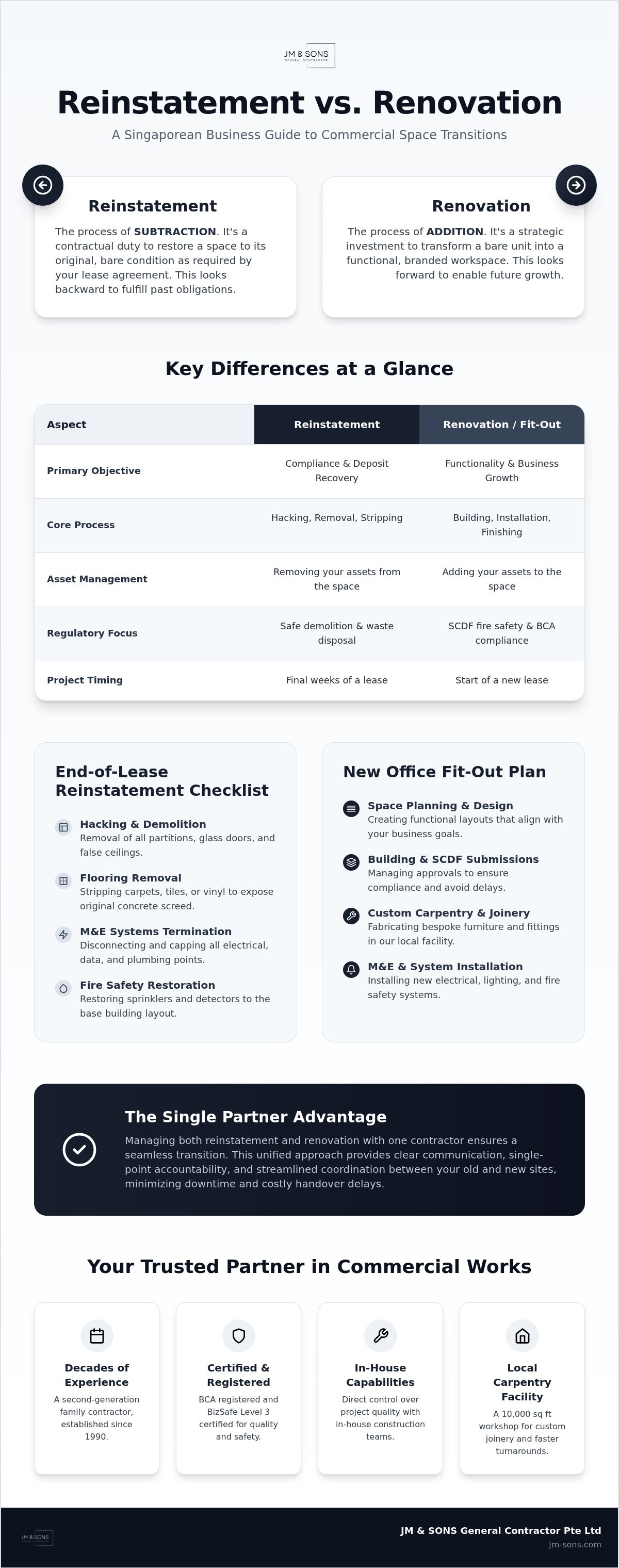
Reinstatement is the contractual process of "undoing" your previous fit-out to return the space to its landlord-approved state. It's a process of subtraction where you remove the physical history of your business from the site. The scope usually includes:
Hacking and removal of internal partitions, glass doors, and false ceilings.
Stripping away floor finishes such as carpet, tiles, or vinyl to expose the screed.
Disconnecting and capping electrical points, data cables, and plumbing.
Restoring fire protection systems, like sprinklers and smoke detectors, to the original base building layout.
Essentially, reinstatement is the "reset button" for a commercial unit.
What is Commercial Renovation?
Conversely, Renovation, or a commercial fit-out, is the process of transformation. It's the "build-up" phase where a bare shell becomes a functional workplace. This involves space planning, custom carpentry from a local facility, and installing new mechanical and electrical systems. Unlike reinstatement, renovation requires significant forward-planning regarding SCDF fire safety submissions and building management approvals. You aren't just hacking walls; you're creating an environment that reflects your brand. It's a complex coordination of trades that must align with your business goals and timeline.
The timing of these works is critical. Reinstatement happens in the final weeks of a lease. It's a race against the clock to hand over keys. Renovation happens at the start, often under the pressure of a rent-free fitting-out period. Managing both simultaneously during a move requires a contractor who understands the technical requirements of both "hacking" and "building."
Key Differences: Restoring vs. Reimagining Your Space
The core of the matter lies in your objective. Reinstatement is a defensive move focused on compliance. You're satisfying a landlord to recover your security deposit. Renovation is an offensive move focused on functionality and growth. You're building a tool for your business to succeed. When comparing reinstatement works vs renovation, the regulatory paths diverge quickly. The Building and Construction Authority (BCA) and SCDF view hacking down walls differently than they view building new ones. Hacking involves structural integrity and safe waste disposal. Building involves fire safety compliance and occupancy loads.
Asset ownership also flips during these stages. Reinstatement is the process of removing your assets, such as your partitions, your carpets, and your lighting. You're paying to turn your property back into the landlord's bare shell. Renovation is the opposite. You're adding value and infrastructure to a space to make it yours. One removes your business's physical footprint; the other establishes it.
Hacking and Removal vs. Installation
Safety is our priority during the removal phase. Hacking isn't just about brute force. It requires specific registered contractors to ensure building systems aren't compromised. We handle the delicate process of disconnecting M&E services without affecting your neighbors or the building's main risers. This technical task demands high accountability. On the other hand, a fit-out is about creation. It involves the procurement of new materials and custom joinery from our 10,000 sq ft facility. You can view our full list of commercial interior fit-out services to see how we manage these transitions from demolition to construction.
Budgeting for Both Processes
Many tenants treat reinstatement as an "unseen cost." They focus entirely on the new office and forget they must pay to leave the old one. It's helpful to look at what drives the costs in each phase:
Reinstatement Costs: Driven by labor hours, hacking complexity, and waste disposal fees.
Renovation Costs: Driven by material quality, fit-out density, and custom carpentry requirements.
Since 2026, rising freight and material costs have impacted the industry, making efficient waste management and procurement even more critical. "A detailed quotation from an ethical contractor prevents budget creep during handover." We believe in clear communication to avoid any surprises at the end of your project. If you're unsure how to split your budget between these two phases, you can message our team for a preliminary assessment.
Reinstatement Works: Navigating End-of-Lease Obligations
Reinstatement isn't just about clearing out furniture. It's a technical restoration of the space to the bare shell state defined in your lease agreement. In Singapore's competitive commercial landscape, landlords use a strict Handover Checklist to ensure the unit is ready for the next tenant. This list typically includes hacking partitions, removing floor finishes, and painting walls to "original white." These activities are governed by the Building and Construction Authority Act, which sets the standards for how structural and non-structural changes are handled in commercial properties. While these regulations provide a baseline, you should always verify specific technical requirements with the Building and Construction Authority (BCA) or your respective building management before starting work. When you weigh the demands of reinstatement works vs renovation, the removal phase is often more labor-intensive because it involves working within a live building environment without disrupting other tenants.
Managing Mechanical and Electrical (M&E) systems is where most businesses face their biggest challenges. You can't just cut wires and leave. Fire sprinklers must be repositioned to their base-building positions, and air-con ducting must be capped or reconnected to the main building riser. For tenants in Grade A office buildings, landlords mandate that contractors hold a BizSafe Level 3 certification. This ensures that high-risk work, such as handling heavy debris or working at height, meets national safety standards. Without this certification, your contractor might not even be allowed past the loading bay.
Dealing with Office Partition Hacking
Removing glass or gypsum partitions requires a methodical approach to site safety. Shattering glass or falling gypsum boards can cause serious injuries if not handled by professionals. Once the walls are down, the debris must be disposed of correctly. We ensure all construction waste is sent to approved facilities according to NEA regulations. This prevents illegal dumping and protects you from potential fines. For a deeper look at these requirements, see our Singapore Reinstatement Works: 2026 Tenant Compliance Guide. It's practical to check these disposal standards with building management to ensure compliance with their specific waste removal protocols.
Ensuring Landlord Acceptance
The final hurdle is the joint site inspection. This is where building management reviews the space against the original floor plan. Any missed nails in the ceiling or uneven floor screed will end up on a "defects list." We attend these inspections with you to provide immediate technical answers. As a second-generation family contractor, we take accountability for our work. We don't just hack and leave; we stay until the landlord signs off on the handover. This transparency ensures there are no hidden costs or disputes over your security deposit.
Renovation and Fit-Out: Planning for Business Growth
While the previous phase focused on restoration, the fit-out phase is where your business vision takes physical form. The technical contrast between reinstatement works vs renovation becomes clear during this build-up. You aren't just clearing a site; you're coordinating complex systems like fire protection, electrical distribution, and custom furniture. This phase requires a forward-looking strategy. It begins with meticulous space planning to ensure every square foot serves your operations while meeting building management standards.
Coordination is the backbone of a successful fit-out. We manage the logistics of after-hours works to ensure your neighbors in occupied malls or office blocks aren't disturbed. This is a standard requirement in Singapore's commercial landscape. It involves a high level of accountability to ensure the site is clean and safe for public access by the following morning. Managing these timelines effectively prevents the project from stalling and helps you meet your move-in date.
SCDF and Fire Safety Requirements
Fire safety is non-negotiable for commercial renovations. We handle the coordination of the Fire Safety Certificate (FSC) and Temporary Fire Permit (TFP) to ensure your space is legally habitable. F&B and retail tenants must prioritize these systems due to higher occupancy risks and specific cooking equipment regulations. You can find more details on these protocols in our guide on F&B Renovation Fire Safety Requirements Singapore. Missing an SCDF submission can lead to significant delays, so we integrate these approvals into the earliest stages of our project management.
Custom Carpentry and Joinery
Quality control is easier to maintain when production stays local. We leverage our own 10,000 sq ft carpentry facility to build bespoke office desks, retail shelving, and F&B counters. This in-house capability reduces lead times compared to outsourcing and allows us to handle complex project coordination more effectively. You get direct transparency on the materials and craftsmanship used in your space. We believe that seeing the work in progress builds trust and ensures the final result matches your brand identity. If you have a specific floor plan or design in mind, send your documents to our team for a carpentry review.
Managing the Transition: Why One Contractor for Both?
Relocating a business is a high-stakes transition. It's often viewed as two isolated events, but the reality is a chronological relay. One lease ends as another begins. When you manage reinstatement works vs renovation through two different vendors, you double your coordination effort. You're stuck in the middle of two different timelines, two sets of site rules, and two different communication styles. Choosing a single partner to handle both the exit and the entry creates a bridge that most businesses overlook. It's about moving from a defensive compliance mindset at the old unit to a strategic growth mindset at the new one without losing momentum.
Accountability is the greatest asset in this transition. If one contractor handles both sites, there's no room for finger-pointing regarding delays or missing equipment. You have one point of contact who understands the full picture of your relocation. This consistency ensures that the technical details from the hacking phase of your old office inform the build-out of your new one. We believe in a straight-shooter attitude. If a deadline is tight, we'll tell you. If a building management rule is complex, we'll explain why. This transparency is why we've grown through personal relationships rather than aggressive corporate expansion. It's a methodical approach that prioritizes your peace of mind over simple project completion.
Streamlining Project Management
Coordinating the move-out and move-in requires precision. We align the hacking schedule at your old unit with the procurement of materials for your new space. This reduces overheads because we can deploy our construction and hacking teams across both sites as needed. You don't have to manage two separate sets of building management permits or security deposits. For a deeper look at the build phase, refer to our Office Interior Fitting Out Singapore: The 2026 Contractor’s Guide. We focus on making the handover of your old space as seamless as the grand opening of your new one.
Choosing a Reliable Partner Since 1990
We've been helping Singaporean businesses navigate these complexities for over 30 years. Founded in 1990 by Mr. Jamaludin Bin Masood, JM & SONS is a second-generation family business that values long-term relationships over quick transactions. Our BCA registration and BizSafe Level 3 certification aren't just badges. They're markers of our commitment to safety and industry standards. We take an Ethical Expert approach, providing transparent, itemized quotations so you know exactly where your budget is going. We don't hide costs in vague lump sums or pressure you into unnecessary upgrades. We believe that honesty is the only way to build lasting trust in the construction industry. When comparing reinstatement works vs renovation, having a partner who cares about the integrity of the process as much as the final result makes all the difference.
Contact JM & SONS for a detailed reinstatement or renovation quote to share your site photos or floor plans with our team.
Securing Your Next Business Milestone
Managing a commercial move is a balancing act between settling old lease liabilities and investing in a new vision. Success comes from recognizing that reinstatement works vs renovation are two sides of the same coin. One requires the methodical "undoing" of a space to satisfy landlord requirements; the other demands a strategic "build-up" to drive business growth. By addressing both with a single, accountable partner, you eliminate the risk of miscommunication and costly delays between tenancies.
Since 1990, we've operated as a second-generation family contractor dedicated to providing peace of mind. Our BCA Registered and BizSafe Level 3 Certified teams handle everything from complex hacking to high-end fit-outs. With our 10,000 sq ft local carpentry facility, we ensure your new environment is built with precision and care. We're ready to help you navigate your next transition with transparency and technical expertise.
Request a detailed quotation for your reinstatement or renovation project today. We look forward to helping you build a space where your business can truly thrive.
Frequently Asked Questions
What exactly is included in a standard reinstatement scope in Singapore?
A standard reinstatement scope in Singapore involves returning the unit to a "bare shell" state. This typically includes hacking down gypsum or glass partitions, removing floor finishes to expose the screed, and painting walls to the original white. You must also restore mechanical and electrical (M&E) systems, such as fire sprinklers and air-con ducting, to the building's base layout. Always verify these specific requirements with your building management or the relevant authorities before starting.
Is it possible to avoid reinstatement if the next tenant wants my current fit-out?
You can avoid these works if the incoming tenant agrees to take over your current fit-out through an "as-is" agreement. However, this requires written consent from the landlord. Most landlords prefer a bare shell handover to ensure the unit is standardized for future leasing. If you secure an agreement, ensure all parties sign a waiver of reinstatement. Otherwise, the liability for restoring the space might simply pass to the next tenant.
How much time should I buffer for reinstatement works before my lease ends?
You should buffer two to four weeks for reinstatement works before your lease officially expires. Larger spaces or units with complex M&E requirements may need even more time. Starting early is critical because you must account for the joint inspection and any subsequent "defects list" the landlord might issue. Failing to hand over keys by the lease end date could make you liable for additional rent or liquidated damages as per your tenancy agreement.
Do I need a separate permit for hacking walls in a commercial building?
Yes, you generally need a permit from Building Management or the MCST before any hacking begins. For structural changes, you may also require professional endorsement and submissions to the Building and Construction Authority (BCA). In certain industrial or commercial blocks, specific HDB permits might also apply. A qualified contractor will coordinate these approvals to ensure work is done safely and legally, preventing costly fines or work-stop orders during your transition.
What happens if my landlord rejects the reinstatement work?
If the landlord rejects the reinstatement, they'll issue a defects list highlighting areas that don't meet the "original condition" standard. You'll be required to rectify these issues at your own expense. During this period, the landlord may withhold your security deposit or charge rent for the extra days taken to fix the defects. Working with an experienced contractor who attends the joint inspection helps resolve these technical disputes immediately on-site for a smoother handover.
Can a renovation contractor also handle the SCDF fire safety submission?
A competent renovation contractor can coordinate SCDF fire safety submissions on your behalf. This is a critical part of the process when comparing reinstatement works vs renovation because new layouts often trigger fire code updates. We handle the coordination of Fire Safety Certificates (FSC) and Temporary Fire Permits (TFP). This ensures your new office or F&B space is legally compliant and safe for occupancy from the very first day of your lease.
Why is BizSafe Level 3 important for commercial renovation projects?
BizSafe Level 3 is often a mandatory requirement for contractors entering Grade A office buildings and major shopping malls in Singapore. It proves that the contractor has a robust Risk Management plan in place for high-risk activities like hacking and electrical works. For business owners, this certification provides peace of mind that the site is managed professionally. It reduces the likelihood of accidents that could lead to legal liabilities for your company during renovation.
How does the cost of reinstatement compare to a full office fit-out?
Reinstatement is generally less expensive than a full renovation because it focuses on removal and disposal rather than procurement and installation. When evaluating reinstatement works vs renovation, remember that fit-out costs are driven by high-quality materials and custom carpentry from our 10,000 sq ft facility. Reinstatement costs are primarily driven by labor hours and waste management fees. Budgeting for both phases early in your relocation plan ensures you don't face a cash flow crunch.
Disclaimer: Please verify all legal and regulatory details with the relevant authorities or your building management before commencing any construction or hacking works.


Comments