
Change of Use Submission Singapore: The 2026 Business Owner’s Guide

You've found the perfect location, negotiated the rent, and are ready to sign the lease. But if you haven't confirmed that the Urban Redevelopment Authority (URA) allows your specific business activity there, you're taking a massive financial risk. A successful change of use submission Singapore is the most critical step to take before you pick up a sledgehammer or commit to a long-term tenancy.
It's normal to feel anxious about hidden costs like the Land Betterment Charge or the technical differences between URA Lodgment and Planning Permission. You want to start your renovation on time without the fear of stop-work orders or legal penalties hanging over your head. This guide simplifies the 2026 regulatory environment, giving you the clarity needed to ensure your commercial space is legally compliant from day one. We'll walk through the current S$500 application fees, the 10-day processing timelines, and how to coordinate with agencies like the SCDF to keep your project on track.
Table of Contents
What is a Change of Use Submission in Singapore?
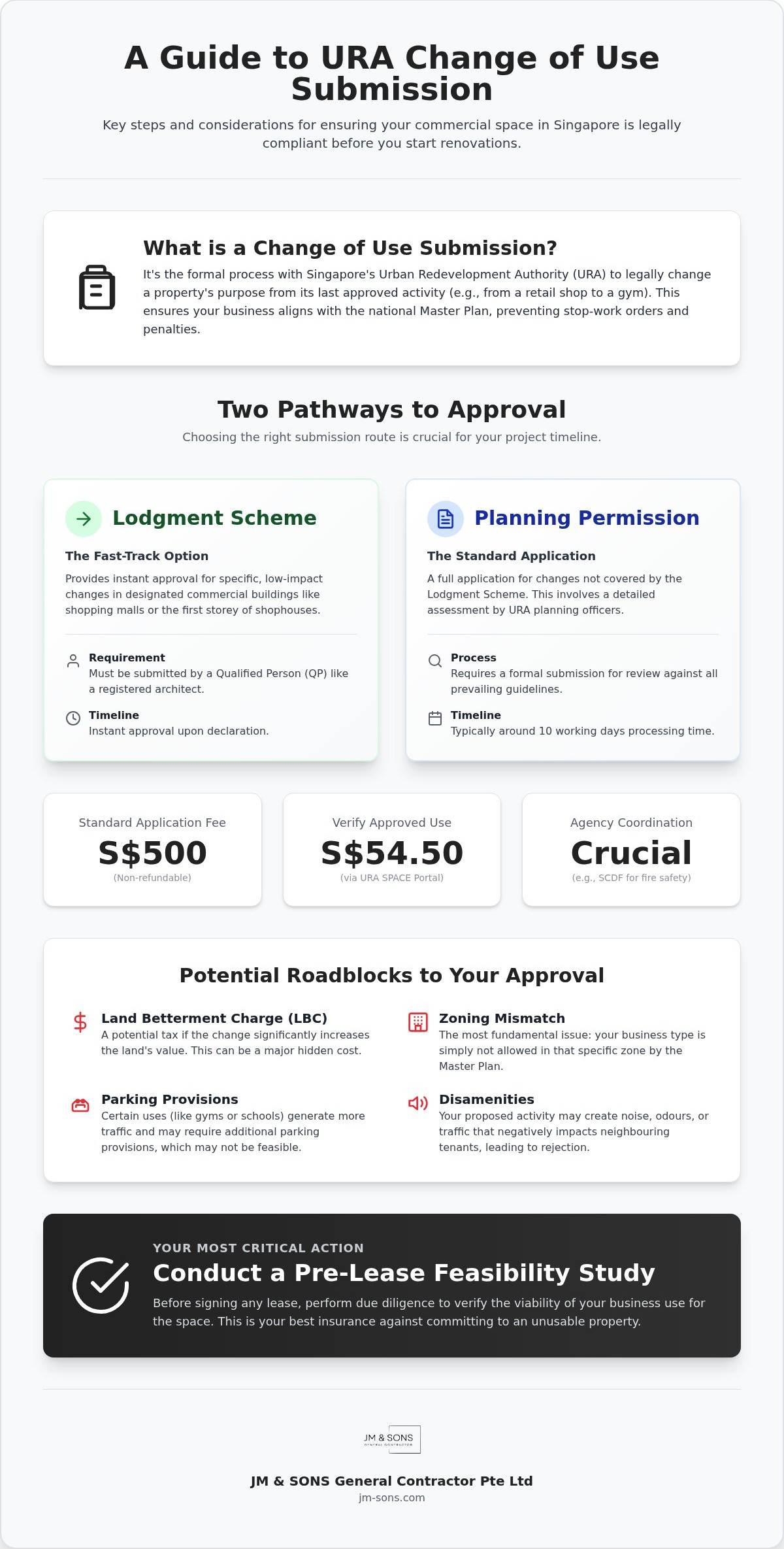
A change of use submission Singapore is the formal regulatory process required by the Urban Redevelopment Authority (URA) whenever a business owner intends to utilize a commercial premises for a purpose different from its last approved use. Every square meter of land in our city-state is governed by the Master Plan 2025/2026, a statutory land use plan that guides Singapore's development over the next 10 to 15 years. If your business activity does not align with the specific designation of your unit, you must secure legal permission before you can begin your interior fit-out or open your doors to the public.
Consider a scenario where you find an attractive shophouse unit previously occupied by a retail boutique. If you intend to transform that space into a massage parlour, a fitness gym, or a commercial school, the "use class" changes significantly. These activities have different impacts on the surrounding environment, such as varying requirements for waste management, floor loading, and pedestrian traffic. Without an approved submission, you are operating outside the law.
The risks of non-compliance are severe and can jeopardize your entire business venture. Business owners who bypass this step often face heavy financial penalties, immediate stop-work orders that freeze your renovation progress, and the mandatory requirement to reinstate the unit to its original state. We have seen cases where tenants were forced to vacate premises after spending thousands on renovations simply because the use could not be supported by the authorities.
The Role of the Urban Redevelopment Authority (URA)
The URA acts as the guardian of Singapore’s limited land resources. By managing land use through a system of Zoning, they ensure that commercial activities remain compatible with their surroundings. This prevents "disamenities"-disturbances such as excessive noise, foul odours, or traffic congestion-from affecting neighbouring tenants or residents. The URA uses a "Use Classes" system to categorize activities; for example, Class I covers shops while Class II covers offices. Understanding which class your business falls into is the first step in determining the feasibility of your location.
When is Submission Not Required?
There are specific instances where a formal application might not be necessary. Under the "Deemed Permission" concept, certain changes between similar use types are allowed without a new submission, provided they meet specific criteria set by the URA. You can verify the currently approved use of any property by performing an enquiry on the URA SPACE portal for a fee of S$54.50. This small investment provides a clear history of the premises and is a vital part of your due diligence.
However, even if a change appears exempt, the regulations can be nuanced, especially in conservation areas or mixed-use developments. Our team at JM & SONS General Contractor Pte Ltd recommends consulting with a professional before making any assumptions. We believe in a "measure twice, cut once" philosophy, ensuring that your tenancy is built on a foundation of total regulatory compliance and transparency.
Application vs. Lodgment: Which Path Should You Take?
Determining the most efficient route for your change of use submission Singapore depends on the location and nature of your business. The URA offers two distinct pathways: the Lodgment Scheme and the full Planning Permission application. While both satisfy the legal requirement for approval, they operate on very different timelines and administrative frameworks. Selecting the wrong path can lead to unnecessary delays that eat into your rent-free period.
Regardless of the route, you'll need to pay a non-refundable processing fee of S$500. This fee is standard across the board. The real decision lies in whether your business fits the "standard" criteria for instant approval or requires a more detailed assessment from planning officers. Understanding these distinctions helps you set realistic expectations for your renovation start date.
The Lodgment Scheme for Commercial Buildings
The Lodgment Scheme is the fast-track option for business owners. It provides instant approval for specific, low-impact changes in designated buildings. For example, if your unit is located within a purpose-built shopping mall or on the first storey of a shophouse with an existing commercial zoning, you might qualify. This scheme is designed to reduce administrative overhead for straightforward changes that the URA has already deemed acceptable for those locations.
It's important to remember that "instant" doesn't mean "automatic." You still need to appoint a Qualified Person (QP), such as a registered architect, to make a formal declaration. This professional must certify that your proposal complies with all prevailing guidelines. If the declaration is found to be inaccurate later, the approval can be revoked, leading to costly reversals. We've seen how a thorough pre-check saves clients from these pitfalls, ensuring their business launch remains on schedule.
Full Planning Permission for Complex Cases
When your business activity doesn't fit the strict lodgment criteria, you must apply for full Planning Permission. This route involves a detailed evaluation by URA officers. Standard applications typically take about 10 working days to process. However, if your business requires consultation with other agencies, like the Singapore Food Agency (SFA) for food shops or the Land Transport Authority (LTA) for traffic concerns, the timeline can extend to 12 weeks.
In these complex cases, the URA evaluates the "site context" thoroughly. They look at how your business might affect local parking or noise levels in the neighbourhood. JM & SONS General Contractor Pte Ltd assists in preparing the necessary justifications and site documentation to support your application. We focus on clear, honest communication with the authorities to minimize the risk of multiple rounds of clarifications. If you're unsure which path fits your unit, message our team for a preliminary review of your floor plans and site details.
Critical Factors That Can Block Your URA Approval
Securing URA approval isn't just about filling out forms. It's a technical evaluation of how your business impacts the building and the neighbourhood. A change of use submission Singapore can be rejected for several reasons, even if the landlord is happy to have you as a tenant. You need to look beyond the floor area and consider the "hidden" infrastructure of the property.
One of the most common deal-breakers is parking provision. The URA mandates a specific number of car park lots based on the business type. For example, a restaurant typically requires more parking than a standard retail shop. If the building's current parking capacity is already maxed out, your application for an F&B use might be denied unless there's a nearby public car park or you pay a deficiency charge. These costs can add up quickly, so checking the parking status is vital.
Another critical factor is the Land Betterment Charge (LBC). This is a tax levied by the Singapore Land Authority (SLA) when a change of use increases the property's value. If you're converting an industrial unit into a commercial showroom, the LBC could amount to a significant sum. This charge must be paid before the URA issues final permission. We always advise our clients to use the LBC estimator tool during the feasibility stage to avoid unexpected financial strain. We believe in transparency, and knowing these costs upfront is part of a "straight-shooter" approach to business planning.
The Intersection of Change of Use and Fire Safety
URA approval is only half the battle. Once the planning permission is granted, you must ensure the unit meets office renovation fire safety requirements Singapore. Changing a use class often increases the "fire load" or the number of people inside a space. For example, moving from a low-occupancy warehouse to a high-density tuition centre requires upgraded fire sprinklers, exit signs, and potentially new escape routes. In larger commercial complexes, you'll also need to coordinate with the building's Fire Safety Manager (FSM) to ensure your fit-out doesn't compromise the entire building's safety systems.
Addressing Traffic and Amenity Concerns
The URA is protective of Singapore's residential character. If your proposed business causes "disamenity", such as excessive noise, traffic congestion, or foul smells, it will likely be blocked. Gyms and music schools must demonstrate robust noise insulation plans. High-volume F&B outlets must satisfy the National Environment Agency (NEA) regarding exhaust systems and waste disposal. If your kitchen exhaust vents too close to a residential window, your change of use won't be approved. We identify these potential roadblocks early so you don't waste money on a space that simply isn't viable for your needs.
A Step-by-Step Guide to the Submission Process
Navigating a change of use submission Singapore requires a disciplined order of operations. It's a sequence of technical milestones that must be cleared before your renovation team can set foot on-site. Many business owners treat the submission as a mere formality, but the URA evaluates every application against current planning constraints. Missing a single step can result in a rejected application and a lost non-refundable processing fee.
The process moves from feasibility to formal documentation. You'll need to prepare a comprehensive submission set that includes scaled floor plans, recent site photos, and a clear business proposal. These documents are submitted through the GoBusiness Singapore portal. Once the S$500 fee is settled, you must monitor the portal for any "Requests for Information" (RFI). Responding accurately to these queries is the only way to move your case toward the final Written Permission (WP) or Temporary Permission (TP).
Pre-Submission: The Most Critical Phase
The work begins before you ever touch the URA portal. We strongly advise that you never sign a definitive lease without a "Subject to URA Approval" clause. This legal safeguard ensures you aren't stuck with a multi-year tenancy for a space you cannot legally use. You should use the URA SPACE portal to investigate the unit's history, but a digital check isn't enough.
A physical site survey by JM & SONS General Contractor Pte Ltd is vital during this phase. We look for hidden structural constraints, such as the placement of existing grease traps or the capacity of the current mechanical ventilation. Our project coordination services identify these technical roadblocks early, allowing you to negotiate with the landlord from a position of honesty and data rather than guesswork.
Post-Approval: Moving to the Fit-Out Phase
Once you receive your Written Permission, you have a legal blueprint for your business. This document often contains specific conditions, such as limits on your gross floor area or requirements for noise insulation. Your office interior fitting out Singapore plans must be strictly aligned with these URA conditions.
Any deviation from the approved plans during construction can lead to a failure of the final fire safety inspection or a rejection of your business license. We ensure that every partition, workstation, and utility point matches the approved submission exactly. This methodical approach eliminates the risk of forced reinstatement, protecting your capital and ensuring your 2026 business launch stays on track. If you're currently reviewing a floor plan for a new tenancy, send us the document for a preliminary feasibility check before you commit to the lease.
Coordinating Authority Submissions with Your Fit-Out
Coordinating the administrative side of a change of use submission Singapore with the actual physical fit-out is where most business owners feel the most pressure. We believe in a "straight-shooter" approach. This means being completely transparent about what can be achieved and when. We don't believe in over-promising just to secure a contract. Instead, we focus on providing a clear, honest roadmap that bridges the gap between authority approval and your first day of operations.
Once the URA grants permission, the clock starts ticking on your rent-free period. You can't afford a disconnect between your submission plans and your construction team. Our heritage dates back to 1990, and we've spent decades building relationships with Singapore landlords and building management teams. We understand the nuances of coordinating after-hours works and managing the strict requirements of Grade A office buildings or historic shophouses. This experience allows us to navigate the "red tape" without slowing down your site progress.
Why Choose an Experienced Contractor for Submission Coordination?
Managing a commercial project involves juggling multiple agencies. You aren't just dealing with the URA; you're coordinating with the SCDF for fire safety and the BCA for structural stability. We act as your single point of contact. This eliminates the "blame game" that often occurs between consultants and contractors. Our team ensures that every floor plan declaration is accurate from the start. A small error in a drawing can lead to a rejected submission or, worse, a requirement to tear down completed work during the final inspection.
Our in-house 10,000 sq ft carpentry facility provides a unique advantage. While the authorities are reviewing your change of use submission Singapore, we can begin pre-fabricating your custom joinery and bespoke fixtures. This rapid deployment model ensures that the moment the Written Permission is issued, we're ready to install. It's a methodical process designed to give you peace of mind, backed by our BCA registration and BizSafe Level 3 certification.
Get Started with Your 2026 Commercial Project
A successful project starts with a detailed quotation. We don't provide "ballpark" figures that hide authority coordination costs. Every quote we issue accounts for the complexities of the submission process and the specific technical requirements of your unit. Honesty regarding timelines is our core value. If a multi-agency review is likely to take 12 weeks, we tell you that upfront so you can plan your business launch realistically.
We invite you to share your floor plans, site photos, or any existing URA correspondence with us. Our team will review your documents and provide a practical assessment of your project's feasibility. Let's ensure your 2026 business expansion is built on a foundation of regulatory compliance and high-quality craftsmanship.
Securing Your Business Future in 2026
A successful business expansion in Singapore is built on more than just a great concept; it requires a foundation of absolute regulatory compliance. We've detailed how a strategic change of use submission Singapore acts as a safeguard against unviable tenancies and unexpected costs like the Land Betterment Charge. By aligning your business activity with the URA Master Plan before you commit to a lease, you eliminate the anxiety of legal penalties and ensure a clear, predictable timeline for your opening day.
Since 1990, JM & SONS General Contractor Pte Ltd has served as a reliable partner for SMEs and MNCs navigating these regulatory complexities. As a second-generation family contractor with BCA registration and BizSafe Level 3 certification, we prioritize accountability and clear communication. We handle the expert coordination required for URA and SCDF submissions, ensuring that your physical fit-out matches your legal permissions exactly. Let's work together to provide you with the "peace of mind" that comes from a job done honestly and correctly the first time.
If you're currently evaluating a commercial unit, chat with our team on WhatsApp for a Change of Use feasibility check. We invite you to share your floor plans and site photos so we can provide an honest, practical assessment of your project's next steps.
Frequently Asked Questions
How long does a URA change of use approval last?
The duration depends on the type of permission granted. Written Permission is typically permanent as long as the use remains unchanged. However, Temporary Permission (TP) is time-bound, usually lasting between 1 to 10 years. You must monitor the expiry date on your TP and apply for a renewal at least two months before it lapses to ensure your business operations remain legally compliant.
Can I start my renovation while waiting for URA approval?
You should not commence any physical works until you have received formal approval. Starting a renovation before your change of use submission Singapore is approved puts you at risk of immediate stop-work orders and fines. If the URA eventually rejects the application due to parking or noise issues, you will be legally required to reinstate the unit to its original state, resulting in a total loss of your renovation capital.
What is the difference between Temporary Permission and Written Permission?
Written Permission is a permanent grant for uses that align with the long-term zoning of the Master Plan. Temporary Permission is used when the URA wants to evaluate the impact of a specific activity on the neighbourhood over time. For example, a new F&B outlet in a residential area might receive a three-year TP to ensure it does not cause traffic or noise disamenity to the local residents.
Do I need to pay the Land Betterment Charge (LBC) for every change of use?
The LBC is only applicable if the change in use results in an increase in the land value. This is common when converting lower-value industrial spaces into higher-value commercial showrooms or offices. You can use the Singapore Land Authority's LBC estimator to get an early indication of whether this tax applies. If required, the charge must be settled before the URA issues the final Written Permission for your project.
What happens if my change of use submission is rejected by URA?
If an application is refused, the URA will provide a formal notice stating the specific planning grounds for rejection. You have the right to submit an appeal or a revised proposal that addresses these concerns, such as reducing the seating capacity to lower parking demand. JM & SONS General Contractor Pte Ltd often assists clients in reviewing these rejection notes to determine if a technical workaround or a change in business layout is feasible.
Is a Qualified Person (QP) always required for a submission?
A QP is not mandatory for simple change of use applications that do not involve structural changes or fire safety alterations. However, for most commercial fit-outs in Singapore, a QP is necessary to certify that the plans meet BCA and SCDF standards. Even for simple cases, having a professional review your declaration prevents common errors that lead to enforcement action. We coordinate with registered QPs to ensure every technical detail is accounted for.
How much are the URA submission fees in 2026?
The standard processing fee for a change of use submission Singapore is S$500 as of August 2026. This fee is non-refundable and must be paid at the point of application via the GoBusiness portal. If you are applying for a renewal of a Temporary Permission, the fee is also S$500. These costs are purely for authority processing and do not include the professional fees for any architects or contractors involved in your project.
Does a change of use affect my property tax or fire insurance?
Yes, changing the activity of a premises can alter its Annual Value (AV), which is the basis for your property tax assessment by IRAS. Furthermore, your fire insurance provider must be notified of the change. A retail shop has a different risk profile than a commercial kitchen or a woodworking workshop. Failing to update your insurer could result in a voided policy if you need to make a claim after your renovation.
SEO Metadata & Internal Links
Suggested Meta Titles
Change of Use Submission Singapore: 2026 URA Process Guide
URA Change of Use Singapore | 2026 Fees & Timeline Guide
Suggested Meta Descriptions
Master the change of use submission Singapore process for 2026. Learn about URA fees, LBC requirements, and how to ensure your commercial space is legally compliant.
Avoid legal penalties in Singapore. Our guide covers URA change of use submissions, lodgments, and fire safety coordination for commercial renovations.
Internal Link Strategy
Authority Coordination Services:services 4
Office Renovation Fire Safety Guide:office renovation fire safety requirements in singapore a 2026 compliance guide
Commercial Fitting Out Guide:office interior fitting out singapore the 2026 contractor s guide


Comments