
Direct Contractor vs ID for Singapore Office Renovations
- JM & SONS
- Jul 23
- 12 min read

The common belief that choosing a direct main contractor vs interior designer is a simple choice between saving money and getting a pretty office is a half-truth that often leads to costly compliance errors. For many Singaporean business owners, the real challenge isn't just the aesthetic. It's the fear of hidden costs in ID packages or the risk of poor workmanship and permit delays when going direct. You want a workspace that reflects your brand without the stress of navigating BCA or SCDF requirements on your own.
We understand that your priority is a functional, compliant office delivered on time. This article provides a transparent, expert-led framework to help you decide which path fits your specific needs based on your budget, project complexity, and the level of technical accountability required. We'll explore the real price differences, clarify who is responsible for structural safety, and provide the clarity you need to manage your renovation with complete peace of mind.
Table of Contents
Defining the Roles: Direct Main Contractor vs Interior Designer
Choosing between a direct main contractor vs interior designer isn't just about who draws the plans. It's about who owns the responsibility for your office space. An Interior Designer (ID) acts as your creative consultant. They translate your brand identity into a physical layout. A Direct Main Contractor is the engine of the project. They are the builders who turn those drawings into a safe, functional reality. Understanding these distinct roles is the first step toward a successful office fit-out.
The ID's Scope: From 3D Renders to Furniture Sourcing
Interior Designers excel at the "vision" stage of a renovation. They provide 3D renders and material mood boards to help you see the final result before work begins. Their scope often includes aesthetic curation, such as selecting colour palettes and sourcing soft furnishings. When you pay an ID a project management fee, you're paying for their time spent coordinating various vendors and ensuring the design intent remains consistent. They are your primary point of contact for style and spatial flow, acting as an intermediary between your business and the tradespeople on site.
The Main Contractor's Scope: Procurement, Construction, and Safety
A direct contractor focuses on the "how" of construction. They manage the technical trades directly, including masonry, electrical wiring, plumbing, and custom carpentry. They don't just execute; they assess technical feasibility. They determine if a wall can safely come down or if the electrical load supports your new server room. At JM & Sons, our roots as a second-generation family contractor since 1990 mean we prioritize structural integrity and safety standards. Being BCA registered and BizSafe Level 3 certified ensures that every technical aspect meets Singapore's rigorous building management rules.
The "direct" part of a main contractor is vital for accountability. It means you're dealing with the source of the labour and materials. For example, our 10,000 sq ft local carpentry facility allows us to control the quality of custom joinery without relying on third-party workshops. This direct line of communication cuts out the middleman and provides you with a clear, detailed quotation that reflects actual construction costs rather than marked-up management fees.
There are common misconceptions about both roles. A contractor isn't just a "hacker" who breaks walls; they are licensed professionals responsible for site safety and technical compliance. Likewise, a professional ID does more than "decorate"; they solve complex spatial problems. Deciding which professional to lead your project depends on whether you need a creative lead to build a concept from scratch or a technical partner to execute a clear vision with precision.
The Cost and Value Gap: Beyond the Quotation
The financial decision between a direct main contractor vs interior designer often comes down to transparency. Many business owners look at the bottom line of a quotation without questioning the origin of the costs. While an initial estimate might look attractive, the actual value lies in how that money is allocated across materials, labour, and management fees. Understanding this gap is essential to avoiding budget overruns that can plague commercial projects.
Where Your Money Goes with an Interior Designer
Engaging an Interior Designer typically involves a multi-tiered pricing structure. You aren't just paying for the renovation; you're paying for aesthetic guidance and project coordination. Design fees cover the conceptual work and 3D visualisations, while management fees account for the ID's time spent on-site. It's also common for IDs to earn commissions on material sourcing or to apply markups on the subcontractors they hire. While this provides a high level of "hand-holding," it's important to look Beyond the Quotation to see if these premiums fit your business objectives.
Direct Main Contractor: Efficiency Through Direct Procurement
A direct main contractor operates with a leaner management layer. By dealing directly with the source of the construction, you eliminate the middleman markups often found in ID packages. This directness is particularly valuable when the contractor has in-house capabilities. At JM & Sons, we operate a 10,000 sq ft local carpentry facility. This allows us to control the quality and cost of custom joinery directly, passing those savings on to our clients. For straightforward office fit-outs where the vision is already clear, this model provides significant cost efficiency without sacrificing quality.
Hidden costs are a major pain point in the Singapore renovation market. A "cheap" quote often relies on vague descriptions, leading to expensive Variation Orders (VOs) once the project is underway. We prioritize detailed, fixed quotations that reflect the true scope of work. This approach ensures you don't face unexpected bills during the final stages of your renovation. If you have a floor plan ready and want a clear, honest assessment of the costs involved, you can speak with our team for a detailed breakdown.
Ultimately, the value of a direct contractor lies in accountability. When the firm providing the quote is the same firm doing the work, there's no room for miscommunication between the "designer" and the "builder." This integrated approach has been the foundation of our family-run business since 1990, providing the peace of mind that comes from knowing exactly where every dollar of your renovation budget is being spent.
Complexity and Compliance: Navigating Singapore’s Regulations
Compliance in Singapore is a detailed process that determines how smoothly your project proceeds. The choice between a direct main contractor vs interior designer often impacts who takes the lead on these technical submissions. While a designer focuses on the visual intent, a direct main contractor with BCA registration and BizSafe Level 3 certification generally handles the coordination of structural and safety requirements. Since every building has unique constraints, you should always verify the latest requirements with the relevant authorities or your building management before starting work.
HDB and BTO Renovation Rules
Residential renovations are governed by specific guidelines to protect the building's structural integrity and the comfort of other residents. It's generally required to engage an HDB registered renovation contractor for any works within these units. These guidelines cover everything from the types of walls that can be modified to the specific hours when noisy work is permitted. We recommend that you verify your specific renovation plans with HDB directly to ensure all proposed changes align with their current housing policies and safety standards.
Commercial and Retail Compliance (BCA & SCDF)
Commercial fit-outs involve layers of fire safety and structural oversight. Modifications to partitions or ceilings can affect the coverage of fire protection systems like sprinklers and smoke detectors. An experienced contractor coordinates these technical aspects to help you work toward obtaining a Fire Safety Certificate (FSC). Because regulations can change depending on your unit's "Change of Use" status or the building's age, you should consult with the SCDF or a Qualified Person (QP) to confirm the specific fire safety submission requirements for your space.
Building Management (MCST) often has its own set of house rules regarding renovation deposits, work permits, and after-hours access. At JM & Sons, our experience since 1990 has shown that early dialogue with the MCST is the best way to prevent site delays. We advise all tenants to check their lease agreements and building handbooks for specific restrictions on delivery routes or debris removal. Proactively verifying these details with your building manager ensures that your team can work efficiently without administrative interruptions.
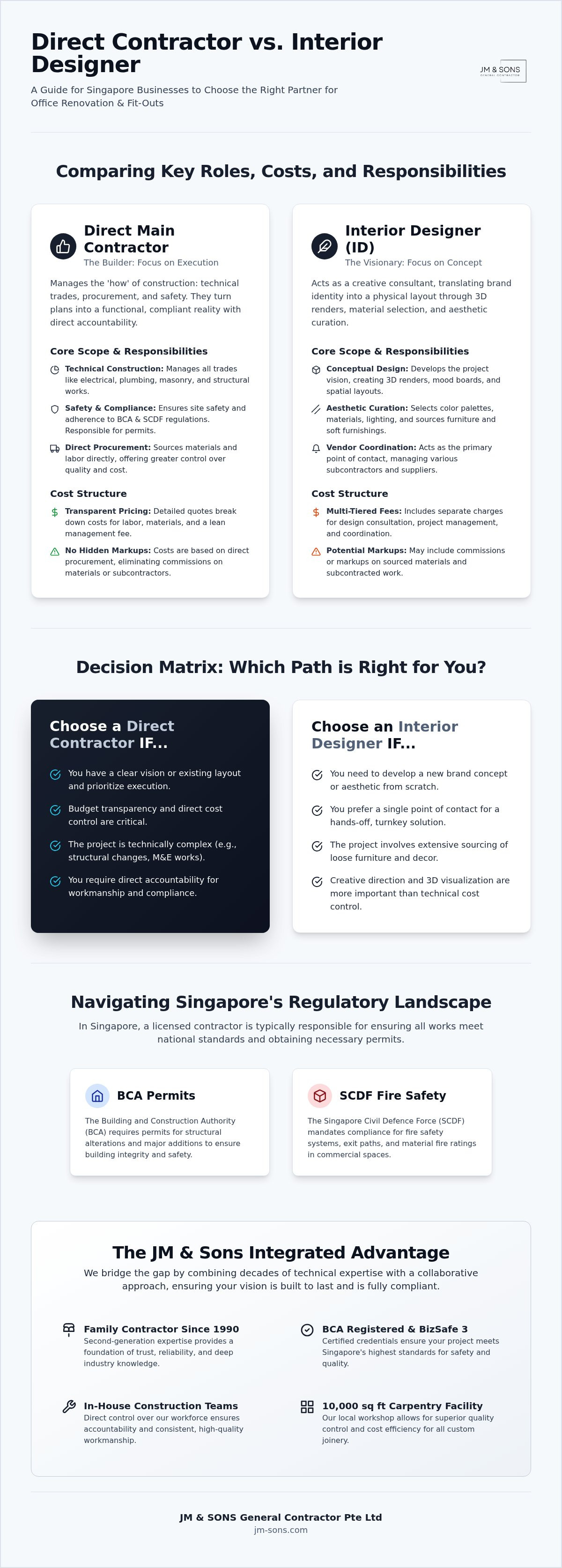
Decision Matrix: When to Hire an ID vs a Direct Contractor
Choosing the right partner for your renovation requires an honest assessment of your project goals. The debate between a direct main contractor vs interior designer isn't about which professional is superior. It's about which model fits your specific circumstances. You need to balance your desire for creative input against the technical demands of the site. Use this tactical framework to evaluate your needs before signing any agreement.
Step 1: Define your design involvement. Do you already have a floor plan and a clear aesthetic in mind? If you have a vision, a direct contractor can execute it with precision. If you're starting with a blank slate and need mood boards to find your style, an ID is the better creative lead.
Step 2: Assess project complexity. Is this a cosmetic refresh or a major structural overhaul? Projects involving wall hacking, heavy electrical upgrades, or fire safety modifications require the technical oversight of a builder who understands structural integrity.
Step 3: Evaluate your budget. Are you paying for aesthetics or for technical execution? If your priority is maximizing your spend on quality materials and skilled labour, the direct route is more efficient. You avoid the management markups often found in design packages.
Step 4: Consider the timeline. Who can manage the site faster? Direct contractors usually have better control over their in-house teams. This reduces the delays that often happen when an ID has to coordinate multiple third-party sub-trades.
Step 5: Check the credentials. Does the project require BCA registration or BizSafe Level 3 certification? Ensure your choice meets these legal and safety benchmarks to protect your business from liability.
Best Scenarios for an Interior Designer
An ID is the ideal choice for first-time owners who feel overwhelmed by the sheer number of design choices available. If your project is a high-concept luxury space where the visual "wow factor" is the primary goal, an ID’s ability to curate unique furniture and decor is invaluable. They provide a fully hands-off experience. They manage every minor aesthetic detail so you don't have to spend your time sourcing cushions or light fixtures.
Best Scenarios for a Direct Main Contractor
A direct main contractor is the logical choice for commercial office fit-outs and retail renovations where technical specifications are strict. If you already have a clear layout or are working with a franchise design manual, you don't need to pay for conceptual design. This model is also essential for reinstatement works and structural Addition & Alteration (A&A) projects. At JM & Sons, we specialize in these high-stakes environments, using our in-house construction capabilities to ensure every detail matches your technical requirements.
Your choice ultimately impacts the accountability and speed of the project. If you're ready to move forward with a technical partner who prioritizes structural integrity and clear communication, get in touch with us to discuss your project requirements. We believe in providing the peace of mind that comes from direct, honest collaboration.
The JM & Sons Advantage: Integrating Design and Technical Construction
The choice between a direct main contractor vs interior designer often feels like a trade-off between creative vision and technical reliability. At JM & SONS General Contractor Pte Ltd, we bridge this gap by offering an integrated approach that combines design coordination with direct construction oversight. We don't just manage the site; we take full responsibility for the technical execution of your office fit-out, ensuring that the final result is as functional as it is compliant with Singapore's building standards.
Second-Generation Family Values Meet Professional Standards
Our business was founded in 1990 by Mr. Jamaludin Bin Masood, built on a foundation of hard work and direct manual effort. Today, as a second-generation family contractor, we maintain those core values while operating with modern technical competence. Accountability is personal for our team. We provide detailed, transparent quotations that reflect the actual requirements of your site, avoiding the vague estimates that often lead to budget overruns. Our BizSafe Level 3 certification and BCA registration reflect a long-term commitment to maintaining a safe and professional working environment.
Handling complex coordination is a central part of our service. We manage the dialogue between your business, the Building and Construction Authority (BCA), and the Singapore Civil Defence Force (SCDF) to streamline the approval process. Because we understand the nuances of Building Management (MCST) requirements, we handle the necessary work permits and security deposits directly. This technical leadership allows you to focus on your business relocation or expansion while we ensure the physical space meets every regulatory benchmark.
Our 10,000 Sq Ft Carpentry Facility
Direct control over the manufacturing process is what sets us apart from firms that rely entirely on external vendors. We operate our own 10,000 sq ft local carpentry facility, which allows us to produce custom joinery with high precision. This in-house capability provides several practical advantages for our clients:
Consistent Quality: We oversee the selection of materials and the assembly of every piece of furniture, ensuring it meets our internal quality standards.
Reliable Timelines: Managing our own production schedule means we can better control lead times and respond quickly to site changes.
Direct Communication: Our carpenters and site managers work together closely, reducing the risk of measurement errors that often occur with third-party workshops.
By operating as a direct builder with sophisticated design coordination, we offer a model that prioritizes structural integrity and clear accountability. We believe in providing a "straight-shooter" service where every technical detail is communicated clearly and every promise is backed by over three decades of industry experience. This integrated approach ensures your renovation is handled with the care and technical expertise it deserves.
This level of dedication to technical expertise and direct accountability is a standard shared by top-tier firms globally; for those looking for similar excellence in specialized bathroom or kitchen projects in the Malmö region, you can discover MZ Bygg & Renovering and their professional renovation services.
Choosing the Right Path for Your Office Transformation
Deciding between a direct main contractor vs interior designer is about aligning your business goals with the right level of technical accountability. If you have a clear vision and require a partner who manages the structural integrity and fire safety compliance of your space directly, the direct contractor model provides the most transparency. By removing the middleman, you gain better control over your budget and the quality of the final fit-out.
At JM & Sons, we've spent over 30 years building a reputation for honesty and reliability. As a second-generation family business founded in 1990, we combine our BCA registration and BizSafe Level 3 certification with the capabilities of our in-house 10,000 sq ft carpentry facility. We handle the complex coordination with building management and authorities so you don't have to worry about the paperwork. Our focus is on delivering a workspace that is safe, compliant, and built to last.
If you're ready to start your renovation with a clear and honest assessment of your site, contact JM & Sons for a detailed, transparent quotation on your next project. We look forward to helping you build a workspace that supports your team's success.
Frequently Asked Questions
Is it cheaper to hire a contractor directly in Singapore?
Hiring a contractor directly is often more cost-effective because it removes the management markups and material commissions typically found in design packages. You are paying for direct labour and procurement rather than an intermediary coordination service. This approach is particularly efficient for businesses that already have a clear layout or corporate design guidelines in place.
Can a main contractor help with 3D drawings and design?
Many established main contractors provide design-and-build services that include technical 3D drawings and spatial planning. While their focus remains on technical feasibility and structural integrity, these renders help you visualise the final office layout. This ensures the proposed design is buildable within your budget and complies with building management rules.
What is the difference between an ID and a design-and-build contractor?
An interior designer (ID) acts primarily as a creative consultant who manages the project and sub-contracts the construction work. A design-and-build contractor, like JM & SONS General Contractor Pte Ltd, provides a single point of accountability by handling both the design coordination and the actual building works in-house. This model often leads to better communication and fewer delays during the construction phase.
Do I need an ID for a simple BTO renovation?
You do not strictly require an ID for a standard BTO renovation if you are comfortable selecting your own materials and have a clear spatial plan. A direct contractor can execute the hacking, tiling, and carpentry works based on your instructions. For residential projects, you must ensure the firm is an HDB registered renovation contractor to comply with structural safety regulations; additionally, engaging Prime Defectors to identify any property defects before your renovation begins can prevent future disputes with contractors or developers.
Who handles the SCDF and BCA submissions for office renovations?
Professional contractors coordinate these technical submissions through a Qualified Person (QP) to ensure the project meets fire safety and structural standards. When comparing a direct main contractor vs interior designer, look for a partner who understands the nuances of SCDF fire safety and BCA permits. We recommend verifying the specific requirements for your unit with the relevant authorities or your building management.
How do I verify if a contractor is HDB registered or BCA approved?
You should verify a contractor’s credentials by checking the official HDB and BCA online directories. These public databases confirm if a firm is authorised to carry out specific types of renovation or structural work. Additionally, checking for BizSafe Level 3 certification is a practical way to ensure the contractor maintains professional safety standards on-site.
Can I hire an ID just for design and a contractor for the work?
You can hire an ID solely for a design-only package and then engage a direct contractor for the physical work. This allows you to benefit from professional aesthetic guidance while maintaining direct control over the construction costs. However, this requires you to be more active in project coordination to ensure the contractor’s technical execution matches the designer’s intent.
What happens if my renovation doesn't follow building management rules?
Non-compliance can result in immediate stop-work orders, the loss of your renovation deposit, and potential legal action from the MCST. Building management (MCST) rules are in place to ensure the safety and quiet enjoyment of all tenants. We advise you to check your building’s specific house rules and work permit requirements with the management office before any work commences.


Comments