
Factory Reinstatement Contractor Singapore: The 2026 Industrial Handover Guide

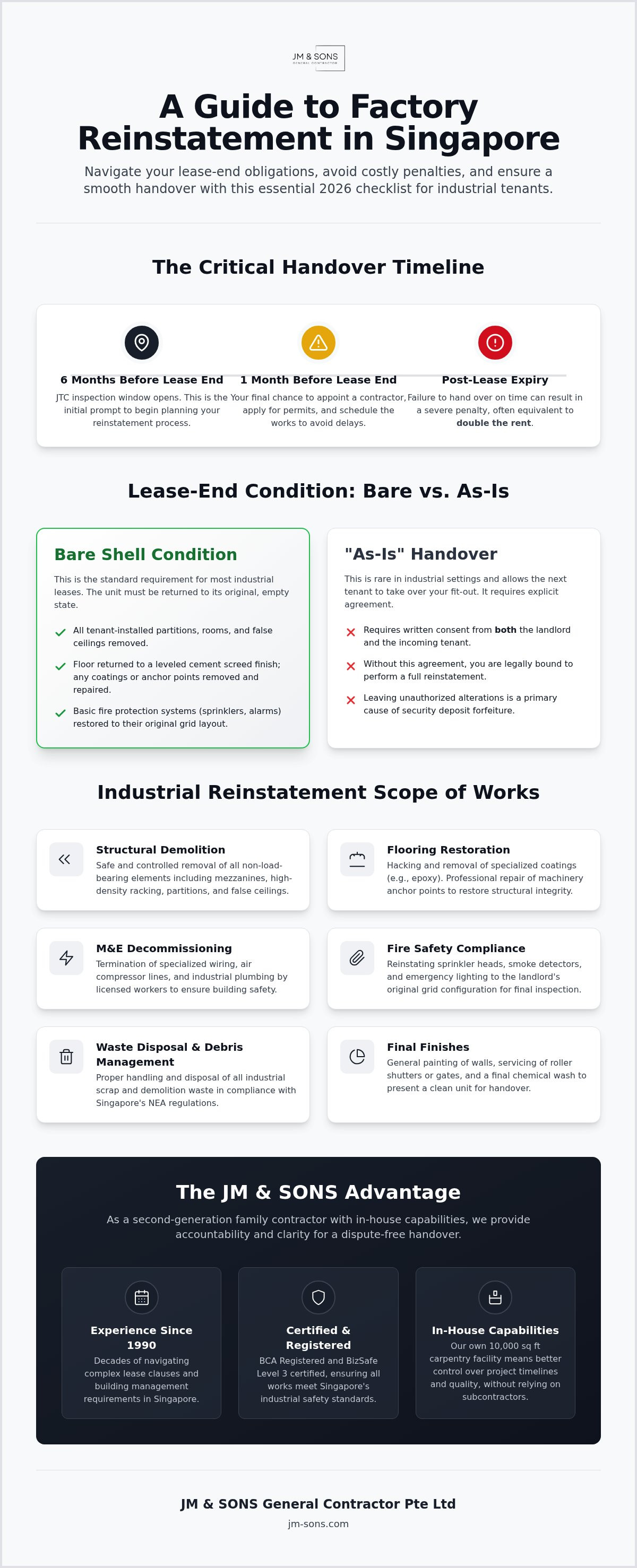
Imagine reaching the final months of your industrial lease only to realize that returning the keys involves much more than just moving out your machinery. In Singapore's competitive industrial market, failing to complete your reinstatement by the lease expiry date can lead to a penalty of double the rent. It's a stressful realization for any business owner. You likely feel that the handover process is an uphill battle filled with vague requirements and the looming threat of hidden costs.
We believe you deserve a smooth exit that respects both your budget and the landlord's expectations. Selecting an experienced factory reinstatement contractor Singapore is the most effective way to ensure your space meets every technical standard without the typical last minute panic. This 2026 guide simplifies the complexities of industrial handovers, covering everything from JTC inspection timelines to fire safety compliance. We'll walk you through the essential steps to secure your deposit and move forward with peace of mind, grounded in the accountability of a second generation family contractor.
Table of Contents
Understanding Factory Reinstatement in Singapore
In Singapore's industrial sector, reinstatement refers to the process of restoring a leased factory unit to its "original bare condition." This isn't just a standard cleanup; it's a contractual obligation rooted in lease covenants on property condition. Landlords insist on this because they need a blank canvas to market to the next tenant. A factory unit that still contains the previous tenant's specialized electrical trunking or heavy racking is significantly harder to lease out to a new business with different operational needs.
Factory spaces face a level of wear and tear that office units simply don't. You're often dealing with heavy machinery imprints on the floor, chemical stains, or high-capacity power installations. These require specialized handling that goes beyond basic demolition. Engaging a factory reinstatement contractor Singapore at least one month before your lease ends allows for proper site assessment and permit applications. While JTC might initiate contact six months early, this final one-month window is your last chance to finalize a contractor and execute the works to avoid the double-rent penalties that kick in if you exceed your handover date.
Bare Condition vs. As-Is Condition
You need to understand the technical difference between "bare" and "as-is" handovers. A bare shell condition usually means the unit is returned with empty walls, a leveled cement screed floor, and basic fire protection systems intact. Everything you added, from partitions to mezzanine levels, must go. An "as-is" handover, where the next tenant takes over your fit-out, is rare in industrial settings. Unless you have written consent from both the landlord and the incoming tenant, you're legally bound to clear the space. Leaving unauthorized alterations behind is a fast way to lose your security deposit.
Common Industrial Lease Requirements
Industrial leases, especially those under JTC or major private REITs, contain specific clauses regarding structural integrity. If your operations involved anchoring heavy equipment into the floor, you'll need to repair those anchor points to a professional standard. Other common requirements include:
Demolition of Mezzanines: Any custom-built levels, high-density racking systems, or platforms must be dismantled safely.
M&E Termination: Specialized wiring, air compressors, and industrial plumbing must be capped off by licensed workers to ensure the building's core systems remain safe.
Decontamination: If your factory handled pollutive materials or chemicals, you might need to prove the site is clean before the landlord accepts the keys.
Since 1990, we've seen how these requirements have become stricter and more technically demanding. As a BCA registered contractor, we focus on meeting these specific lease obligations so you can close your tenancy without disputes or unexpected costs.
Key Scope of Industrial Reinstatement Works
Industrial reinstatement involves a technical scale of work that far exceeds typical commercial office clearing. While a standard office might only require the removal of carpet and a few drywall partitions, a factory unit often contains heavy-duty infrastructure that must be decommissioned safely. Every task is governed by the specific reinstatement clause in your lease, which mandates the return of the property to its original state. This process requires meticulous debris management; in Singapore's industrial zones, all waste disposal must comply with NEA regulations to ensure hazardous materials or heavy industrial scrap are handled correctly.
Success in this phase depends on restoring the unit's fire protection systems to the landlord's original grid. This isn't just about appearance. It's a safety requirement. If you've moved sprinklers to accommodate new racking or mezzanine levels, they must be shifted back to their primary positions before the final inspection. If you are unsure which parts of your setup need to be removed, you can message us for a site walkthrough.
Structural Restoration and Hacking
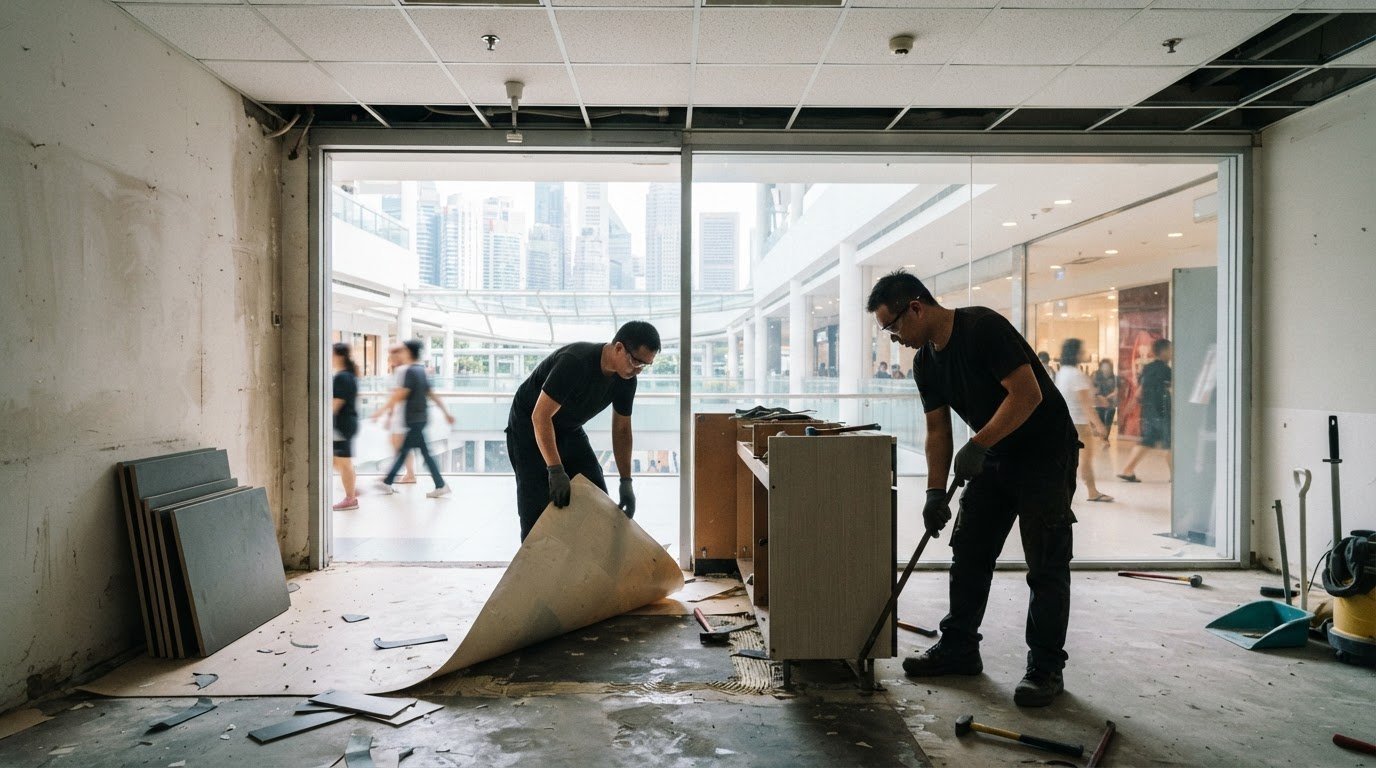
The structural phase focuses on clearing the footprint of your operations. This includes the removal of all partition walls, false ceilings, and any custom built-in workstations. If your facility utilized specialized floor coatings like epoxy or heavy-duty polyurethane to protect against chemical spills, these must often be removed to reveal the original substrate. Hacking works are defined as the controlled demolition of non-load-bearing elements. Our team handles this with precision to avoid damaging the building's core structure, ensuring that your security deposit remains protected from claims of structural negligence.
M&E (Mechanical & Electrical) Reinstatement
Mechanical and electrical works are the most complex part of industrial restoration. Most factories have high-power requirements that involve extensive electrical trunking and customized DB boxes. A professional factory reinstatement contractor Singapore will systematically dismantle these systems while ensuring the base building's power remains stable. We focus on restoring factory high-bay lighting and emergency exit signs to their original configurations. Plumbing points used for industrial processes must be capped off securely, and any specialized ventilation or exhaust systems must be removed, leaving the walls and ceilings in their original, clean state. Since we operate our own 10,000 sq ft facility, we understand the technicalities of industrial infrastructure and the precision required to dismantle it correctly.
Navigating JTC and Building Management Requirements
JTC typically initiates the handover process six months before your lease expires by arranging a joint site inspection. This walkthrough is the most important meeting of your tenancy exit. During this session, JTC officers identify the specific items that must be removed or repaired. Their guidelines are strict, and their timeline is non-negotiable. If you don't complete the works by the expiry date, you face the heavy penalty of double rent for every day of delay. We've seen many tenants caught off guard by the technicality of these requirements, which is why early planning is essential.
Coordinating with Building Management (MCST) is just as critical as dealing with JTC. Your MCST manages the daily logistics of the industrial complex. They control work permits, lift usage, and loading bay access. Most buildings require a renovation deposit, typically between $2,000 and $5,000, which they hold until they're satisfied no damage was done to common property. A seasoned factory reinstatement contractor Singapore will handle these administrative hurdles for you, ensuring that security guards and facility managers are aligned with your move-out schedule.
Industrial zones are busy environments where downtime costs money. Disruption to neighboring units can lead to immediate work stop orders from management. We often perform high-impact hacking or noisy removals during after-hours to maintain a good relationship with the surrounding businesses. This methodical approach prevents unnecessary delays and keeps your project on track without causing friction in the building.
Permits and Authority Submissions
You must verify current SCDF and BCA requirements before any hacking begins. Industrial units often have complex fire safety systems, including sprinklers and heat detectors, that must be restored to their original grid. If your facility included specialized zones like cold rooms or mezzanine levels, you may need to address "Change of Use" implications. These technicalities require professional coordination to ensure the space is compliant for the next tenant. You can find more details on these requirements in our Singapore Reinstatement Works: 2026 Tenant Compliance Guide. Failing to manage these submissions correctly can result in the forfeiture of your security deposit.
Waste Disposal and NEA Standards
Managing industrial waste requires more than just a skip bin. Large-scale factory debris, such as metal racking, machinery components, or chemical-stained materials, must be handled by NEA-licensed waste collectors. Proper documentation of this disposal is often required to prove you've met environmental standards during the handover. For the final joint inspection, the unit must be "broom-clean." This means all operational traces are gone, the floor is leveled, and the space is ready for immediate occupancy. We prioritize this level of detail because we believe in delivering the peace of mind that comes with a job done right, rooted in the accountability of our family-run heritage.
How to Choose a Factory Reinstatement Contractor
Selecting a partner for industrial restoration is a decision that directly impacts your final balance sheet and your reputation with the landlord. A reliable factory reinstatement contractor Singapore must do more than just swing a sledgehammer; they need to understand the technical nuances of industrial site regulations. Many firms in the market act as middlemen, outsourcing the hacking, electrical work, and waste disposal to third parties. This often leads to a dilution of accountability and a lack of oversight on safety standards. We believe in a different approach. Since 1990, we've maintained direct control over our projects through our in-house team and our 10,000 sq ft local carpentry facility, ensuring that the person you speak to is the one responsible for the work on-site.
Direct contractors offer a level of transparency that middlemen simply cannot match. When a contractor owns their equipment and employs their own skilled workers, they can provide more accurate timelines and firmer pricing. This removes the "middleman markup" and gives you peace of mind that the project won't be stalled by subcontractor disputes. If you're ready to discuss your handover requirements with a team that values honesty, you can WhatsApp us your reinstatement checklist for a detailed review.
Verifying Credentials and Safety Standards
Safety is a non-negotiable requirement in Singapore's industrial parks. BizSafe Level 3 is the minimum standard most building managements require before granting site access. Without this certification, your contractor might be turned away at the gate, leading to costly delays. BCA registration is another vital mark of technical competence. It proves that the contractor has the financial standing and the proven track record to handle complex construction works. Always ask for a history of successful industrial handovers to ensure they've dealt with the specific pressures of factory environments before.
Analyzing the Quotation
The most dangerous document in a handover is a "thin" quotation. These are often vague, lump-sum figures that look attractive at first but hide significant costs. A professional quote should address every item in the landlord's handover checklist line-by-line. This level of detail prevents disputes during the final inspection when a landlord points out a missed repair that wasn't "explicitly included" in your contractor's scope. While the technicalities differ, the principles of choosing a partner remain consistent across sectors. You can see how we apply this same rigor to other commercial spaces in our guide on how to choose an office renovation contractor in Singapore.
JM & SONS: Professional Factory Reinstatement Since 1990
Since 1990, JM & SONS has operated with a simple philosophy: provide honest, high-quality construction services that stand the test of time. As a second-generation family-owned general contractor, we don't just see ourselves as a service provider. We see ourselves as a partner in your business transition. Our roots are in manual effort and personal relationships, which is why we've grown into a trusted factory reinstatement contractor Singapore. We understand that an industrial handover isn't just about clearing a space; it's about fulfilling a moral and contractual responsibility to the landlord and the building's future.
Our 10,000 sq ft local carpentry facility and dedicated in-house team are the backbone of our operations. Unlike firms that rely heavily on third-party subcontractors, we maintain direct control over every phase of the project. This allows us to ensure that hacking, M&E decommissioning, and site clearing are done to our exacting standards. It also means we can provide detailed, transparent quotations that address every line item of your lease requirements. You won't find hidden surprises in our invoices because we value fairness and openness above all else. We prioritize accountability and clear communication from the first site visit to the final key handover.
The Ethical Expert Approach
We prioritize your peace of mind throughout the entire reinstatement journey. This starts with a clear understanding of our heritage and values, which you can learn more about on our About JM & SONS page. Our "Ethical Expert" persona means we take the lead during joint inspections with landlords or JTC officers. We speak their language and understand their technical expectations. By acting as your advocate during these meetings, we help ensure that the scope of work is fair and that the final handover is accepted without dispute. We take the pressure off your shoulders so you can focus on your next business move without the stress of potential rental penalties.
Comprehensive Industrial Capabilities
Our team is equipped to handle projects of any scale, from compact light industrial units to expansive warehouses. As a versatile factory reinstatement contractor Singapore, we coordinate the complex interplay between structural hacking and delicate M&E restoration with methodical precision. Managing strict building management (MCST) rules and after-hours work schedules is part of our daily routine. We don't believe in high-pressure sales tactics or marketing fluff. Instead, we offer a logical, trust-oriented process that begins with a genuine conversation about your needs.
If you're preparing for an upcoming handover, the best first step is to share your floor plan or reinstatement checklist with us. We'll provide a detailed assessment that reflects the true scope of work required to meet Singapore's industrial safety standards and your landlord's specific expectations.
Securing a Smooth Industrial Handover
Successfully navigating a factory exit in 2026 requires more than just meeting a deadline. It's about ensuring every technical requirement from JTC and building management is satisfied to protect your security deposit. You've learned that the scope of industrial works, from M&E decommissioning to structural hacking, demands a level of precision that only an experienced team can provide. Partnering with a reliable factory reinstatement contractor Singapore ensures that every item on your landlord's checklist is addressed with technical competence, helping you avoid the hidden costs that often surface during final inspections.
Since 1990, we've built our reputation on accountability and straightforward communication. Our BCA registration, BizSafe Level 3 certification, and 10,000 sq ft in-house carpentry facility provide the stability you need for complex project coordination. We're here to act as your ethical expert, managing the technicalities so you can focus on your business's next chapter with peace of mind. If you're ready to start your handover process, contact JM & SONS for a detailed factory reinstatement quote. We'll review your floor plans and checklist to ensure a transparent, dispute-free transition.
Frequently Asked Questions
How much does factory reinstatement cost in Singapore?
Costs for industrial restoration vary significantly based on the unit's size, the complexity of the M&E systems, and the extent of the hacking required. Factors like the removal of mezzanine levels or specialized industrial floor coatings will influence the final amount. We recommend requesting a detailed, line-by-line quotation that matches your landlord's checklist to avoid hidden fees. This ensures transparency and helps you budget accurately for the handover.
How long does a typical factory reinstatement project take?
A standard project usually takes between two to four weeks, but the timeline depends on the scale of the facility and the scope of work. Larger warehouses with extensive racking or specialized electrical trunking may require more time for safe decommissioning. It's best to engage a factory reinstatement contractor Singapore at least one month before your lease expiry. This allows for site inspections, permit applications, and the execution of works without rushing the final handover.
Do I need SCDF approval for reinstatement works?
You must ensure that all fire safety systems are restored according to SCDF regulations. If your reinstatement involves shifting or removing fire sprinklers, detectors, or hose reels, these works must comply with the original building fire safety plan. We coordinate fire safety compliance to ensure the unit meets all necessary standards before the landlord accepts the keys. It's vital to verify specific requirements with a Qualified Person (QP) if structural changes are made.
Can I leave some of my fit-outs for the next tenant?
You can only leave fit-outs if you have written consent from both the landlord and the incoming tenant. In most industrial leases, the default requirement is a return to a "bare-shell" condition. Landlords often prefer a clear space to attract a wider range of businesses. Without a formal agreement, leaving items behind could lead to a deduction from your security deposit to cover the cost of their removal by the landlord.
What happens if the landlord rejects the reinstated unit?
If the landlord rejects the unit during the joint inspection, you'll be required to rectify the outstanding issues before the lease ends. Failure to complete these rectifications by the expiry date can lead to penalties, including double rent for the period the unit remains unreturned. Our team prioritizes accountability and attends these inspections to address any landlord concerns immediately. This proactive approach helps secure your deposit and ensures a smooth handover process.
Is a permit required for hacking industrial floor screed?
Yes, most building managements (MCST) require a work permit before any hacking begins. This is to manage noise levels, debris disposal, and potential vibrations that might affect neighboring units. You'll often need to place a renovation deposit with the management office, which is refundable after the works are completed without damage to common property. We handle the permit application process to ensure all hacking works comply with building house rules.
Why is BizSafe certification important for my contractor?
BizSafe Level 3 certification is a mandatory requirement for contractors to work in most JTC and private industrial parks in Singapore. It proves that the contractor has implemented a robust risk management system to ensure workplace safety. Choosing a certified factory reinstatement contractor Singapore protects your business from legal liabilities associated with site accidents. Since we're BizSafe Level 3 certified, we prioritize safety standards during every phase of the demolition and clearing process.
What is included in a 'broom-clean' condition?
A broom-clean condition means the unit is completely cleared of all tenant property, debris, and dust. All partitions, custom built-ins, and industrial equipment must be removed, leaving the walls and floors bare. The floor should be swept or vacuumed, and the space should be ready for immediate inspection or fit-out by the next occupant. We use NEA-licensed waste collectors to ensure all industrial debris is removed responsibly, leaving the site in a professional state.

Comments