
Office Reinstatement Notice: Singapore Tenant Guide 2026

Serving your landlord a formal exit notice does not mean you have budgeted enough time to return the keys. Many commercial tenants assume their lease termination timeline and their physical office reinstatement notice period are the exact same window. In reality, confusing contractual notice with the practical lead time needed for contractor procurement, hacking, and building approvals is the quickest way to put a substantial security deposit at risk.
We understand the pressure you're dealing with. Balancing strict lease clauses against commercial building management guidelines, MCST permit lead times, and site restoration works can feel overwhelming when daily operations are still running. You shouldn't have to risk your company's hard-earned capital over avoidable scheduling oversights. This guide clarifies both your contractual and operational notice timelines, outlining a reliable schedule for contractor appointments, on-site demolition, and handover inspections so you can secure your full deposit return without landlord friction.
Table of Contents
Understanding the Office Reinstatement Notice Period in Singapore Leases
The Reverse Planning Timeline: Calculating Your Reinstatement Schedule
Operational and Building Constraints That Impact Notice Windows
Essential Reinstatement Checklist: Protecting Your Security Deposit
Partnering with an Experienced Contractor for On-Time Reinstatement
Understanding the Office Reinstatement Notice Period in Singapore Leases
In Singapore commercial real estate, tenancy agreements treat handover obligations with strict formality. The contractual clause binding you to return the premises to its handover condition functions as a binding legal obligation known as a covenant. Tenants often misunderstand the operational realities behind this clause. Missing written deadlines doesn't simply irritate landlords; it can trigger financial penalties, delayed deposit refunds, or claims for double rent during unauthorized holding over.
To avoid these disputes, you must evaluate the operational office reinstatement notice period alongside your tenancy expiry date. Reinstatement isn't an overnight task. It represents a structured, legal, and physical process that demands strict adherence to formal timelines.
Contractual Non-Renewal Notice vs. Reinstatement Commencement Notice
A common error commercial tenants make is treating lease termination and physical handover planning as the same milestone. They are two distinct contractual actions:
Contractual Non-Renewal Notice: Formal, written notification sent to the landlord stating you won't exercise an option to renew. This formal communication strictly follows the lease agreement's terms.
Reinstatement Commencement Notice: Operational notice delivered to building management (MCST) and the landlord. This notification informs them that your appointed contractor is ready to start demolition, hacking, and restoration works on-site.
Always review your original lease early. Tenancy agreements often specify precise written forms, designated delivery methods, and mandatory advance periods for both formal non-renewal and initial site access.
Standard Commercial Lease Clauses Across Singapore Landlords
Institutional landlords across Singapore typically require a three-month or six-month formal notification window before the lease expires. When you deliver non-renewal notice, landlords often exercise their reinstatement option. This clause dictates whether fixtures can stay or if you must return the unit to a certified bare-shell condition, with all partitions, raised floors, and custom electrical wiring removed.
For detailed steps on handling these specifications, our comprehensive commercial renovation and reinstatement resources provide practical guidance on local building standards. Landlords will inspect every ceiling tile, sprinkler position, and distribution board against the original handover condition report. Failing to issue proper advance notice limits your ability to schedule physical works, increasing the risk of landlord-appointed contractors completing the work at premium market rates billed directly against your security deposit.
The Reverse Planning Timeline: Calculating Your Reinstatement Schedule
Reinstatement success relies on backward planning from the day your keys must return to the landlord. Waiting until the final month guarantees operational friction. Your practical office reinstatement notice period begins well before tools ever hit a wall, driven by the realities of common commercial lease terms that enforce specific condition benchmarks. A disciplined countdown protects your security deposit and shields your team from rushed, costly handovers.
Months 4 to 6: Lease Audits and Dilapidation Walk-Throughs
The first stage centers on contractual clarity. Schedule a joint site walk-through with the landlord's representative and building management (MCST) to audit the premises against original floor plans.
Cross-reference the original handover condition report with current layouts.
Document existing structural defects or wear to ensure you aren't held liable for prior damage.
Confirm which tenant improvements (such as meeting room partitions or supplementary air-conditioning units) can be retained versus those requiring complete removal.
Months 2 to 3: Contractor Procurement and Permit Filings
Once your handover scope is formally established, begin competitive procurement. Engaging specialists through professional commercial interior services ensures you receive transparent quotations based on actual site conditions rather than rough estimates.
This phase demands substantial administrative coordination. Your contractor must prepare detailed Method Statements, Risk Assessments, and verify worker certifications. Commercial buildings require security deposits and insurance certificates before issuing renovation permits. If alterations impact fire sprinkler layouts or exit pathways, your contractor must also coordinate mandatory fire safety filings. If you're reviewing scope requirements, you can speak directly with our project team to clarify standard MCST processing timelines.
Final Month: Physical Demolition, Restoration, and Handover
With operational permits secured, physical hacking and restoration commence on-site. The final 30 days demand tightly synchronized execution:
Dismantle drywall, glass partitions, and built-in joinery, followed by flooring removal and screed leveling.
Reconfigure mechanical, electrical, and plumbing (M&E) installations back to base-building grids.
Patch wall surfaces, repaint using building-approved color codes, and replace damaged ceiling acoustic panels.
Conduct a pre-handover cleaning to present a clean bare-shell unit.
Always reserve at least five business days before lease expiry for the final joint inspection. This buffer allows your contractor to handle minor rectification requests without risking lease overstay penalties.
Operational and Building Constraints That Impact Notice Windows
Planning on paper looks simple until commercial property management rules take over. Many businesses establish their office reinstatement notice period assuming contractors can work uninterrupted twelve hours a day. In prime Singapore commercial developments, reality looks very different. Operational building guidelines determine your actual pace of work, creating project bottlenecks that quickly eat through your remaining lease timeline.
MCST Work Permits and Renovation Deposit Processing
You cannot simply hire a team and begin hacking the following morning. Building managements (MCSTs) across Singapore enforce a formal permit application process that typically takes between two to three weeks to clear. Before issuing an approval letter, property managers review several mandatory contractor submissions:
Comprehensive Method Statements detailing demolition steps, dust control, and site protection.
Risk Assessment matrices audited under bizSAFE Level 3 standards.
Proof of adequate Public Liability Insurance and Work Injury Compensation policies naming the MCST as an interested party.
Refundable contractor renovation deposits to cover potential common area damage.
Failing to account for these administrative lead times will stall your program before site work even starts.
Noisy Work Restrictions and After-Hours Logistics
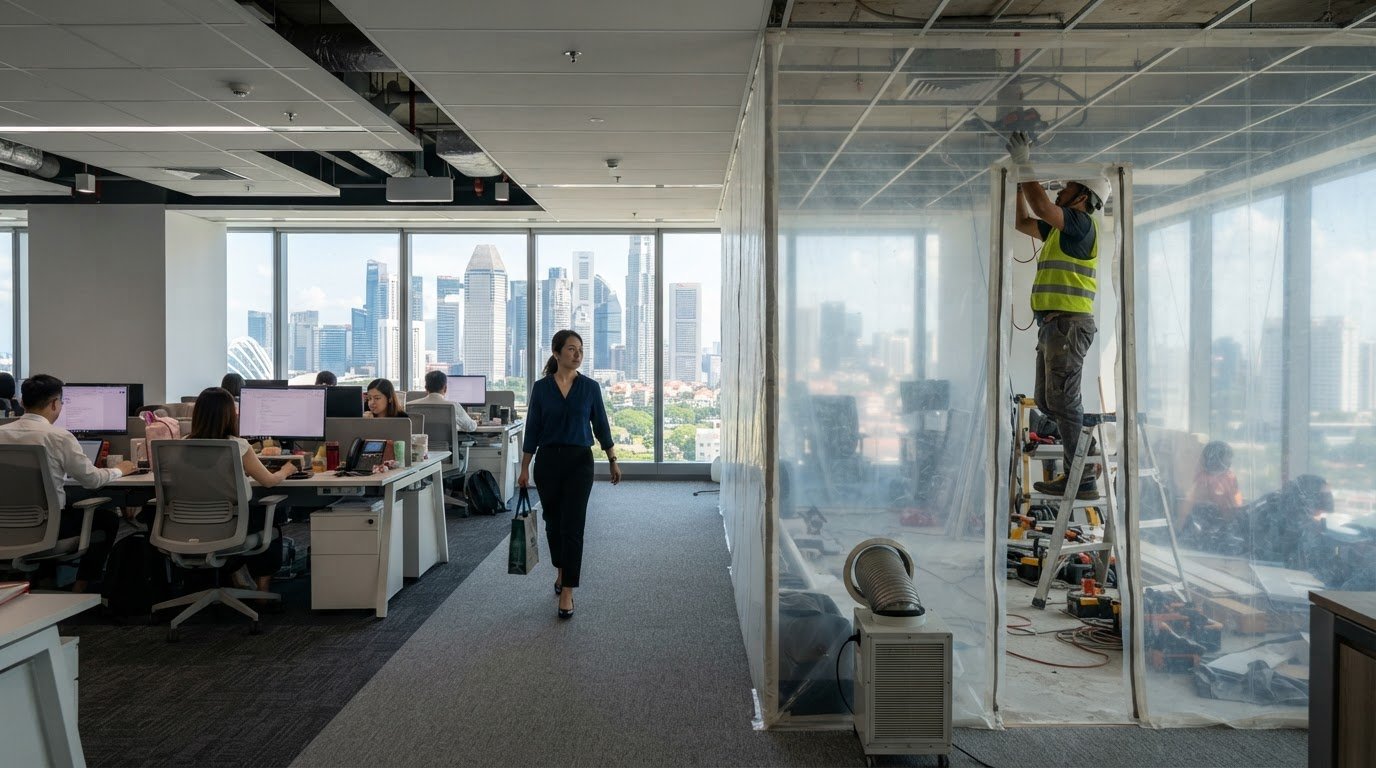
Commercial buildings within the Central Business District (CBD) and major regional hubs strictly ban loud activities during regular office hours. Any core drilling, heavy tile hacking, or drywall dismantling must happen outside business hours, usually weekday evenings after 6:00 PM or on Saturdays after 1:00 PM.
Restricting heavy demolition to these narrow windows effectively stretches physical milestones. A hacking phase that would take four days on an open site can easily span two to three weeks within an occupied commercial tower. Moving debris introduces additional friction. Commercial properties require contractors to reserve dedicated service lifts and loading bays well in advance, often limiting disposal runs to designated nighttime hours.
Fire Protection and M&E System Restoration Lead Times
Returning a space to bare condition involves balancing mechanical, electrical, and plumbing (M&E) services back to landlord baseline standards. Relocating or recapping fire sprinkler heads requires isolating building water pipes, which demands advance clearance from property management.
For context on how complex system configurations are originally installed and reversed, explore our detailed office fitting-out guides. Commercial developments also insist that only the building's appointed base contractor can isolate major air-conditioning ducting or fire alarm circuits. These nominated vendors operate on their own service schedules, making early coordination crucial to protecting your handover date.
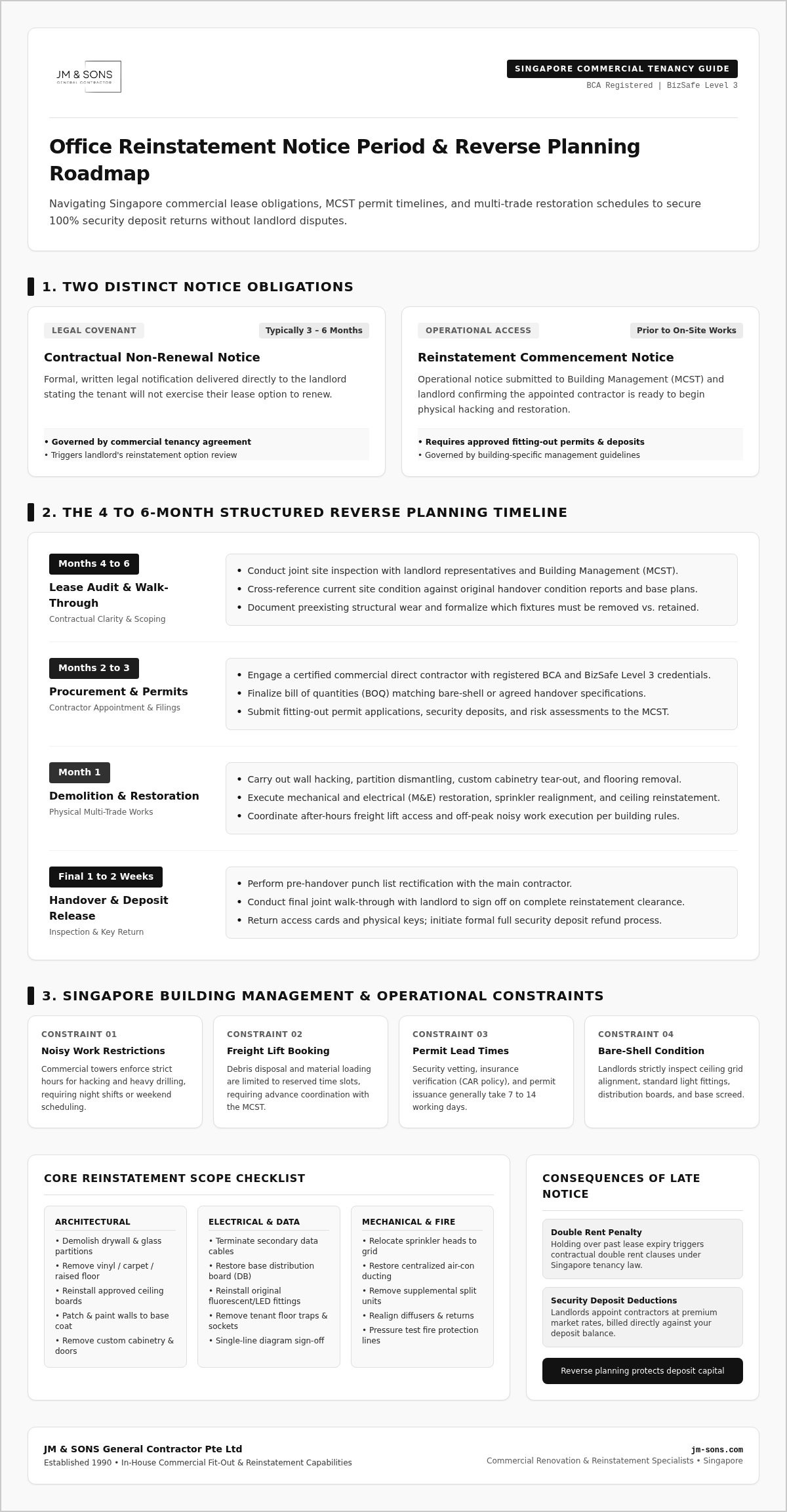
Essential Reinstatement Checklist: Protecting Your Security Deposit
Recovering your commercial deposit without deductions depends entirely on how closely your space matches the initial handover condition. Landlords inspect commercial premises with an exacting eye. Managing your operational office reinstatement notice period effectively means leaving sufficient room to audit every trade against your building's tenancy schedule before handing back the keys.
Architectural and Structural Restorations
Demolition involves far more than clearing furniture. Building inspectors examine surface finishes and structural integrity thoroughly:
Partitions and Joinery: Dismantle all drywall, acoustic partitions, tempered glass doors, and built-in carpentry back to structural perimeter boundaries.
Ceilings and Grids: Replace discoloured, damaged, or cut acoustic ceiling boards. Realign grid runners warped by previous fitting works.
Flooring and Screed: Strip secondary carpets, adhesive vinyl, or raised access floor finishes. Patch cracks and level floor screeds to a smooth, uncompromised finish.
Wall Finishes: Fill anchor holes, smooth plaster surfaces, and apply building-specified neutral paint across all exposed walls.
Electrical, Lighting, and Data Infrastructure Termination
Commercial tenants frequently face deposit withholdings over electrical non-compliance. Returning mechanical and electrical services to baseline requirements demands licensed precision:
Extract non-original cabling, server room data trunks, and floor power boxes back to designated riser points.
Restore original fluorescent or LED light troffers strictly matching reflected ceiling plans.
Ensure distribution boards (DBs) are professionally tested, cleaned, certified, and clearly labeled.
If you're unsure how your current office layout compares against baseline building provisions, send your handover checklist to our team for a fast layout review.
The Joint Inspection and Final Handover Sign-Off
Never enter a landlord inspection unprepared. Conduct an internal walkthrough with your reinstatement contractor two to three days before the official handover date. Test all base lights, inspect paint uniformity, and verify that fire sprinkler heads sit unobstructed at their regulated heights.
During the official inspection with building management, document every detail. If minor touch-ups are requested, having a dedicated on-site team ensures immediate resolution. Once property managers sign the handover clearance document, submit it directly to lease administration to initiate your full security deposit refund.
Partnering with an Experienced Contractor for On-Time Reinstatement
Reinstatement deadlines leave no room for trial and error. Successfully navigating your office reinstatement notice period comes down to who you trust on the ground. When your lease end date is non-negotiable, working with an experienced main contractor ensures every demolition permit, hacking shift, and mechanical restoration progresses smoothly without placing your commercial deposit at risk.
Proven Track Record and Singapore Regulatory Compliance
Returning commercial premises cleanly requires deep familiarity with Singapore's regulatory environment and building management standards. JM & SONS is a second-generation family builder operating in Singapore since 1990. Backed by BCA registration and bizSAFE Level 3 certification, our team understands the strict safety risk assessments, worker credentials, and site protocols commercial landlords require. You can learn more about our building heritage and core values on the About JM & SONS page.
Direct In-House Capabilities and Seamless Site Execution
Coordination delays multiply when contractors subcontract core trades across multiple layers of vendors. JM & SONS manages site operations directly, supported by in-house project teams and our own 10,000 sq ft local custom carpentry facility. This hands-on structure allows our supervisors to handle wall demolition, electrical isolation, and ceiling restorations concurrently rather than consecutively.
Our crews routinely manage after-hours noisy works, service lift schedules, and NEA-compliant debris disposal around strict MCST guidelines. Clear communication remains central to our approach: we provide transparent, itemised quotations that prevent unexpected cost escalations before handover.
Start Your Handover Planning Early
If you're facing an upcoming tenancy expiry, don't wait until the final month to review your operational office reinstatement notice period. Getting ahead of the calendar gives your team room to audit the lease, clarify disputed fixtures with the landlord, and avoid punitive double-rent penalties.
We welcome you to connect directly through our WhatsApp Consultation line. Share your architectural layout, handover checklist, or site photos with us, and we'll help you plan a predictable, compliant restoration schedule that protects your bottom line.
Secure Your Commercial Deposit with Confident Handover Planning
Returning your office space on schedule shouldn't be an eleventh-hour scramble. Protecting your company's capital comes down to recognizing your operational office reinstatement notice period, accounting for building management permit lead times, and executing on-site works against strict baseline standards. When you align contractual exit dates with practical site milestones, securing a full security deposit release becomes a structured, predictable process.
As a second-generation family builder established in Singapore since 1990, JM & SONS delivers dependable execution backed by BCA registration, bizSAFE Level 3 certification, and our own 10,000 sq ft local custom carpentry workshop. Our direct in-house trade teams coordinate MCST work permits, after-hours hacking, and M&E restoration without vendor handoffs or unexpected schedule slips. To review your tenancy conditions, simply share your existing floor plan or handover checklist and connect with JM & SONS on WhatsApp. We're ready to help you navigate a smooth, dispute-free handover so you can focus entirely on your business's next chapter.
Frequently Asked Questions
How much notice is typically required for office reinstatement in Singapore?
Commercial leases in Singapore generally mandate a three to six-month formal written notice before tenancy expiry. Operationally, your practical office reinstatement notice period requires engaging contractors and surveying premises at least three to four months prior to handover. This ensures sufficient time to obtain building permits, execute hacking, and pass final landlord inspections. Always verify your specific lease agreement to confirm contractual deadlines.
Can my landlord deduct reinstatement costs directly from my commercial security deposit?
Yes, landlords have the contractual right to deduct restoration expenses from your security deposit if you fail to return the unit in its stipulated handover condition. If unauthorized partitions, damaged ceiling tiles, or obsolete data cabling remain after the lease end date, landlords will hire their own contractors to complete rectifications. These expenses are deducted directly from your deposit at prevailing market rates.
What happens if office reinstatement works exceed my tenancy expiry date?
Overrunning your handover deadline puts your business in breach of contract and often triggers hefty financial penalties. Most Singapore commercial tenancy agreements include holding-over clauses that charge double the prevailing monthly rent for unauthorized occupation beyond the lease expiry. Calculating an accurate office reinstatement notice period with built-in inspection buffer days protects your firm against these expensive delays.
Do I need building management approval before starting office reinstatement works?
Yes, obtaining building management (MCST) approval is mandatory before any contractor can access the premises for demolition. Property managers require formal permit applications supported by detailed Method Statements, bizSAFE Level 3 risk assessments, valid contractor insurance, and security deposits. Because processing typically requires two to three weeks, contractor paperwork must be submitted well before your planned demolition start date.
Can I negotiate to leave behind existing office fit-outs instead of reinstating?
You can negotiate to retain certain improvements if the landlord or incoming tenant explicitly agrees to adopt them. Landlords occasionally accept functional installations such as pantry plumbing, glass meeting rooms, or upgraded distribution boards. However, you must secure this agreement through a formal written indemnity or lease variation letter, otherwise the default bare-shell reinstatement covenant remains legally binding.
How long does physical office reinstatement typically take in Singapore commercial buildings?
Physical site restoration usually takes between one to eight weeks, depending entirely on floor area and fit-out complexity. Small offices under 1,000 sq ft typically require one to two weeks, mid-size spaces between 1,000 and 3,000 sq ft take two to four weeks, and larger premises over 3,000 sq ft often require four to eight weeks to complete properly.
Are reinstatement works permitted during normal office hours in Singapore?
Low-noise activities like painting and plaster patching are permitted during normal business hours, but heavy hacking is strictly restricted in occupied commercial towers. Property managers typically limit noisy demolition, tile hacking, and core drilling to weekday evenings after 6:00 PM or weekends after 1:00 PM on Saturdays. Your contractor must structure shift schedules around these specific building house rules.

Comments