
Renovating a 30-Year-Old HDB Flat: A Practical 2026 Guide
What if the most important renovation decision is what you choose not to replace? When renovating a 30 year old HDB flat, age alone doesn’t show whether the wiring, plumbing, bathroom waterproofing or existing finishes are in suitable condition. A flat may look ready for new tiles and a fresh layout, but hidden wear can affect the work needed once renovation begins.
Before committing to materials and costs, start by understanding the flat itself. This guide explains what to inspect, what to discuss with qualified professionals, and how to decide whether to retain, repair, replace or investigate an existing feature. It also covers what to verify with HDB and relevant parties, including your block’s Home Improvement Programme status before planning bathroom upgrades. A condition-led scope and early checks can help you make informed choices and manage avoidable surprises during renovation in Singapore.
Table of Contents
Renovating a 30-Year-Old HDB Flat: Start by Assessing Its Condition
Older HDB Flat Renovation: Check Wiring, Plumbing and Wet Areas Before Design
What Should You Retain, Repair or Replace in a 30-Year-Old HDB Flat?
Plan the Renovation in Stages: From Inspection to HDB Work Checks
Choosing Support for Your Older HDB Flat Renovation in Singapore
Renovating a 30-Year-Old HDB Flat: Start by Assessing Its Condition
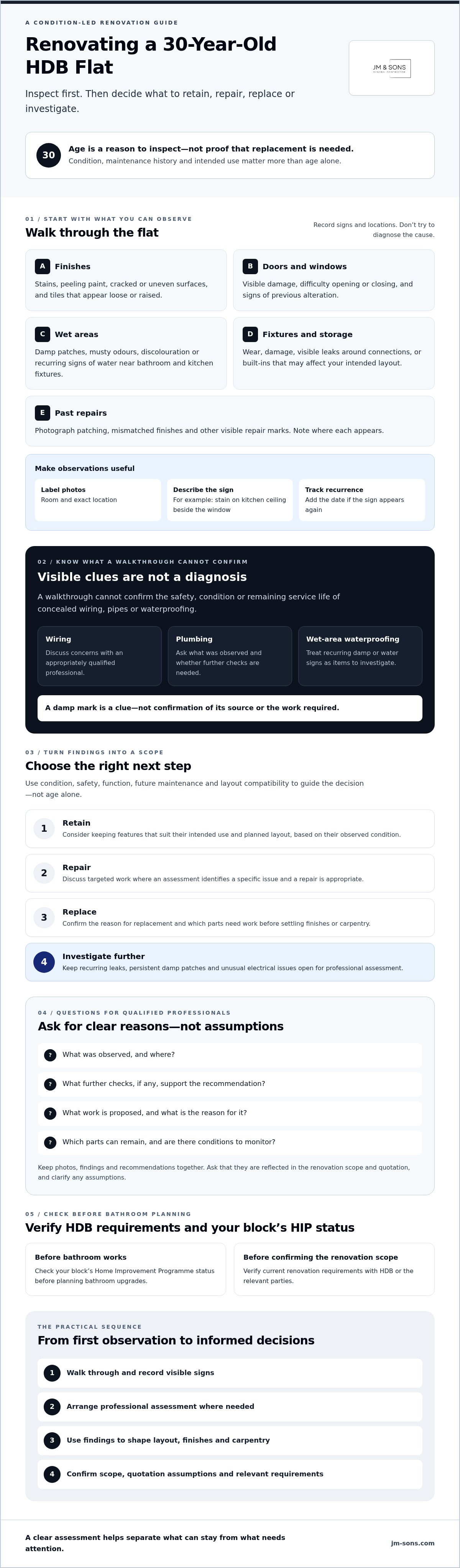
A flat’s age is a reason to inspect it, not proof that hidden defects are present. Two flats built around the same time can have different maintenance histories and conditions. Before deciding what to hack, replace or cover with new finishes, separate visible observations from issues that need a qualified professional to assess.
Condition, maintenance history and intended use matter more than age alone when deciding what to retain, repair or replace. A worn cabinet door is easy to see and discuss. A damp patch may have a cause that cannot be confirmed by looking at the surface. The Housing & Development Board (HDB) provides context about Singapore’s public housing system. Check current HDB guidance separately for renovation requirements.
What to look for during an initial walkthrough
Walk through the flat in daylight if possible and record observations without trying to diagnose them. Note the room, exact location and whether the issue appears to be recurring. This makes later conversations with renovation professionals more specific.
Finishes: Record stains, peeling paint, cracked or uneven surfaces, and tiles that appear loose or raised.
Doors and windows: Check for visible damage, difficulty opening or closing, and signs of previous alteration.
Wet areas: Note damp patches, musty odours, discolouration or recurring signs of water around bathroom and kitchen fixtures.
Fixtures and storage: Look for wear, damage, leaks around visible connections, and built-ins that may affect your intended layout.
Past repairs: Photograph patching, mismatched finishes or other visible repair marks, and note where they appear.
Take clear photos and label each one by room and location. A note such as “stain on kitchen ceiling beside the window” is more useful than an unlabelled photo. Record what you saw without assuming what caused it. If the same sign appears again, add the date so you can explain whether it seems persistent or intermittent.
Which issues need professional assessment?
A walkthrough cannot confirm the safety, condition or remaining service life of concealed wiring, pipes or waterproofing. Ask suitably qualified professionals to assess concerns that go beyond visible wear. This is particularly important if you notice recurring leaks, persistent damp patches or unusual electrical issues. Keep these items open for investigation rather than assuming a full replacement is necessary or that the system is sound.
Use assessment findings to shape the renovation scope before committing to finishes or built-in carpentry. That gives you a clearer basis for discussing what can remain, what needs attention and what still requires investigation. When you receive a recommendation, ask which observation supports it and whether any further check is needed before the work is confirmed.
Older HDB Flat Renovation: Check Wiring, Plumbing and Wet Areas Before Design
Concealed systems can affect more than the repair list. Wiring routes, pipes and bathroom waterproofing may influence where you place appliances, plan storage or choose finishes. Discuss their condition before finalising the layout and carpentry. Then inspection findings can inform the scope instead of prompting rushed changes once work is underway.
Age alone isn’t a reason to replace a system. Ask what was observed, what work is recommended and why. A visible symptom is a clue to investigate, not confirmation of the underlying defect. A damp mark, for example, doesn’t by itself identify the source or show how much work is needed.
Electrical wiring and plumbing: questions to ask
For concerns about wiring or plumbing, seek an assessment from an appropriately qualified professional. Ask for a clear explanation in plain language, and request that proposed work be distinguished from components that can remain. When comparing recommendations, check that each one refers to the same part of the flat and the same observed issue.
What was observed, and where?
What further checks, if any, support the recommendation?
What work is proposed, and what is the reason for it?
Which parts can remain, and are there conditions to monitor?
Keep assessment findings, photographs and recommendations together. They’ll help you compare the proposed scope with your intended layout and clarify assumptions in the renovation quotation. Don’t rely on an assumed replacement age or a general lifespan; ask for advice based on the actual system and its condition.
Waterproofing and bathrooms: understand the signs
In bathrooms and other wet areas, record where you see dampness, staining, loose finishes or recurring leaks. Note whether signs appear in the same place over time and whether they return after repairs. These observations help professionals understand what needs investigation, but they can’t confirm the condition of concealed waterproofing on their own.
Before selecting tiles, fittings or other bathroom finishes, ask whether further checks are needed and how the findings affect the work. Verify current requirements for your proposed wet-area renovation with HDB and the relevant parties before confirming the scope. The Building and Construction Authority (BCA) guidance on building works not requiring approval covers its stated building-works context. Don’t assume it settles HDB renovation requirements, which should be checked with HDB.
If you have inspection notes or photos, you can share them with JM & SONS to discuss how findings may be reflected in a renovation scope.
What Should You Retain, Repair or Replace in a 30-Year-Old HDB Flat?
A 30-year-old flat doesn’t automatically need a complete overhaul. The right scope depends on what’s in good condition, what works for your household and what needs attention for safety, function or compliance. For anyone renovating a 30 year old HDB flat, assess those essentials before committing to aesthetic changes.
Use your walkthrough and professional assessments to sort each feature into one of four decisions. If there isn’t enough evidence yet, pause and ask what needs to be checked before confirming the scope.
Retain what works, based on evidence
Sound doors, storage, fixtures or finishes may be worth keeping if they serve the household and fit the proposed layout. Before planning around an existing item, check its condition, safety and any applicable requirements. Ask the contractor to flag practical constraints, such as how an existing fixture may affect new carpentry or access for future maintenance. If you plan to keep a fixture, make that clear in the brief so the proposed work can account for it.
Prioritise essential work before visual upgrades
Put confirmed safety and functional concerns ahead of optional changes to colours, finishes or styling. Separate necessary work from preferences in your renovation brief and ask for the quotation to show them clearly. This makes it easier to see what is driving the scope and reconsider optional items without losing track of work that needs attention.
Plan the look of the flat after condition and compliance questions are clearer. This order leaves room for informed choices without assuming every older feature must go.
Plan the Renovation in Stages: From Inspection to HDB Work Checks
A condition-led sequence helps keep renovation decisions grounded in what the flat needs. For owners renovating a 30 year old HDB flat, age alone doesn’t determine which work is permitted or what approvals may apply. Check current HDB guidance for the specific works you’re proposing, and confirm details with relevant parties before scheduling.
Document the flat. Gather available floor plans, site photos and information about previous renovations. List household priorities, observed issues, intended changes and features you hope to retain.
Arrange relevant assessments. Have qualified professionals assess concerns that can’t be resolved through a visual check, such as wiring, plumbing or waterproofing. Do this before locking in a layout, finishes or built-in carpentry.
Define the renovation scope. Use the findings to separate confirmed work from items that remain provisional. Ask the contractor to record the scope, exclusions and unresolved questions in writing.
Verify requirements. Check current HDB guidance for the exact proposed works. If it’s unclear whether a particular change needs approval or has other conditions, ask HDB or the relevant party before proceeding.
Plan and coordinate the works. Once the scope and checks are clearer, agree on the work sequence, access arrangements and coordination needed for the flat and building.
Prepare a useful renovation brief
A concise brief gives contractors a shared starting point. Include practical needs, such as storage priorities or planned appliance locations, alongside your notes and photographs. Mention previous alterations if you know about them. For each issue, state what you observed, where it is and whether it has recurred. Ask each contractor to identify what is confirmed, what depends on further assessment and what is excluded, so you can compare proposals on a consistent basis.
Verify proposed works before scheduling
Approval and work conditions depend on the specific proposal, not simply on the flat’s age. Verify current HDB requirements for the intended work, and seek clarification rather than relying on assumptions or advice meant for a different alteration. Also check access, work coordination and any building-specific arrangements with the relevant parties before agreeing to a schedule.
JM & SONS provides residential renovation services for HDB, BTO and resale flats. If you’re preparing a scope, share your floor plan, site photos or renovation notes to discuss how assessment findings can be reflected in the work plan.
Choosing Support for Your Older HDB Flat Renovation in Singapore
For an older flat, a useful contractor discussion connects what has been observed to a clear, workable scope. When renovating a 30 year old HDB flat, you may be balancing visible upgrades with issues that need assessment. Look for straightforward explanations, clear responsibilities and a written quotation that distinguishes confirmed work from assumptions.
Questions to ask before appointing a contractor
Use these questions to understand how a contractor will manage the work, not just how the finished flat might look:
How will inspection findings be reflected in the scope? Ask for defined work items, exclusions and assumptions in writing. If an item depends on further assessment, clarify how that will be handled before work proceeds.
Who coordinates the work? Confirm who will coordinate trades, communicate changes and respond to questions from the site.
How are changes documented? Ask how a change to the agreed scope will be explained and recorded, including any effect on the work involved.
What relevant experience and current credentials can you verify? Discuss experience with HDB and resale-flat renovation, and confirm responsibilities and credentials directly with the contractor.
Compare quotations by scope and detail, not just by their total. A clear document should help you see what is included, what is excluded and which decisions remain open. Check that the work items reflect your agreed priorities, and ask for clarification if a quotation uses broad descriptions that don’t explain what will be done. This makes it easier to compare proposals and discuss uncertainties before they become changes during the project.
How JM & SONS can support residential renovation planning
JM & SONS General Contractor Pte Ltd provides renovation services for HDB, BTO and resale flats in Singapore. Its residential renovation services are relevant for owners seeking a contractor to help turn inspection findings and household priorities into a defined renovation scope. Ask how proposed work, exclusions and unresolved assessment questions would be set out in a quotation.
JM & SONS is a family-owned company founded by Mr. Jamaludin Bin Masood and currently managed by his sons. When discussing your project, bring your floor plan, site photos and assessment notes so you can talk through the intended scope and any open questions.
There’s no need to have every decision settled before starting a conversation. If you’re preparing a renovation brief, share your floor plan, site photos or existing renovation checklist to discuss the scope with JM & SONS.
Make Your Renovation Decisions with Confidence
Renovating a 30 year old HDB flat doesn’t mean every system or finish needs replacing. Start with the flat’s actual condition, seek professional assessment for concealed concerns, then decide what to retain, repair, replace or investigate further. Confirm current HDB requirements for your proposed work before finalising the scope and schedule.
Clear communication matters too. A detailed quotation should distinguish confirmed work from assumptions and exclusions. JM & SONS General Contractor Pte Ltd provides renovation services for HDB, BTO and resale flats in Singapore, so owners can discuss how household priorities and assessment findings may translate into a defined scope.
Have a floor plan, site photos or an existing renovation checklist? Share your floor plan or site photos with JM & SONS General Contractor Pte Ltd to discuss your renovation scope. A careful start can help you shape a plan around the home you actually have.
Frequently Asked Questions
Is a 30-year-old HDB flat worth renovating?
It can be worth renovating if the flat suits your needs and the work makes sense after assessing its actual condition. Age alone doesn’t show whether wiring, plumbing, waterproofing or finishes need attention. Before deciding, consider the flat’s maintenance history, assessment findings, intended layout and work required. A condition-led scope helps you weigh renovation priorities without assuming the whole flat needs an overhaul.
What should I check before renovating an old HDB flat?
Check visible finishes, doors, windows, fixtures, storage, wet areas and signs of past repairs, then record what you find with notes and photos. Ask qualified professionals to assess concerns involving concealed wiring, plumbing or waterproofing. If your block’s Home Improvement Programme (HIP) status may affect planned bathroom work, check it before committing to that scope. Verify current renovation requirements with HDB and relevant parties.
Does a 30-year-old HDB flat need rewiring?
Not necessarily. A flat’s age by itself doesn’t establish that its wiring needs replacement or confirm that it’s in suitable condition. If you notice unusual electrical issues or have concerns about the system, ask an appropriately qualified professional to assess it. Request a clear explanation of any observed issue, recommended work and components that may remain. Don’t rely on an assumed replacement age or lifespan.
Do I need HDB approval to renovate an older flat?
Requirements depend on the work proposed, not the flat’s age. HDB guidance states which works require a permit and what other conditions may apply. The research for this guide indicates homeowners must engage a contractor listed in HDB’s Directory of Renovation Contractors for renovation works, and that the contractor submits permit applications where required. Check current HDB guidance and confirm the requirements for your exact scope before work begins.
Should I replace the flooring in a 30-year-old HDB flat?
Replace it only if its condition, function or compatibility with your plans supports that decision. Note cracked, loose, raised or uneven areas, but ask a suitable professional to assess the cause and extent before deciding on work. Flooring that remains sound and suits your household may be retained. Discuss floor levels, adjoining finishes and the intended layout before choosing replacement materials or finalising the renovation scope.
How do I avoid unexpected work when renovating an old HDB flat?
You can reduce avoidable surprises by documenting the flat, arranging professional assessments before finalising finishes or carpentry, and recording findings in the renovation brief. Ask for a written quotation that separates confirmed work from provisional items, assumptions and exclusions. Verify requirements with HDB and relevant parties before scheduling. Clear answers early won’t rule out every issue, but they make open questions and scope changes easier to manage.
Can I keep the original features in an older HDB flat?
Yes, if the feature is in suitable condition, works for your household and fits the intended layout. Existing doors, storage, fixtures or finishes may be worth retaining, but don’t assume they’re suitable without checking their condition and any applicable requirements. Ask the contractor to flag practical constraints, such as how an existing fixture may affect new carpentry or maintenance. Keep the decision under review if further assessment is needed.