
Shopping Mall Tenant Reinstatement in Singapore: The 2026 Compliance Guide

Your security deposit isn't just a financial buffer; it's the final hurdle between a successful exit and a costly dispute. Most retail tenants find that the hardest part of leaving a mall isn't the move itself, but meeting the rigid shopping mall tenant reinstatement standards set by landlords. You've likely dealt with vague schedules and the constant pressure of mall management's tight timelines. It's a stressful period where the fear of hidden costs from sub-standard contractors often looms large.
This professional guide provides the clarity you need to navigate these 2026 compliance requirements without the usual headaches. We'll break down the specific technical demands of Singapore's retail landscape, from fire safety coordination to the latest BCA Green Mark standards. While we provide this roadmap based on our experience, we always recommend verifying specific mall guidelines with your building management. As a second-generation family business founded in 1990, JM & Sons prioritizes transparency. We've spent decades managing complex mall coordination and after-hours works. We're here to help you understand the process, avoid deposit forfeiture, and ensure your transition is handled with the integrity it deserves.
Table of Contents
Understanding Shopping Mall Tenant Reinstatement in Singapore
Shopping mall tenant reinstatement is the technical process of returning a retail unit to its "bare shell" state. This isn't just about moving your furniture out; it's the systematic reversal of what is a fit-out. In Singapore's competitive retail market, landlords are incredibly strict about this process. They require a uniform, clean slate so the next tenant can begin their renovation without inherited obstructions.
The financial stakes are high. If your chosen contractor fails to meet the mall's standards, the building management will often appoint their own team to complete the works. These management-appointed contractors typically charge premium rates, which are then deducted directly from your security deposit. Avoiding this forfeiture requires a clear understanding of your legal and technical obligations from day one.
In 2026, the landscape has shifted toward higher accountability. With the launch of BCA Green Mark Version 7 in September 2026, malls are placing a heavier emphasis on sustainable disposal. You're now expected to provide documentation regarding debris management and the responsible recycling of construction waste. It's no longer enough to just clear the space; you must prove it was done according to modern environmental standards.
The Restoration Clause in Your Lease
Your journey begins with the Tenancy Agreement. You'll need to identify the specific "Original Condition" description. This legal clause defines exactly how the space looked before you moved in. In premium Singapore shopping centres, "as-is" handovers are rare. Most landlords will issue a Handover Protocol document. This is a detailed checklist that outlines which fixtures must be removed and which original base-build items, like essential M&E points, must remain intact. Treat this document as your primary roadmap for commercial reinstatement works.
The Expectation Gap: Moving Out vs. Reinstating
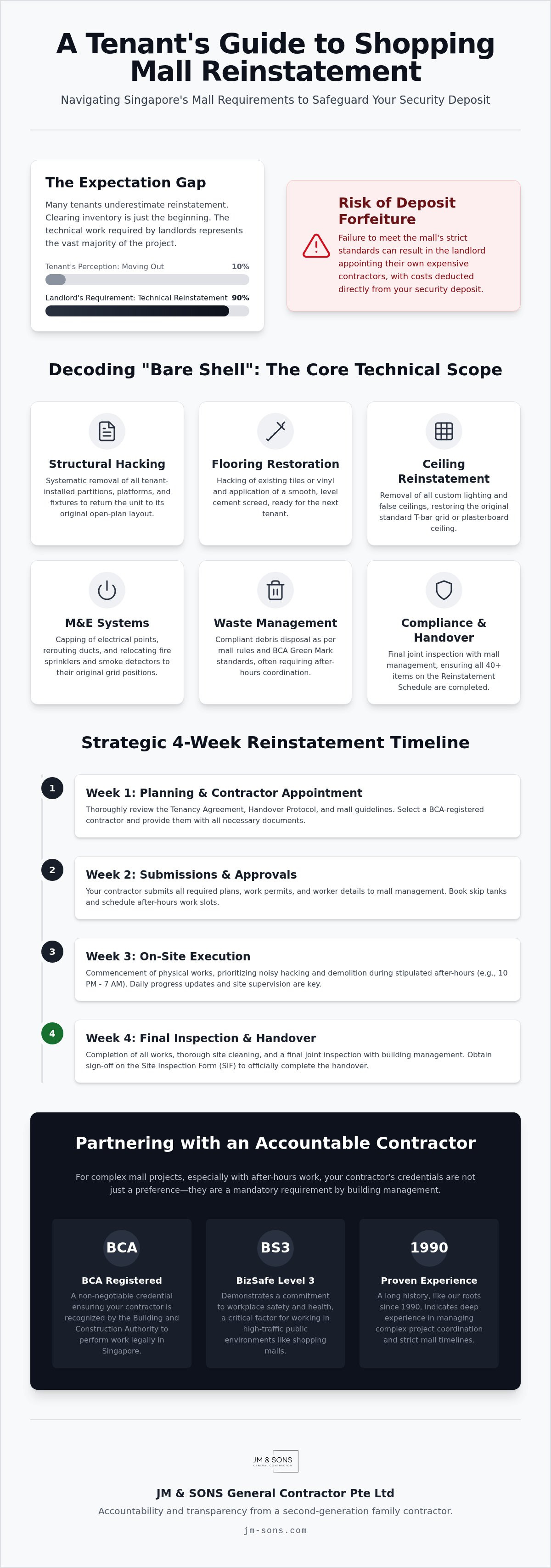
There's often a significant gap between a tenant's perception of moving out and the landlord's requirement for shopping mall tenant reinstatement. Clearing inventory and signage is only about 10% of the total scope. The remaining 90% is where the technical complexity lies. Landlords will look for specific finishes that tenants often overlook. These include:
Flooring restoration: Hacking away tiles or vinyl and applying a smooth, level layer of cement screed.
Ceiling grids: Removing all custom lighting and restoring the standard T-bar grid or plasterboard ceiling.
Fire Safety: Relocating fire sprinklers and smoke detectors to their original grid positions to ensure building-wide compliance.
Professional coordination for mechanical and electrical (M&E) systems is mandatory. You can't simply cut wires and leave them in the wall. Every electrical point and air-conditioning duct must be capped or rerouted according to the mall’s original schematic. This requires a contractor who understands the building's infrastructure as well as they understand demolition.
Navigating Mall Management and Regulatory Requirements
Successful shopping mall tenant reinstatement hinges on your ability to meet the landlord's administrative demands before a single hammer swings. Most mall managements issue a comprehensive Reinstatement Schedule that can contain over 40 individual scope items. These aren't suggestions; they're rigid requirements that dictate how every screw and wire must be handled according to BCA's Building Control Act. You'll need to navigate the Site Inspection Form (SIF) process, which acts as the official record of the unit’s condition during the handover.
Managing the physical work is equally restricted by the mall’s operational rhythm. Most shopping centres in Singapore strictly enforce after-office-hours rules for any noisy works or hacking. This usually means your contractor must operate between 10:00 PM and 7:00 AM to avoid disrupting shoppers. Waste management is another critical factor. You're responsible for complying with mall-specific debris disposal rules, which often include booking specific time slots for skip tanks and ensuring the loading bay is cleared before the mall opens for retail traffic the next morning.
SCDF and Fire Safety Compliance
Fire safety is the most common reason for a failed handover. You must restore all fire protection systems, including sprinklers, smoke detectors, and emergency exit signs, to their original base-build positions. If your fit-out involved significant partitions, an SCDF submission may be required to certify that the reinstated space still meets fire safety codes. Building management won't sign off on your unit until they receive a formal fire safety clearance. It's a technical area where we often advise tenants to speak with our team about your mall's specific requirements to avoid last-minute delays.
Permits and Insurance Requirements
Before work begins, your contractor must secure a Permit to Work (PTW). Mall management won't issue this without proof of comprehensive insurance, specifically Public Liability and Work Injury Compensation (WICA). These documents protect you from the financial fallout of accidental damage to the mall’s common property. For a deeper look at these regulatory hurdles, you can refer to our Singapore Reinstatement Works: 2026 Tenant Compliance Guide. At JM & Sons, our BizSafe Level 3 certification and BCA registration ensure we have the necessary credentials to handle these submissions on your behalf, providing peace of mind throughout the coordination phase.
The Technical Scope of Mall Reinstatement Works
Successful shopping mall tenant reinstatement isn't just about clearing the floor space; it's a technical reversal of the entire fit-out process. This phase requires a methodical approach to dismantling the structural and mechanical additions you've made over the years. Landlords expect the unit to be returned as a clean, functional shell. While specific mall rules vary, the broader legal framework regarding property obligations in Singapore, such as Singapore's Housing and Development Act, informs how landlords structure these restoration requirements to ensure the asset's long-term value.
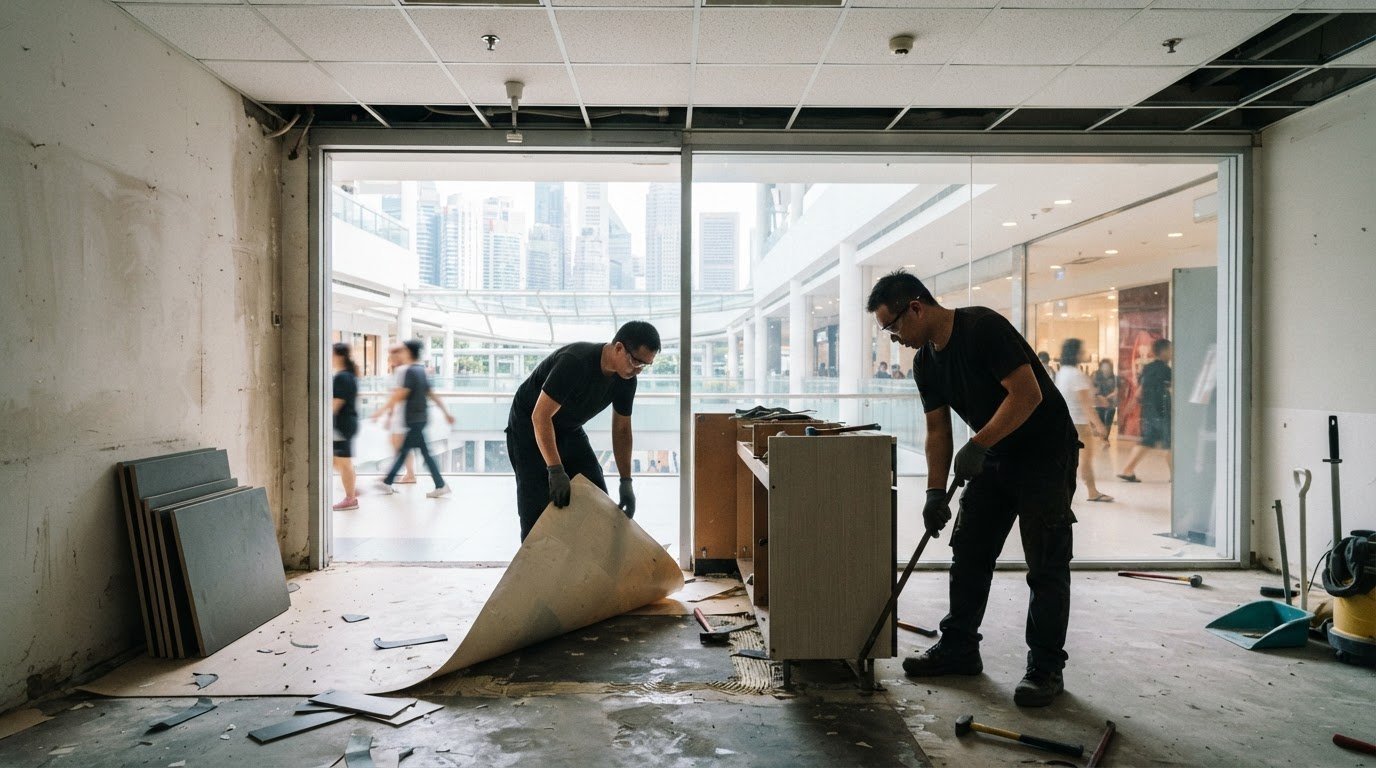
The core of the work involves structural hacking and surface restoration. You'll need to remove all non-load bearing partitions, false ceilings, and any mezzanine levels added to the unit. Flooring is another major component; you must hack away existing tiles or vinyl and apply a fresh, level layer of cement screed. Electrical systems also require attention. All power points must be terminated, and the Distribution Board (DB) must be restored to its original layout. Finally, walls must be painted to the landlord-approved neutral "white-wash" state to provide a blank canvas for the next tenant.
Mechanical & Electrical (M&E) Restoration
The technical complexity of shopping mall tenant reinstatement is most apparent in the M&E restoration. This involves the building's shared infrastructure, meaning mistakes can affect more than just your unit. For air-conditioning (HVAC) systems, you must relocate diffusers to their original grid positions to ensure balanced airflow across the floor. Plumbing and drainage points in F&B units or hair salons require professional capping to prevent leaks or blockages. If you replaced the standard mall-issued light fixtures during your fit-out, you'll need to reinstall the original units to maintain uniformity.
Hacking and Debris Removal
Hacking must be performed with extreme care to avoid damaging the mall's main structural elements or shared services like fire mains and data cables. It's a high-stakes environment where a single error can lead to significant repair costs. Debris removal is equally challenging. High-traffic malls have strict logistics for loading bays and specific debris routes that must be followed during after-hours windows. Understanding the technical requirements of the exit is just as important as the initial setup, which we detail in our Singapore Mall Fit-Out: 2026 Guide for Retail Tenants. Our team at JM & Sons handles these logistics daily, using our in-house capabilities to ensure the work is done safely and without middleman delays.
Planning Your Exit: Timeline and Avoiding Penalties
Timing is everything when it comes to a successful shopping mall tenant reinstatement. While the physical work might only take a few weeks, the administrative runway is much longer. Industry data suggests you should start planning for reinstatement 3 to 6 months before your lease expires. This allows ample time for contractor sourcing and the mandatory 2 to 4 weeks required for mall management to approve your technical submissions. If you wait until the final month to begin your search, you risk missing the handover date entirely.
The consequences of a late handover are often written into your contract as "Liquidated Damages." This is a daily penalty, usually equivalent to a multiple of your current rent, charged for every day the unit remains in your possession past the expiry date. To avoid these costs, we recommend a strict 4-week execution countdown. This window covers the physical hacking, restoration, and a vital buffer period for the final inspection and any necessary rectification works. Before any work starts, conduct a pre-reinstatement site walk with your contractor and building management to align on every item in the Site Inspection Form (SIF).
The 5-Step Reinstatement Process
A structured approach prevents missed details that lead to failed inspections. Our team follows a proven 5-step method to ensure accountability:
Step 1: Document Review – We analyse your lease and the landlord's specific reinstatement schedule to identify every obligation.
Step 2: Site Survey – We identify M&E points, fire safety systems, and structural challenges that aren't visible on paper.
Step 3: Execution – This is the active phase of hacking, dismantling, and restoring the unit to its bare shell state.
Step 4: Internal Quality Check – Our project managers verify that every point on the landlord's list has been met before the official walk-through.
Step 5: Official Handover – The joint inspection and final sign-off with the landlord to release your security deposit.
Managing the Handover Inspection
The joint inspection is the moment of truth. You should arrive prepared with floor plans, electrical diagrams, and the original handover photos from the start of your tenancy. These documents are your best defence if a landlord requests restoration beyond your original scope. It's common for landlords to issue a "snag list" of minor rectifications. Having a "straight-shooter" contractor present during this walk-through is invaluable. We can often resolve technical disputes on the spot by referencing the building's technical guidelines. If you're feeling the pressure of a looming deadline, send us your reinstatement checklist for a transparent assessment of your timeline.
Partnering with an Accountable Reinstatement Contractor
Choosing the right partner for your shopping mall tenant reinstatement is about more than finding a team to clear the space. It's about accountability and technical compliance. In Singapore, mall managements strictly enforce safety and professional standards. BCA registration and BizSafe Level 3 certification aren't optional; they're non-negotiable requirements for entry. These credentials prove a contractor understands the risks of after-hours works and possesses the insurance coverage necessary to protect you and the landlord from accidental property damage.
Transparency in pricing is another pillar of a successful exit. You should look for detailed quotations that break down every M&E point, hacking task, and debris disposal fee. Lump-sum estimates often hide gaps in the scope that lead to "hidden costs" once the landlord issues a final rectification list. A straight-shooter approach ensures you know exactly what you're paying for before the first partition is dismantled. This level of detail is especially important when coordinating with Singapore mall security protocols, which require precise scheduling for loading bay access and noise-intensive works.
The value of in-house capabilities cannot be overstated. When a contractor operates their own resources, such as a 10,000 sq ft local carpentry facility, they reduce reliance on third-party subcontractors. This leads to better communication and fewer middleman markups. Most importantly, it ensures that when a tight mall deadline looms, the necessary manpower and equipment are ready to go without delay.
Why Heritage and Experience Matter
Experience in the local landscape provides a level of peace of mind that newer firms often can't match. The JM & SONS story began in 1990. As a second-generation family contractor, we've grown through personal relationships and a strong moral compass. We don't believe in high-pressure sales; we believe in the integrity of the process. Our decades of experience mean we're already familiar with the specific handover requirements of major Singapore shopping centres, which helps prevent technical disputes during the joint inspection. You can learn more About JM & SONS and our commitment to professional standards.
Evaluating Contractor Transparency
When interviewing potential partners, look for evidence of their coordination skills. An accountable contractor should be able to explain the nuances of SCDF fire safety submissions and building authority requirements clearly. They should provide evidence of previous shopping mall tenant reinstatement projects and demonstrate a clear understanding of the Site Inspection Form (SIF) process. Ultimately, you're looking for a partner who cares as much about the final physical result as they do about the safety of the work environment. This focus on reliability ensures your security deposit is protected and your transition is as smooth as possible.
Securing Your Security Deposit through Compliance
Returning a retail space to its bare shell state is a high-stakes coordination project. Successful shopping mall tenant reinstatement requires more than just a moving crew; it demands a deep understanding of mall management's technical schedules and SCDF fire safety requirements. You've learned that early planning is your best defense against daily liquidated damages. Most failed handovers stem from overlooked M&E points or poor coordination during after-hours works.
As a second-generation family business operating since 1990, we prioritize transparency and accountability. We're a BCA Registered Contractor and BizSafe Level 3 certified, ensuring that every hacking and restoration task meets Singapore's strict 2026 compliance standards. We don't believe in vague estimates. We provide the technical expertise needed to ensure your joint inspection is a success. If you're ready to plan your exit with peace of mind, contact JM & SONS for a detailed reinstatement quotation. We're here to help you navigate your next transition with integrity and professional care.
Frequently Asked Questions
What is the typical duration for shopping mall reinstatement in Singapore?
Physical execution usually takes 2 to 4 weeks depending on the unit size and complexity. However, the total timeline should include a 3 to 6-month planning phase. This buffer accounts for contractor sourcing and the 2 to 4 weeks needed for mall management to approve your technical submissions. Starting early ensures you have enough time for the final joint inspection and any minor rectifications required by the landlord before your lease officially expires.
Can I reuse my existing contractor who did the fit-out for the reinstatement?
You can certainly engage your original fit-out contractor if they possess the necessary mall credentials. Most Singapore shopping malls require contractors to be BCA registered and BizSafe Level 3 certified. Since your original contractor is already familiar with the unit's M&E layout and structural modifications, they may provide a smoother shopping mall tenant reinstatement process. Always verify that their insurance, such as Public Liability and WICA, remains valid for the reinstatement period.
What happens if I cannot finish the reinstatement before my lease expires?
Failing to complete works on time usually triggers "Liquidated Damages" clauses in your tenancy agreement. This typically involves paying a daily penalty, often equivalent to a multiple of the daily gross rent, for every day the unit remains unhanded. Landlords may also use your security deposit to appoint their own contractors at premium rates. To avoid these financial penalties, it's vital to maintain a strict 4-week execution schedule with built-in buffer days for the final sign-off.
Do I need to restore the flooring if I installed high-quality marble or wood?
Yes, you must usually remove all tenant-installed floor finishes unless the landlord explicitly agrees to keep them in writing. Most mall managements require the unit to be returned as a bare shell with a smooth, level layer of cement screed. Even if your marble or wood flooring is in excellent condition, the incoming tenant will likely have different design requirements. Landlords prioritize a uniform "clean slate" to facilitate the next fit-out without inherited obstructions.
Is an SCDF submission always necessary for retail reinstatement?
An SCDF submission is not always mandatory but is often required if your reinstatement involves significant changes to fire safety systems. If you are relocating sprinklers, smoke detectors, or emergency exit signs to their original grid positions, building management may require professional certification. At JM & Sons, we coordinate these fire safety compliance requirements to ensure the mall's fire protection system remains intact and the landlord signs off on your handover without technical delays.
How is the cost of mall reinstatement calculated?
Costs are determined by the total floor area and the complexity of the technical scope. Key factors include the volume of structural hacking required, the number of M&E points needing termination, and the amount of debris for disposal. Since mall works must occur after-hours, labor rates for night shifts also influence the total. We recommend requesting a detailed quotation rather than a lump-sum estimate to ensure every landlord requirement in the reinstatement schedule is accurately accounted for.
What are the common reasons landlords reject a reinstatement handover?
Rejections often occur due to technical discrepancies in M&E restoration or poor surface finishes. Common snags include uneven cement screeding, improperly capped plumbing points, or fire sprinklers that don't align with the original building grid. Landlords also frequently flag incomplete debris removal in common areas or damage to the mall's shared services. Having an accountable contractor present during the joint inspection helps resolve these minor snag list items quickly through clear technical communication and immediate rectification.
Who is responsible for disposing of the debris and old fixtures?
The outgoing tenant is legally responsible for the removal and disposal of all debris and fixtures. In practice, your shopping mall tenant reinstatement contractor handles the logistics. This includes booking skip tanks and navigating specific debris routes mandated by mall management. Under 2026 standards, there is an increased focus on sustainable disposal. You must ensure your contractor follows the mall's specific waste management protocols to avoid fines and ensure the loading bay is cleared before retail hours.

Comments