
Commercial Reinstatement Singapore: The 2026 Tenant’s Handover Guide
- JM & SONS
- 1 day ago
- 12 min read

What if the most expensive part of your office move isn't the new fit-out, but the space you're leaving behind? It's a common fear for many business owners in Singapore. You've focused on your new growth, but the fine print of your lease agreement regarding commercial reinstatement Singapore can lead to unexpected costs if handled poorly. We understand the pressure of meeting tight move-out deadlines while trying to satisfy strict building management requirements and SCDF fire safety standards.
You want a handover that's smooth and dispute-free, without the stress of hidden penalties. This 2026 guide is designed to give you a clear understanding of the reinstatement process, from the initial site survey to the final inspection. We'll share insights on managing timelines and why working with a BCA registered, BizSafe Level 3 contractor is vital for your peace of mind.
Since 1990, our team at JM & Sons has approached every project with a sense of moral responsibility and technical precision. We'll walk you through the technical scope of work and the coordination needed for a successful restoration. By the end of this article, you'll know exactly how to protect your security deposit and ensure your landlord receives the unit in its original condition.
Table of Contents
What is Commercial Reinstatement and Why is it Mandatory in Singapore?
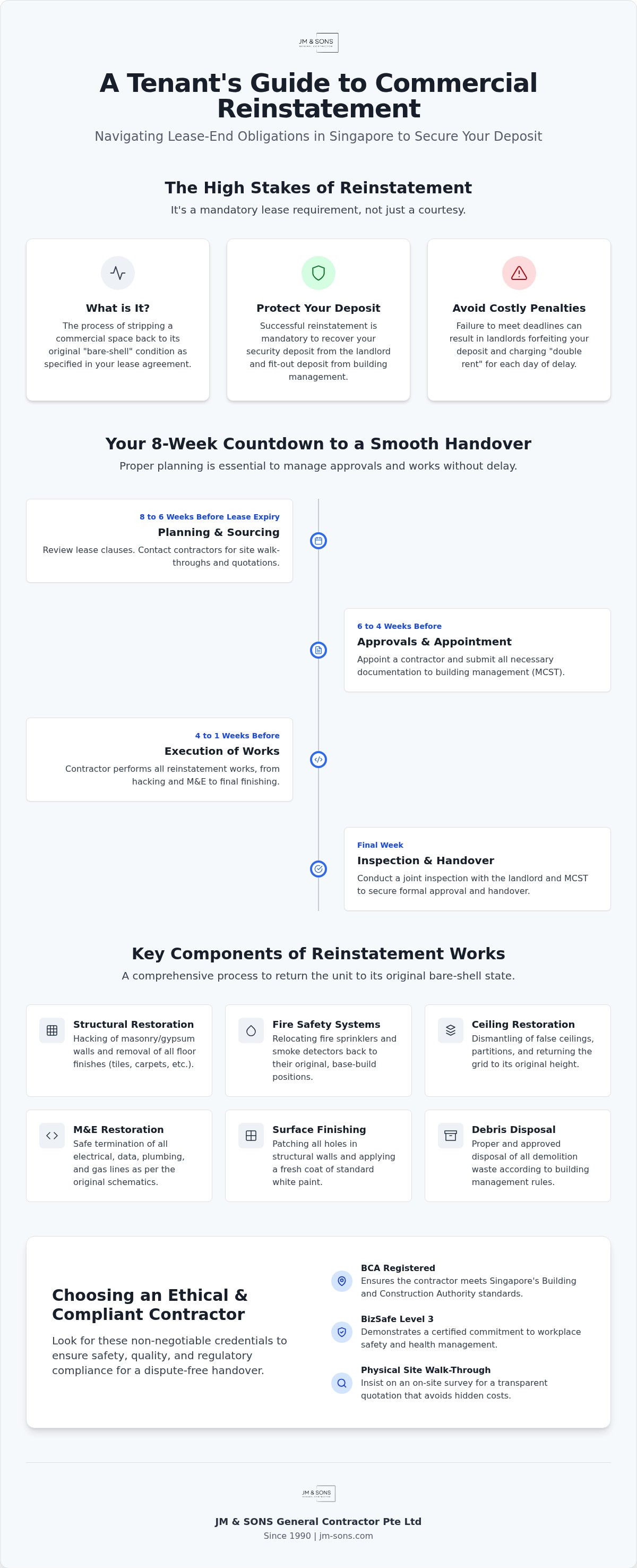
In simple terms, commercial reinstatement is the process of stripping down a business space to the exact condition it was in when you first collected the keys. In Singapore, this almost always means returning the unit to a "bare-shell" state. This isn't just a courtesy; it's a legal requirement embedded in almost every commercial Leasehold estate agreement. Landlords rely on this clause to ensure the property is ready for the next occupant to begin their own renovation without clearing away your old partitions or wiring.
If you fail to complete the commercial reinstatement Singapore requirements specified in your contract, the financial impact is immediate. Landlords typically hold the right to forfeit your security deposit to cover the costs of doing the work themselves. They might even charge you "double rent" for the days the unit remains un-reinstated past your lease expiry. It's a high-stakes situation where clarity is your best defense against avoidable losses.
The "Bare Shell" vs. "As-Is" Condition
A "bare-shell" condition usually involves removing all floor finishes, false ceilings, partition walls, and temporary plumbing. However, some tenants hope to leave their improvements behind for the next tenant in an "as-is" condition. You shouldn't assume this is allowed. Without explicit, written consent from your landlord, you're legally bound to remove everything. Always refer back to your original handover condition report and site photos from your first day in the unit. These documents are the only objective evidence of what the space looked like before your business moved in.
The Role of Building Management (MCST)
Beyond your landlord, you must answer to the building's Management Corporation Strata Title (MCST). They provide a "Fit-out Manual" that dictates how commercial reinstatement Singapore must be performed. This manual covers everything from the hours you can perform noisy hacking to where your debris must be disposed of. The MCST also holds a separate "Fit-out Deposit" from you. They won't release these funds until they're satisfied that no damage was done to common areas, like lifts or corridors, during the move-out process. At JM & Sons, we prioritize this coordination with building management to prevent our clients from facing unnecessary fines or delays during the final inspection.
Key Components of Professional Reinstatement Works
Executing a successful commercial reinstatement Singapore project requires a methodical dismantling of every customized element you added to the space. Restoration is a multi-layered process that goes far beyond simple demolition. Most landlords in Singapore expect a complete return to "bare shell" condition. This ensures you comply with the reinstatement clause in Singapore typically found in commercial agreements. The goal is to leave the unit in a clean, neutral state that allows the next tenant to start their fit-out immediately.
A comprehensive scope usually involves these core elements:
Structural Restoration: Hacking of masonry or gypsum walls and removing floor tiles or carpets.
Ceiling Restoration: Dismantling false ceilings and returning the grid to the original base-build height.
Fire Safety: Relocating fire sprinklers and smoke detectors to their original positions as per the building's fire protection layout.
Surface Finishing: Patching all holes in structural walls and applying a fresh coat of white paint.
Mechanical and Electrical (M&E) Restoration
M&E restoration is often the most scrutinized part of the handover. Landlords don't just want wires gone; they want them safely terminated. Simply cutting wires and leaving them in the ceiling void is a fire hazard and a major reason for failed inspections. All electrical points must be terminated according to the building's original electrical single line diagram. For F&B units, we ensure that plumbing and gas lines are professionally capped off to prevent leaks. If you're unsure about your unit's current wiring state, you can message us for a technical assessment.
Hacking and Debris Management
The physical removal of materials must be handled with care to avoid damaging the building's structural integrity. Hacking masonry walls requires more effort and different equipment than removing gypsum partitions. We prioritize protecting common areas by installing professional hoarding boards. This prevents dust and debris from affecting neighboring units or public corridors.
Responsible waste management is also a legal requirement. All construction and demolition waste must be sent to NEA-approved facilities. As of April 2026, incineration fees at TuasOne or Keppel Seghers are $89.60 per tonne, while the Senoko plant is $93.60 per tonne. Proper disposal certificates are often required by building management before they release your fit-out deposit. At JM & Sons, we handle the entire logistics chain, ensuring every tonne of waste is accounted for and disposed of ethically. We prioritize safety and accountability in every commercial reinstatement Singapore contract we undertake.
Navigating Reinstatement for Offices, Retail, and F&B Units
Every commercial sector in Singapore follows a different set of rules for returning a space. While the general goal is a bare shell, the technical hurdles vary significantly between an office in the CBD and a restaurant in a shopping mall. Understanding these nuances early helps you avoid the friction that often arises during the final walkthrough. Whether you're managing an office move or closing a retail outlet, the scope of your commercial reinstatement Singapore project must align with the specific demands of your industry and building management.
Office reinstatement is frequently a high-volume task. It focuses on the systematic dismantling of modular workstations, the removal of extensive data cabling, and the restoration of systemic M&E services. In contrast, industrial or factory units often require heavy-duty floor repairs to fix damage from heavy machinery or specialized chemical-resistant coatings. These requirements are often grounded in standard practices similar to those found in the Public Sector Standard Conditions of Contract, which emphasize returning a property to a functional, neutral state for the next occupant.
F&B Specific Challenges: Grease Traps and Exhausts
F&B units are arguably the most complex to reinstate. You don't just remove furniture; you have to decommission heavy-duty kitchen infrastructure. This includes the removal of specialized kitchen exhaust systems and ducting that often runs through common building shafts. Grease traps must be professionally cleaned and decommissioned to prevent pest issues or foul odors, which landlords are very strict about. You'll also need to restore gas piping and fire suppression systems, such as Ansul systems, to their original base-build configuration. Because these works are technically demanding, we ensure our team at JM & Sons coordinates closely with licensed plumbers and gas engineers.
Retail and Shopping Mall Requirements
Retail tenants face the challenge of strict mall operating hours. Most major malls in Singapore only allow noisy works, like hacking and material transport, between 10 PM and 7 AM. This requires a contractor capable of managing after-hours shifts and tight logistics. You'll also need to coordinate with mall-appointed fire safety and M&E consultants to ensure your shopfront restoration meets the mall’s specific aesthetic and safety standards. At JM & Sons, we've navigated these mall-specific constraints since 1990, helping tenants manage the high-pressure environment of a mall handover without incurring late-completion fines. Every commercial reinstatement Singapore project we handle in the retail sector prioritizes these logistical details to ensure a smooth transition.
How to Plan Your Reinstatement Timeline and Budget
Planning for commercial reinstatement Singapore shouldn't be an afterthought. Many tenants wait until the final two weeks of their lease to look for a contractor. This delay often leads to rushed work, higher costs, and failed inspections. We recommend starting your planning at least 4 to 8 weeks before your lease ends. This window allows for a thorough site walk-through, which is non-negotiable for accurate pricing. A "guesstimate" over the phone often leads to disputes later. A physical survey identifies the true volume of debris and any existing damage to the base building that you're responsible for fixing.
While you prepare for your exit, you might also be planning your next move. Understanding the reverse process is just as important for your business continuity. You can read our guide on Office Interior Fitting Out Singapore to see how your new space will come together and how to avoid future reinstatement headaches through smarter design.
Factors Influencing Your Reinstatement Cost
Every unit has unique challenges that dictate the final price. The volume of debris is a major factor. A space filled with high-density masonry partitions costs more to clear than an open-plan layout. Accessibility also matters. If your unit is far from the loading bay or requires small service lifts, the labor time increases significantly. Finally, the condition of the original base must be considered. Restoring damaged floor screed or replacing broken ceiling grids can add unexpected figures to your bill if they weren't documented during your initial move-in.
A Typical Reinstatement Timeline
A well-coordinated commercial reinstatement Singapore project usually follows a structured four-week cycle to ensure a smooth handover:
Week 1: Site survey, detailed quotation approval, and contractor appointment.
Week 2: Submission of the Method of Statement (MOS) and risk assessments to Building Management for work permits.
Week 3-4: Physical works begin, including hacking, M&E termination, painting, and professional cleaning.
Final Week: Joint inspection with the landlord to sign off the handover and finalize the return of your deposit.
Don't forget to budget for "hidden" costs like building management fit-out deposits and after-hours surcharges. These are standard in Singapore and can impact your cash flow if you don't account for them early. Since 1990, JM & Sons has provided transparent, itemized quotes to help business owners avoid these surprises. We believe in accountability and clear communication from the first day. If you need an honest, professional assessment of your current space, contact us to schedule a site walk-through today.
Choosing an Ethical Reinstatement Contractor: The JM & SONS Advantage
Trust is the most valuable currency in the final weeks of a tenancy. Many contractors promise low prices but lack the accountability to see a complex project through to the landlord's satisfaction. At JM & Sons, we've operated as a second-generation family contractor since 1990. We didn't grow through aggressive marketing or corporate expansion. Instead, we grew through manual effort and keeping our promises to both landlords and tenants. For your commercial reinstatement Singapore, this heritage means you're working with a team that values its reputation. We provide detailed, transparent quotations that itemize every hacking and dismantling cost. You don't have to worry about hidden "surprises" on handover day.
Our 10,000 sq ft in-house carpentry facility gives us a distinct advantage. While other contractors might outsource restoration work for custom fixtures or timber elements, we handle it ourselves. This direct control over production means fewer delays and a more reliable timeline. We believe in a "straight-shooter" approach where honesty is valued above all else. If a specific requirement from your landlord is technically challenging, we'll tell you upfront and provide a practical solution that meets safety standards.
Why Credentials Like BizSafe and BCA Protect Tenants
Building management teams in Singapore have strict gatekeeping rules. They won't grant work permits to contractors without the right safety credentials. Our BizSafe Level 3 certification is essential for your protection. It proves we have a rigorously audited Risk Management plan in place for every site. Additionally, our status as a BCA registered contractor ensures we're a legitimate entity audited for technical skill and financial stability. You can learn more about JM & SONS and our long-standing commitment to these industry standards. These certifications aren't just badges; they're your insurance against site accidents and legal liabilities during the move-out process.
Our Approach to Complex Project Coordination
Reinstatement is rarely just about hacking walls. It involves intense coordination with multiple stakeholders. We take the lead in managing relationships with MCSTs and building managers on your behalf. Our team handles the technical details of SCDF fire safety compliance and authority submissions to ensure your unit meets all legal requirements before the keys are returned. If you're facing a looming lease expiry, we're prepared for the challenge.
After-Hours Commitment: We perform noisy works and material transport during approved night shifts to meet your deadline.
Authority Coordination: We manage the paperwork for SCDF and other relevant bodies to ensure fire safety systems are correctly restored.
MCST Liaison: We handle the submission of Method of Statements (MOS) and ensure your fit-out deposit is protected.
We see ourselves as your partner in this transition. By managing the complex logistics of commercial reinstatement Singapore, we allow you to focus on your new business location. Our goal is to provide a "peace of mind" experience that ends with a smooth, dispute-free handover.
Securing a Smooth Handover for Your Business
Closing a commercial unit shouldn't feel like a legal battle. By staying ahead of your lease obligations and starting the planning process at least 4 to 8 weeks before expiry, you transform a complex hurdle into a managed transition. Professional commercial reinstatement Singapore is a technical requirement that ensures the property is returned to the landlord in a compliant, bare-shell state that protects your security deposit.
Since 1990, JM & Sons has operated with a commitment to accountability and clear communication. As a BCA Registered Contractor with BizSafe Level 3 certification, we handle the complex coordination with building management and authority submissions so you don't have to. We believe in providing "peace of mind" through detailed quotations and a straightforward approach to every handover, ensuring you meet your move-out deadline without unnecessary stress.
We invite you to share your existing floor plans, site photos, or the specific reinstatement checklist provided by your landlord or building management. This information helps us provide a more accurate and transparent assessment of your space. Contact JM & SONS today to share your documents and schedule a site walk-through for a detailed quotation.
Frequently Asked Questions
How much does commercial reinstatement cost per square foot in Singapore?
Reinstatement costs are calculated based on the specific volume of materials to be cleared rather than a generic flat rate. Every unit has a different density of partition walls, floor finishes, and M&E complexity. We don't provide "per square foot" estimates because they don't account for accessibility or building management fees. A physical site survey is the only way to ensure you receive a transparent, itemized quotation without hidden surprises.
Do I really need to restore the unit if the next tenant wants my fixtures?
You must obtain formal, written approval from the landlord before leaving any fit-out elements for an incoming tenant. Without this document, you're legally bound to return the space to its bare-shell state. Landlords often prefer a clean slate to avoid inheriting maintenance liabilities or non-compliant fire safety systems. Don't rely on verbal agreements with new tenants, as these won't protect your security deposit during the final inspection.
What happens if I cannot finish the reinstatement before my lease expires?
Late handovers typically trigger "holding over" charges, which can be as high as double the daily rental rate. If the unit isn't ready, the landlord may also hire their own contractor at a premium rate and deduct the full cost from your security deposit. It's a high-stakes situation that can lead to legal disputes. Appointing a reliable contractor at least 4 to 8 weeks before expiry is the best way to avoid these penalties.
Is SCDF submission required for commercial reinstatement works?
SCDF submission is mandatory if the commercial reinstatement Singapore project involves altering the original fire protection system layout, such as sprinkler or smoke detector positions. Restoring a unit to its bare state usually requires moving these components back to their base-build locations. We coordinate these technical submissions to ensure your unit remains compliant with prevailing fire safety codes, preventing delays during the final handover to the building management.
Can I use my own renovation contractor for reinstatement works?
You can appoint any contractor, provided they are BCA registered and possess BizSafe Level 3 certification to satisfy building management safety protocols. Many MCSTs won't grant work permits to contractors who lack these credentials or sufficient public liability insurance. It's also important that your contractor has experience with after-hours logistics and hacking, as these are specialized tasks that differ from standard interior renovation or fit-out works.
What is a "Method of Statement" and why does the building manager need it?
A Method of Statement (MOS) is a detailed safety plan that explains how hacking and debris removal will be executed without damaging the building’s structure. Building managers require this document to assess risks and ensure that noisy works won't disrupt other tenants. A professional contractor handles this entire submission process, including risk assessments, to secure the necessary work permits and ensure that the project proceeds without being halted by the MCST.
Will the landlord deduct from my deposit if the painting is not perfect?
Landlords generally expect a professional white-wash finish that matches the original handover condition to make the unit tenant-ready. If there are visible holes, cracks, or uneven patches, they may consider the reinstatement incomplete. While minor wear and tear is sometimes accepted, a poor paint job is a common reason for failed inspections. We ensure all surfaces are patched and painted to a standard that satisfies even the most stringent building management requirements.
How long does a typical office reinstatement project take?
A standard commercial reinstatement Singapore project takes between 4 to 8 weeks when accounting for surveys, permits, and physical works. The actual hacking and cleaning might only take ten days, but the administrative phase for MCST approvals and authority submissions takes time. Rushing the process often leads to mistakes or safety violations. Planning your timeline early ensures that the final joint inspection happens before your lease officially ends, protecting your cash flow.


Comments