
F&B Renovation Fire Safety Requirements Singapore: The 2026 Compliance Guide
- JM & SONS
- 12 minutes ago
- 12 min read

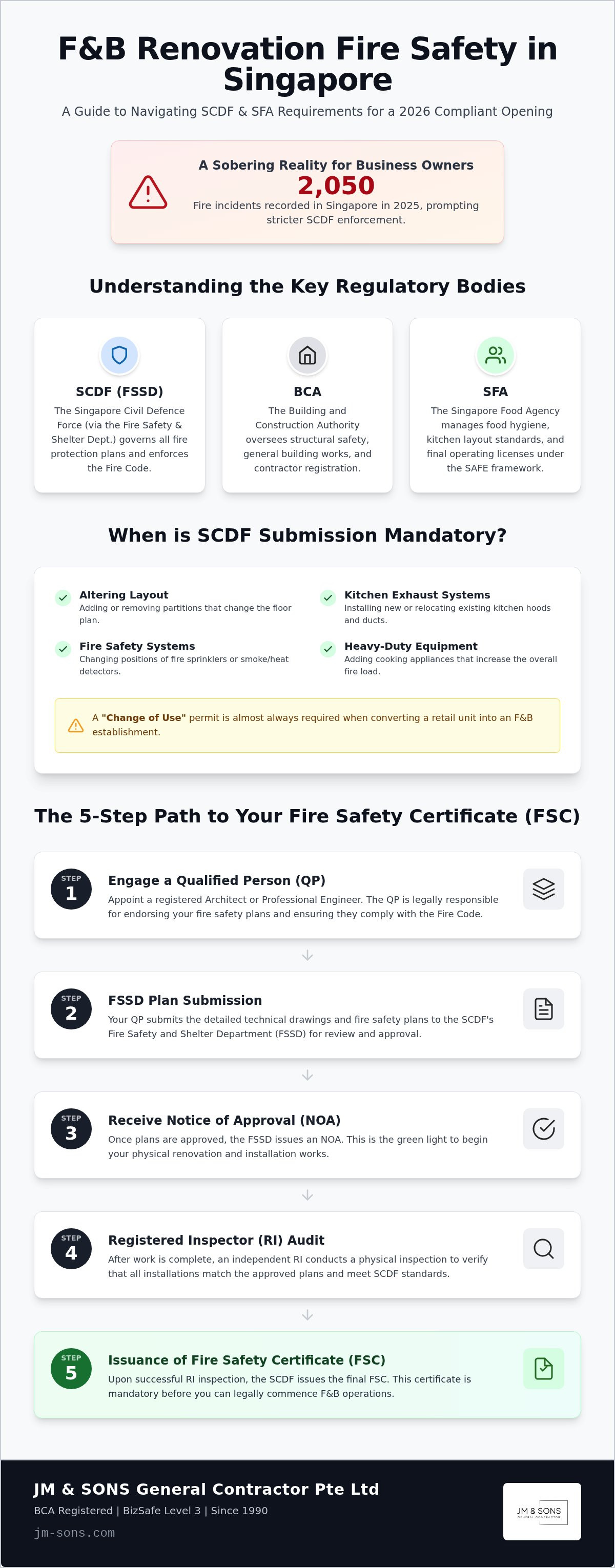
With 2,050 fire incidents recorded in Singapore in 2025, the SCDF has tightened its focus on kitchen exhaust ducts and fire suppression standards. It's a sobering reality for any business owner. Understanding the f&b renovation fire safety requirements Singapore is no longer just about passing an inspection; it's about protecting your investment and your team. We know the stress that comes with balancing SFA licensing and SCDF approvals. You've likely felt the pressure of potential delays or the worry that a hidden compliance cost might drain your renovation budget before the first plate is even served.
We believe in a straightforward approach to safety. This guide provides a clear roadmap to help you navigate SCDF submissions, the critical roles of Qualified Persons (QPs), and the 2026 standards for fire protection systems. You'll learn exactly what's needed to secure your Fire Safety Certificate (FSC) on time. By focusing on practical steps and transparent coordination, we'll help you move from renovation to grand opening with complete peace of mind.
Table of Contents
Navigating Singapore’s F&B Fire Safety Regulations in 2026
In the F&B industry, fire safety isn't a suggestion; it's a strict set of mandatory standards governed by the Singapore Civil Defence Force (SCDF). These regulations exist because commercial kitchens are inherently high-risk environments. You're dealing with open flames, high-pressure gas lines, and significant electrical loads required for modern cooking equipment. The grease buildup in exhaust ducts adds another layer of volatility. The Fire Safety Act provides the legal framework for these rules, and in 2026, enforcement is more rigorous than ever. We've seen how cutting corners on f&b renovation fire safety requirements Singapore leads to more than just fines. It creates genuine danger and significant legal liabilities for business owners. We prioritize transparency and accountability because a safe kitchen is the only foundation for a successful restaurant.
When Is an SCDF Submission Mandatory?
It's a common question for new tenants: does every minor change need a permit? Generally, "minor" works like painting or replacing floor tiles don't require SCDF intervention. However, most F&B renovations fall into the "major" category. You'll need a formal submission if your project involves:
Altering the floor layout or adding partitions.
Installing or relocating kitchen exhaust systems.
Changing the fire sprinkler or smoke detector positions.
Adding heavy-duty cooking equipment that increases the fire load.
If you're taking over a space previously used for retail, a "Change of Use" permit is mandatory. Retail units aren't designed for the heat and grease of a kitchen, so the SCDF requires a full review to ensure the space can safely support F&B operations. Getting this right early prevents the heartbreak of a rejected application just weeks before your planned launch. Our team at JM & Sons often handles these F&B renovation and reinstatement submissions to ensure the technical details align with authority expectations from day one.
Key Regulatory Bodies: SCDF, BCA, and SFA
Your renovation journey involves three primary authorities. The Fire Safety and Shelter Department (FSSD) focuses on your fire protection plans. The Building and Construction Authority (BCA) oversees structural safety and general building works. Finally, the Singapore Food Agency (SFA) manages food hygiene and licensing. Since the introduction of the SFA (SAFE) framework in January 2026, these departments are more integrated. Your kitchen layout must satisfy SFA hygiene rules while simultaneously meeting SCDF fire codes. For example, a partition placed to satisfy food prep separation might accidentally block a fire exit path. As a BCA-registered contractor, we coordinate these overlapping requirements to ensure your space is compliant across the board.
The SCDF Submission Process: FSSD, QP, and RI Coordination
Securing a Fire Safety Certificate (FSC) is a methodical process that requires tight coordination between the business owner, the contractor, and authority-appointed consultants. Since 1990, we've managed these workflows through our F&B renovation and reinstatement services to ensure that f&b renovation fire safety requirements Singapore are met without delaying the kitchen's first service. The process follows a five-step path: initial design planning, plan submission to the Fire Safety and Shelter Department (FSSD), receiving a Notice of Approval (NOA), physical installation and inspection, and finally, the issuance of the certificate. Engaging a Qualified Person (QP) early is the most effective way to avoid structural surprises that could force a redesign mid-construction.
The Role of the Qualified Person (QP)
In Singapore, only a registered Architect or Professional Engineer can serve as a QP. They hold the legal responsibility for endorsing your fire safety plans and ensuring they comply with the Fire Code. While the QP handles the formal submission, we provide the detailed technical drawings and site measurements they need to work accurately. This partnership is vital. If you're unsure how to begin this process, you can speak with our team about coordinating with a QP for your specific site layout.
Registered Inspector (RI) Verification
Once the renovation is complete, a Registered Inspector (RI) acts as an independent auditor. They don't just look at the plans; they test the physical systems to ensure they meet all f&b renovation fire safety requirements Singapore. During a site inspection, the RI verifies that sprinklers, smoke detectors, and emergency exits function exactly as designed. They must issue Form 1 (for architectural works) and Form 2 (for mechanical and electrical works). These documents are mandatory for your final application. We facilitate these inspections by ensuring all systems are pre-tested and ready for the RI's review, minimizing the chance of a failed audit.
Understanding TFP vs. FSC
A Temporary Fire Permit (TFP) is often issued first. It allows you to open for business while minor administrative details are finalized. It's a bridge to your grand opening, but it's not permanent. The Fire Safety Certificate (FSC) is the final, definitive approval. Operating without a valid FSC or an active TFP is a serious offence under the Fire Safety Act. It can lead to heavy fines or forced closure. We guide our clients through both stages to ensure continuous legal compliance from the day the doors open.
Essential Fire Protection Systems for Commercial Kitchens
The kitchen is the operational heart of your establishment, but it's also where the highest fire risks reside. Meeting the f&b renovation fire safety requirements Singapore involves more than just installing equipment; it requires an integrated approach to fire suppression and containment. In 2026, SCDF inspections have placed a heavier emphasis on the integrity of kitchen exhaust systems and automatic shut-off mechanisms. We've seen how recent incidents in March 2026 involving exhaust ducts have led to stricter enforcement. We approach these technical requirements with a "safety-first" mindset, ensuring every component is certified and installed to withstand the rigours of a busy commercial environment.
Kitchen Exhaust System (KSS) Compliance
The Kitchen Exhaust System (KSS) is often the most scrutinized element during an inspection. SCDF mandates that ductwork must have specific thickness and fire-rated insulation to prevent a grease fire from spreading to other parts of the building. One of the most frequent reasons for a Registered Inspector (RI) to reject a handover is the lack of proper maintenance access panels. These panels must be placed at every turn and at specific intervals to allow for thorough grease cleaning. We coordinate the ducting layout with our carpentry and fit-out teams early in the process. This ensures that your exhaust remains compliant without compromising the aesthetics of your dining area or kitchen workflow.
Suppression, Detectors, and Extinguishers
Automatic fire suppression systems, such as Ansul, are mandatory for cooking ranges where open flames or deep frying occur. These systems act as a first line of defence, discharging wet chemicals the moment a fire is detected. In the high-heat environment of a kitchen, we use heat detectors rather than standard smoke detectors to avoid false alarms from steam. For manual fire fighting, you're required to have Class F portable fire extinguishers. These are specifically formulated to handle fires involving cooking oils and fats, which standard extinguishers can't safely suppress. We ensure these are placed in accessible, visible locations as per the Fire Code.
Sprinklers, Signage, and Gas Safety
Relocating sprinkler heads is a common necessity when you change your floor layout. SCDF rules are strict about sprinkler coverage; no area can be shielded by new partitions or bulkheads. Similarly, all 'Exit' and 'Directional' signage must be clearly visible and equipped with backup battery power to function during a blackout. For gas-fueled kitchens, we install automatic gas shut-off valves linked directly to the fire alarm system. If the alarm triggers, the gas supply is cut instantly to prevent the fire from growing. You can learn more about our technical approach to these installations through our F&B Renovation Singapore services.
Location-Specific Challenges: Malls vs. Conservation Shophouses
The location of your establishment fundamentally changes how we approach f&b renovation fire safety requirements Singapore. A unit in a modern shopping mall operates as part of a massive, interconnected network. Conversely, a conservation shophouse is a standalone puzzle of timber and masonry. We've spent over 35 years navigating the specific demands of mall management (MCST) and heritage boards. Each setting requires a different project management strategy to ensure compliance without blowing the budget or the timeline. We focus on getting the technical details right the first time, whether you're under the oversight of a landlord or a government heritage body.
Renovating in a Shopping Mall
Malls operate on a centralized fire alarm and sprinkler network. You can't simply install your own system in isolation. Your fit-out must "tap on" to the building's existing infrastructure. This usually involves paying "tapping-on" fees to the mall's appointed fire contractor and coordinating with the mall's M&E team to link your smoke detectors and sprinklers. Most malls mandate that all noisy or high-risk works happen after hours. We manage these after-hours schedules and coordinate with mall-appointed contractors to ensure your unit doesn't compromise the building's overall fire compartmentation. It's about being a responsible tenant and a precise contractor. We ensure all Permit-to-Work (PTW) documents are filed correctly to avoid work stoppages.
Heritage Shophouse Fire Safety
Conservation shophouses present a unique challenge because they weren't built for modern fire codes. SCDF has specific rules for these heritage structures, especially those with timber floors and staircases. Balancing URA conservation guidelines with safety is a delicate task. Key considerations for these sites include:
Party walls must meet specific Fire Resistance Ratings to prevent fire spread to neighbors.
Existing timber floors often require fire-rated boards or intumescent paint to meet 2026 standards.
Narrow layouts may necessitate smoke lobbies or specific fire-rated doors to protect escape routes.
We understand the structural integrity of these buildings. Our in-house construction team works closely with QPs to find solutions that respect the heritage while meeting every f&b renovation fire safety requirements Singapore. For example, we might need to upgrade a timber staircase to a half-hour or one-hour fire rating depending on the building's height. If you're looking at a heritage site, contact us to discuss your shophouse floor plan and we'll help you identify potential compliance hurdles before you sign the lease.
Ensuring Compliance with JM & SONS General Contractor Pte Ltd: A 35-Year Legacy
In a high-closure industry like F&B, longevity is the ultimate proof of reliability. Since 1990, we've seen many businesses struggle because they underestimated the complexity of f&b renovation fire safety requirements Singapore. We believe that a "straight-shooter" approach is the only way to handle these technical hurdles. This means providing detailed, transparent quotations that include the real costs of fire suppression systems and authority submissions from the start. We don't believe in hiding compliance costs to win a tender only to surprise you with variations later. As a second-generation family business, JM & SONS General Contractor Pte Ltd brings a level of accountability to every project that ensures your restaurant opens safely. Furthermore, just as you protect your physical premises, safeguarding your brand's identity through Henry Goh & Co is another essential step in securing your long-term investment and ensuring your business stays open.
Quality control is easier to maintain when you own the process. Our 10,000 sq ft local carpentry facility allows JM & SONS General Contractor Pte Ltd to manage the production of fire-rated joinery and custom fixtures with precision. We don't outsource these critical components to unknown third parties. This in-house capability ensures that every partition or counter we install meets the specific fire resistance ratings required by your QP. Our BizSafe Level 3 certification reflects our commitment to on-site safety and rigorous hazard management. You can learn more about our history and our team's dedication to craftsmanship on our About JM & SONS General Contractor Pte Ltd page. We take pride in the fact that our manual effort and personal relationships have driven our growth for over three decades.
Managing the Handover and Beyond
The final weeks of a renovation are often the most stressful. We take the lead during this phase, assisting with the final FSC documentation and ensuring your kitchen is ready for the SFA licensing inspection. Our role doesn't end when the last screw is tightened. JM & SONS General Contractor Pte Ltd provides post-renovation support, offering advice on how to maintain your fire protection systems to ensure they pass annual SCDF checks. We want to be a partner in your long-term success, not just a contractor for a one-off job. If you're currently planning a new space or taking over a tenancy, we invite you to share your floor plans or site photos with us. We can provide a preliminary review of the f&b renovation fire safety requirements Singapore specific to your unit, helping you identify potential challenges before they become costly delays.
Our commitment to clear communication and technical competence means you'll always know exactly where your project stands. We handle the complex project coordination with QPs and RIs so you can focus on your menu and your team. By prioritizing transparency and moral responsibility, we provide the peace of mind that comes from knowing your establishment is built to the highest safety standards.
Securing Your F&B Future Through Safety
Opening a restaurant is a significant investment. Navigating the f&b renovation fire safety requirements Singapore shouldn't be the hurdle that delays your success. It's a project management discipline that demands early coordination with Qualified Persons and a deep understanding of current SCDF standards. Whether you're tapping into a mall's centralized network or upgrading a heritage shophouse, the goal remains the same: a safe space that opens on time and stays compliant.
At JM & SONS General Contractor Pte Ltd, we've been a reliable partner for Singapore establishments since 1990. As a BCA-registered and BizSafe Level 3 certified contractor, we bring accountability to every fit-out. Our 10,000 sq ft local carpentry facility allows us to control the quality of every fire-rated component in-house. We don't just build kitchens; we coordinate the complex authority submissions that keep your business legal. We focus on the technical details so you can focus on your passion for food.
If you're ready to move forward with transparency and peace of mind, we're here to help. Contact JM & SONS General Contractor Pte Ltd to discuss your F&B floor plans and fire safety requirements today. Let's ensure your grand opening is backed by 35 years of technical expertise.
Frequently Asked Questions
Do I need a Fire Safety Certificate (FSC) for a small cafe renovation?
Yes, an FSC is mandatory if your cafe renovation involves altering the floor layout, fire sprinklers, or kitchen exhaust. Even small establishments must meet the f&b renovation fire safety requirements Singapore to ensure patron safety. You don't want to risk legal penalties or insurance issues by skipping this step. It's best to verify your specific floor plan with a Qualified Person (QP) before you begin any demolition or construction work on site.
How long does the SCDF submission and approval process typically take?
Plan approval from the FSSD typically takes about two to four weeks after submission by your QP. However, the entire journey from design to receiving your final Fire Safety Certificate (FSC) can take several months. This timeline includes the actual construction phase and the final inspection by a Registered Inspector. We recommend starting the coordination process at least three months before your target opening date to account for any technical revisions required by the authorities.
Can I start my F&B renovation before receiving SCDF approval?
You shouldn't start any physical renovation works that affect fire safety until you've received the Notice of Approval (NOA) from the SCDF. Commencing work prematurely is a violation of the Fire Safety Act and can lead to heavy fines or a forced stop-work order. It also risks costly rectifications if your completed works don't align with the eventually approved plans. Always wait for the official green light to protect your investment and timeline.
What is the difference between a QP and an RI in Singapore?
A Qualified Person (QP) is an architect or engineer who designs your fire safety systems and handles the formal FSSD submission. A Registered Inspector (RI) is an independent professional who audits the completed work to ensure it matches the approved plans. Think of the QP as the designer and the RI as the final examiner. Both roles are essential for you to successfully meet the f&b renovation fire safety requirements Singapore and secure your certificate.
Are fire-rated curtains an acceptable alternative to fire doors in a restaurant?
Fire-rated curtains can be used in specific scenarios, but they aren't a universal replacement for fire doors. Their use depends on the fire compartmentation strategy of your unit and must be endorsed by your QP. These curtains must be SCDF-listed and integrated into your fire alarm system so they deploy automatically during an emergency. You should always check the specific fire code requirements for your building type before choosing curtains over traditional fire-rated doors.
How often must my kitchen fire suppression system be serviced?
Most kitchen fire suppression systems, like Ansul, require professional servicing every six months. This semi-annual maintenance ensures that the wet chemical cylinders are pressurized and the discharge nozzles remain clear of grease buildup. Regular servicing is a standard requirement for maintaining your fire insurance coverage and ensuring the system functions during a flash fire. We advise keeping a clear log of all maintenance activities to present during any unannounced SCDF enforcement checks.
What happens if my restaurant fails the RI inspection?
If your unit fails the RI inspection, the inspector will provide a list of non-compliance issues that need rectification. You'll need to fix these faults, which might involve relocating sprinkler heads or adjusting exhaust duct insulation, before booking a re-inspection. This process can delay your grand opening by several weeks. It's why we emphasize pre-testing all systems and conducting internal audits before the RI arrives on site to ensure a smooth handover.
Does every F&B unit in a mall require its own FSC?
Yes, every individual unit that undergoes a major renovation or a change of use within a mall requires its own Fire Safety Certificate. While the mall has its own building-wide fire certificate, your specific unit's internal layout and protection systems must be independently verified. This ensures that your fit-out hasn't compromised the mall's overall safety network. We coordinate closely with mall management to ensure your unit's FSC application aligns with the building's master fire plan.


Comments