
F&B Reinstatement Cost Singapore: 2026 Buying & Budgeting Guide
- JM & SONS
- Jul 24
- 12 min read

Updated: Aug 3
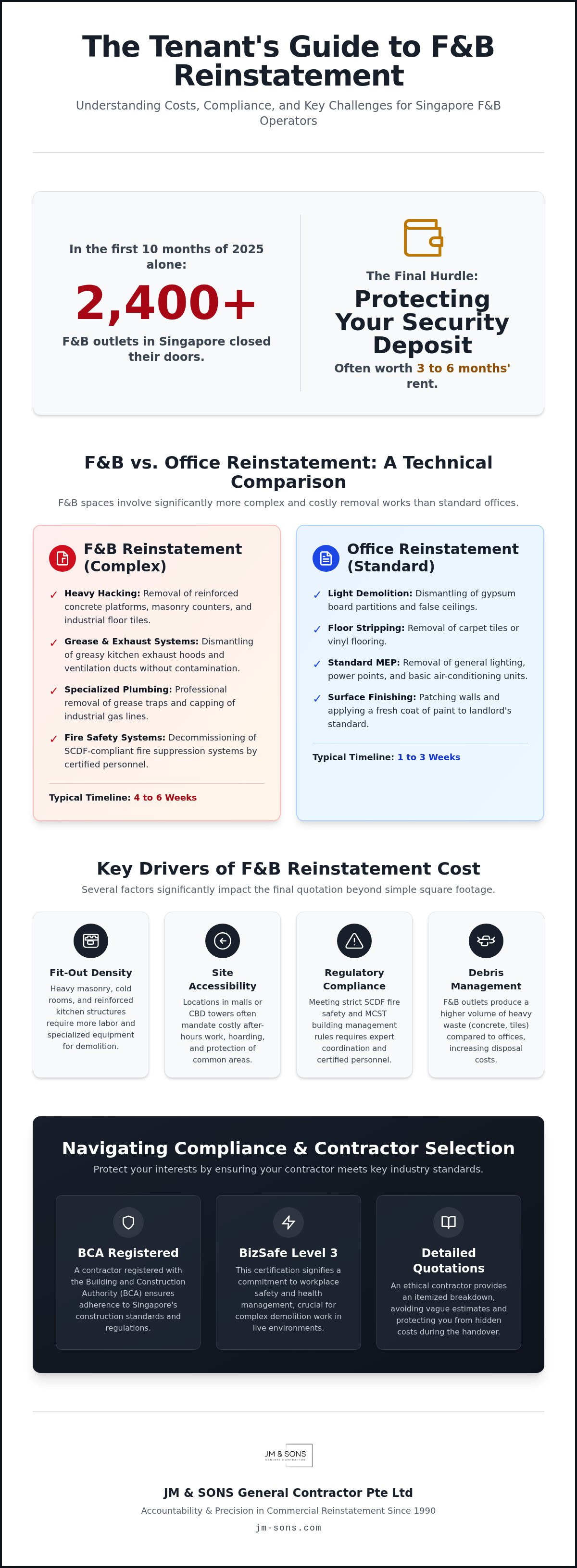
Over 2,400 F&B outlets in Singapore closed their doors in the first ten months of 2025. For many of these business owners, the final challenge wasn't the last service, but the high-stakes process of returning the unit to the landlord. Estimating the F&B reinstatement cost Singapore operators face in 2026 is about more than just hiring a hacking crew. It's a technical exercise in protecting a security deposit that often represents three to six months of hard-earned revenue.
You likely feel the weight of strict MCST requirements or the uncertainty of removing specialized grease traps and kitchen exhaust systems. It's a common fear that a small oversight in floor hacking or SCDF compliance could lead to a rejected handover. JM & SONS General Contractor Pte Ltd has put this guide together to provide a transparent, itemized breakdown of budgeting and regulatory needs. You'll learn how to manage authority clearances and select a contractor who values accountability, ensuring you walk away with your deposit intact and your professional record clear.
Table of Contents
What is F&B Reinstatement and Why is it Unique?
In the Singapore commercial landscape, F&B reinstatement is the process of restoring a restaurant or cafe unit to its "bare shell" state. This isn't a simple cleaning job. It's a technical reversal of a heavy-duty industrial environment back to the condition specified in your original tenancy agreement. Most foundational lease obligations require you to hand back the keys with all your custom modifications removed, leaving only the structural walls, floors, and basic utility points.
Managing the F&B reinstatement cost Singapore operators face is a matter of balancing speed with precision. Food establishments are built with high-impact materials designed to withstand heat, moisture, and heavy traffic. When it's time to vacate, removing these specialized installations requires more than just manual labor. It demands a deep understanding of building management (MCST) rules and SCDF fire safety standards to ensure the unit is safe for the next occupant.
F&B vs. Office Reinstatement: Key Technical Differences
Office units often involve removing carpet tiles and gypsum partitions. These are relatively straightforward tasks. In contrast, F&B units feature heavy-duty kitchen floor tiles that are often bonded to the subfloor with industrial-grade adhesives. Hacking these out without damaging the structural slab requires precision and specialized equipment. The F&B reinstatement cost Singapore tenants pay reflects this added complexity in labor and disposal.
Gas and Fire Suppression: Professional capping of gas lines and the removal of fire suppression systems must be done by certified personnel to avoid safety hazards.
Exhaust and Grease Traps: Kitchen exhaust ducts are often coated in grease. Removing these systems without contaminating the building's central ventilation is a major technical hurdle.
Masonry and Platforms: Many kitchens feature raised concrete platforms or built-in masonry counters that require significant hacking and debris disposal.
The Legal Obligation to Restore "Original Condition"
Your original handover floor plan is the most critical document in this process. Landlords expect the unit to match this blueprint exactly. While "fair wear and tear" is a common term in residential leases, commercial landlords in Singapore are often stricter. Grease stains on walls or damaged utility trunking are frequently rejected during the final joint inspection.
A typical F&B unit requires 4 to 6 weeks for a full restoration. This timeline accounts for the complexity of MEP (Mechanical, Electrical, and Plumbing) work and the necessary permits from the MCST. Planning early is vital. If you fail to meet the deadline, you risk losing a security deposit that often totals three to six months of rent. At JM & SONS, we've managed these complexities since 1990, focusing on clear communication and detailed quotations to protect your financial interests.
Key Cost Drivers for F&B Reinstatement in Singapore
Understanding the F&B reinstatement cost Singapore tenants encounter starts with the density of the fit-out. Unlike a typical retail shop, a restaurant is often built with reinforced masonry. Cold rooms, heavy-duty kitchen platforms, and masonry counters aren't just bolted down; they're integrated into the unit's structure. Removing these requires significant labor and specialized power tools, which naturally drives up the baseline budget compared to simple partition removal.
Site accessibility plays a massive role in the final bill. If your outlet is located within a major shopping mall or a CBD office tower, the MCST will likely mandate night-hacking to minimize noise disruption for other tenants. This shift to after-hours work involves higher labor rates and stricter logistics. You also have to account for the protection of common areas. Contractors must lay down protective walkways and temporary hoarding to comply with BCA's building codes and mall management standards, ensuring no damage occurs to the landlord's property during the move-out.
Debris management is another factor often underestimated. A 1,000 sq ft restaurant produces a far higher volume of heavy waste, such as concrete chunks and thick ceramic tiles, compared to the lightweight aluminum and gypsum found in offices. The cost of disposal and the logistics of moving this weight out of the building are significant. It requires multiple trips with specialized waste disposal trucks, which adds to the overall F&B reinstatement cost Singapore operators must factor into their exit strategy.
Heavy Hacking: Tiles, Masonry, and Kitchen Platforms
Kitchens often feature raised platforms to accommodate drainage and heavy stoves. These are frequently made of reinforced concrete. Hacking these platforms and then performing floor leveling to return the slab to its original state is a precision task. If you've layered new tiles over old ones during your initial fit-out, the hacking time and volume of debris effectively double. Dismantling custom carpentry and heavy-duty glass storefronts also requires a methodical approach to avoid safety hazards on-site.
MEP and Fire Safety Restoration
Restoring the fire protection system is non-negotiable. You must reinstall standard sprinklers and smoke detectors to match the original SCDF-approved plan. This involves technical coordination to ensure the landlord's DB board is terminated correctly and all plumbing floor traps are restored to their original positions. If you're unsure about your unit's specific MEP requirements, ask us for a preliminary checklist to help you plan your budget accurately.
Budgeting Framework: F&B Reinstatement Price Breakdown
F&B tenants often find that standard commercial pricing doesn't apply to their units. When calculating the F&B reinstatement cost Singapore operators should expect to pay, it's helpful to distinguish between a "Per Square Foot" (PSF) estimate and an "Itemized Quote." PSF rates are useful for early-stage budgeting, but they rarely capture the full scope of a kitchen restoration. An itemized quote is the only way to ensure every gas pipe capping and grease trap removal is accounted for without hidden surprises.
Most restaurant units command a 20% to 40% premium over office reinstatement projects. This isn't a random markup. It reflects the intensive labor required for hacking masonry and the specialized technical skills needed to restore complex MEP systems. The Lease Agreements for Retail Premises Act 2023 has introduced a fairer Code of Conduct for lease negotiations, yet the financial responsibility for returning a unit to its bare shell remains firmly with the tenant. To protect your capital, you need a quote that stands up to landlord scrutiny.
Beware of "low-ball" quotes that seem too good to be true. These often omit essential costs like NEA disposal fees or transportation surcharges for CBD locations. A contractor who hasn't stepped foot in your unit can't give you an honest price. A site walk-through is non-negotiable. It allows us to identify structural challenges, like double-layered floor tiles or concealed plumbing, before the work begins. This transparency is at the heart of how we've operated since 1990.
Standard Cost Ranges (Estimated for 2026)
Small cafes under 500 square feet often face higher PSF rates because of minimum mobilization fees. It takes the same effort to coordinate permits and transport a hacking crew for a small kiosk as it does for a medium-sized bistro. Conversely, large restaurant units benefit from economies of scale in debris disposal. In 2026, the general cost for commercial reinstatement in Singapore ranges from S$3 to S$24 per square foot, with F&B units consistently sitting at the higher end of this range due to their technical complexity.
Estimating Debris Removal and NEA Disposal Fees
The volume of waste from a kitchen is substantial. NEA's regulated disposal sites charge by weight, and these fees are a fixed part of your budget. If your outlet is in an Orchard Road mall or a CBD tower, expect transportation surcharges due to restricted loading bay hours and traffic congestion. We also include "handover-ready" cleaning and professional pest control in our scope. Landlords won't accept a unit that still has dust in the corners or signs of kitchen-related pests, so these final steps are vital for the return of your security deposit.
Navigating Regulatory Compliance and Building Management (MCST)
Securing a work permit from the Management Corporation Strata Title (MCST) is the first hurdle in any restoration project. Building management acts as the gatekeeper for the property's structural integrity and aesthetic standards. To even begin hacking, you must submit a formal application along with a renovation deposit. This deposit is separate from your lease security, and it's held by the MCST to cover any potential damage to common areas during the move-out. A contractor with BCA registration and BizSafe Level 3 certification is often a mandatory requirement to satisfy these building managers.
Insurance coverage is equally critical. Most Singapore malls and commercial buildings won't grant site access without valid Public Liability and Work Injury Compensation Act (WICA) insurance. These policies protect you from legal liability if an accident occurs during the removal of heavy kitchen equipment or masonry. While insurance premiums add a small amount to the F&B reinstatement cost Singapore tenants pay, they're essential for a risk-free exit. At JM & SONS, we handle these administrative filings as part of our core service, drawing on our experience since 1990 to navigate mall-specific bylaws.
The role of a BCA-registered contractor goes beyond just manual labor. It's about accountability. When you hire a certified team, you're ensuring that the work meets national safety standards. This is particularly vital for F&B units where gas lines and high-voltage electrical systems must be terminated safely. Cutting corners here doesn't just risk your deposit. It creates long-term legal liability if the unit is handed over in an unsafe condition.
SCDF Fire Safety and Sprinkler Restoration
Fire safety compliance is a major component of the F&B reinstatement cost Singapore establishments face. You must coordinate with the building's nominated fire contractor to restore the sprinkler system and smoke detectors to the landlord's original layout. This often involves re-routing pipes that were modified for your kitchen's hood system. Additionally, all fire-rated doors and emergency exit signage must be tested and confirmed to be in working order. If your fit-out involved structural hacking, a Professional Engineer (PE) endorsement may be required to certify that the building's stability remains intact.
Managing the Handover Process
The final step is the Joint Site Inspection (JSI). This is where you walk through the bare shell unit with the landlord's agent or facility manager. They'll check the unit against the original floor plan and look for "snags" such as unpatched holes in the slab or leftover wiring. We specialize in Reinstatement Works Singapore businesses rely on to minimize these snag lists. By delivering high-quality hacking from day one, we help you avoid minor delay-penalties that can eat into your refund. If you're preparing for a handover, send us your floor plan for a compliance review.
Choosing an Ethical Contractor: The JM & SONS Advantage
Trust is the most important currency when you're closing a business. At JM & SONS, we've spent decades building that trust as a second-generation family contractor. Since 1990, we've grown through manual effort and long-term relationships rather than aggressive marketing. We don't view ourselves as just a service provider. We're a partner who cares about the integrity of the process and the final handover of your unit. Our heritage in the Singapore construction landscape means we value honesty above all else.
Our credentials provide the logic behind the emotional trust our clients place in us. We are a BCA Registered Contractor with BizSafe Level 3 certification, ensuring every project meets modern safety and industry standards. Because we maintain in-house construction capabilities and operate a 10,000 sq ft carpentry facility, we don't rely on layers of subcontractors. This direct control allows us to manage the F&B reinstatement cost Singapore tenants face without adding middleman markups. It means your budget goes directly into the quality of the work.
We take a "straight-shooter" approach to every quotation. We've seen how hidden variation orders can ruin a tenant's exit budget, so we prioritize transparency from day one. When we provide a quote, it's based on a realistic assessment of your unit's needs. We don't use high-pressure sales tactics. Instead, we offer a clear, professional agreement that outlines exactly what it takes to get your security deposit back.
Our Approach to F&B Reinstatement
Project management in a high-traffic mall or a CBD tower requires precision. We handle the complex logistics for you, from applying for MCST work permits to coordinating NEA-regulated debris disposal. You won't be left wondering about the status of your unit. We provide detailed site photos and progress reports for your stakeholders, ensuring full accountability at every stage. Our team is experienced in the specific demands of mall exits, including after-hours works and strict protection of common areas.
Ready to Secure Your Handover?
The best way to start is with a conversation. We invite you to arrange a non-obligatory site walk-through of your F&B unit so we can see the technical challenges firsthand. By sharing your lease requirements and original floor plans, you allow us to build a transparent, itemized quote that leaves nothing to chance. We're here to help you navigate this transition with peace of mind and professional certainty.
Securing Your Deposit for the Next Chapter
Restoring a restaurant space is a complex final milestone that demands more than simple demolition. It requires a methodical approach to hacking reinforced masonry and a technical understanding of SCDF fire safety codes. By focusing on a transparent budgeting framework and early MCST coordination, you can avoid the common pitfalls that lead to rejected handovers. Managing the F&B reinstatement cost Singapore tenants face is ultimately about risk management and protecting your capital for your next business venture.
At JM & SONS, we've helped businesses navigate these transitions since 1990. Our team brings the reliability of a BCA Registered and bizSAFE Level 3 contractor, backed by our in-house 10,000 sq ft carpentry facility. We believe in straight-shooter communication and detailed quotations that leave no room for uncertainty. If you're ready to ensure a hassle-free exit, we're here to help.
WhatsApp JM & SONS for a Detailed F&B Reinstatement Quote to arrange a site walk-through and take the first step toward a successful handover. We look forward to supporting your business transition.
Frequently Asked Questions
How much does F&B reinstatement cost per square foot in Singapore?
Market rates in 2026 for commercial restoration typically range from S$3 to S$24 per square foot. However, F&B units consistently sit at the higher end of this bracket because of the heavy masonry and complex MEP systems involved. A small kiosk might have a higher PSF rate due to minimum mobilization fees, while a larger restaurant might see some economies of scale in debris disposal. Calculating the F&B reinstatement cost Singapore tenants face requires a detailed site walk-through to identify hidden structural challenges.
Why is restaurant reinstatement more expensive than office reinstatement?
F&B units require intensive hacking of reinforced concrete platforms, heavy-duty floor tiles, and masonry counters. You also have to manage specialized systems like grease traps, kitchen exhaust ducts, and gas lines. These technical requirements demand more labor and higher disposal volumes than the lightweight drywall and carpet tiles typically found in office units. The increased technical risk and specialized disposal needs drive the price premium for food establishments.
How long does it take to reinstate a typical F&B unit?
Most F&B units require 4 to 6 weeks for a full restoration to bare shell condition. This timeline includes applying for MCST work permits, performing heavy hacking, and coordinating fire safety inspections. If your unit is in a mall with restricted night-work hours, the duration might extend. It's best to start planning at least two months before your lease expires to avoid late-handover penalties that can eat into your security deposit.
Do I need to hire the building’s nominated fire contractor for sprinkler works?
Yes, most commercial buildings and malls in Singapore mandate the use of their nominated fire contractor for any works involving the central fire protection system. While your main contractor handles the hacking and general restoration, the nominated specialist must certify that the sprinklers and smoke detectors are restored to the building's original SCDF-approved plan. This coordination is a standard part of our project management process to ensure full compliance.
What happens if the landlord rejects the reinstatement work?
If a landlord rejects the handover during the joint site inspection, you'll be issued a snag list of items to rectify. You'll typically be charged pro-rated rent for every day the unit isn't in an acceptable state. Choosing an experienced contractor helps prevent this. They understand the bare shell standard and ensure all utility points and surfaces meet the landlord's specific requirements, protecting you from unnecessary extension costs.
Are disposal fees included in the initial reinstatement quote?
At JM & SONS General Contractor Pte Ltd, we provide straight-shooter quotes that include NEA-regulated disposal fees and transportation surcharges. Some quotes might omit these to appear cheaper, leading to unexpected variation orders later. Because F&B debris is heavy and high-volume, disposal is a significant part of the budget. We ensure these costs are transparently itemized so you have a realistic view of your total exit expenses without hidden surprises.
Is a BCA-registered contractor required for mall reinstatement?
Most mall managements and MCSTs in Singapore require a BCA-registered contractor with BizSafe Level 3 certification to perform any reinstatement works. This ensures the team follows national safety standards and has valid WICA and Public Liability insurance. Hiring a registered contractor protects you from legal liability and provides the building management with the professional assurance they need to grant work permits for complex hacking and electrical termination.
Can I sell my old kitchen equipment to offset the reinstatement cost?
You can certainly engage second-hand equipment dealers to buy your stainless steel tables, chillers, or ovens. While this doesn't directly reduce the contractor's labor for hacking and MEP restoration, the proceeds can help offset your overall business exit costs. We recommend clearing all movable equipment before the reinstatement team begins. This allows the hacking and debris removal to proceed much faster and prevents accidental damage to items you intend to sell.


Comments