
Factory Reinstatement Singapore: The 2026 Tenant’s Handover Guide
- JM & SONS
- 2 days ago
- 11 min read

Updated: 21 hours ago
Imagine it's three weeks before your industrial lease expires, and you've just discovered that the heavy mezzanine your team installed requires a Professional Engineer's endorsement before any dismantling can begin. For many tenants, factory reinstatement Singapore is the most daunting phase of a business relocation. It isn't just about clearing out space; it's a high-stakes race against a ticking clock where one missed permit or an uncoordinated disposal can lead to heavy late handover penalties and the forfeiture of your security deposit.
We understand the pressure you're under. It's difficult to coordinate heavy machinery removal with structural hacking while ensuring every fire sprinkler and smoke detector is returned to its original position according to the building management's strict guidelines. This 2026 guide provides the clarity you need to manage reinstatement costs and navigate complex industrial lease requirements. We'll walk you through the technicalities of PE certifications, fire safety compliance, and a step-by-step roadmap to ensure your factory handover is smooth, honest, and entirely stress-free.
Table of Contents
Understanding Factory Reinstatement Requirements in Singapore
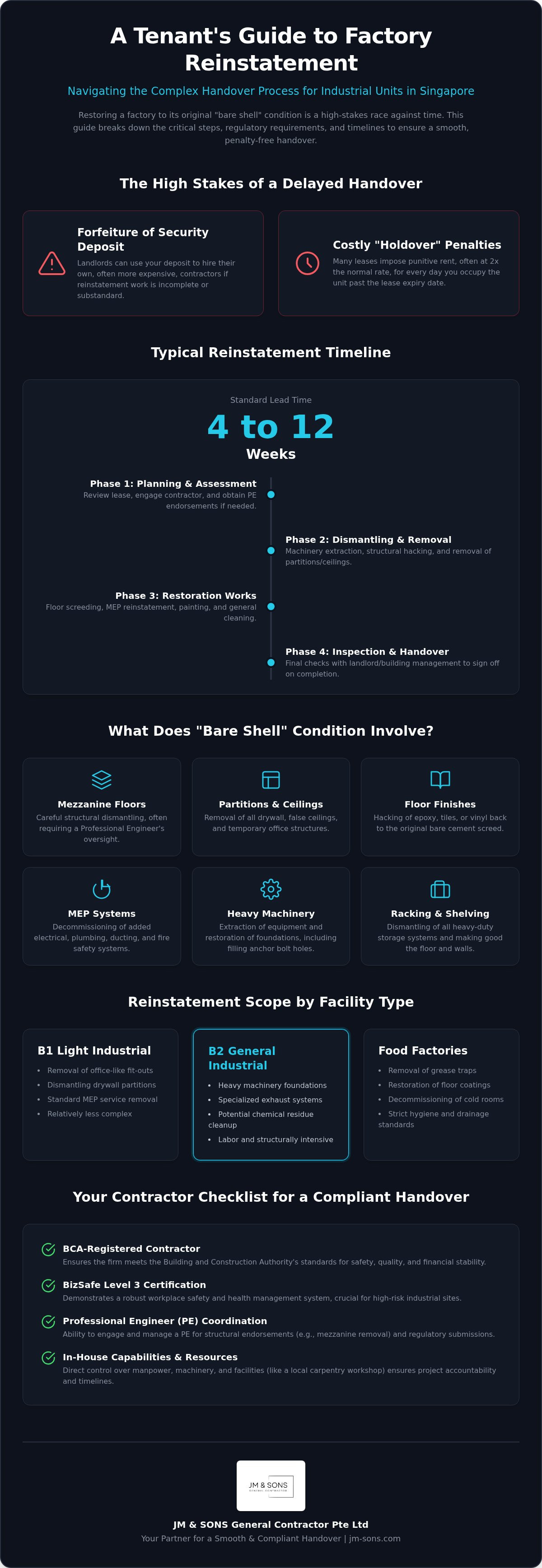
Factory reinstatement Singapore involves more than just a simple cleanup. It is the legal process of restoring an industrial unit to its "bare shell" or original handover state. For most tenants, this means dismantling every addition made during the tenancy, from mezzanine floors and heavy-duty racking to specialized electrical systems. Landlords, especially institutional ones like JTC, expect the premises to be returned in a condition that allows the next tenant to move in without dealing with your legacy structures.
Failing to meet these standards carries significant financial weight. If the handover is delayed or the work is substandard, landlords can forfeit your security deposit to cover their own contractors. Even worse, many industrial leases include "holdover" clauses. These require you to pay rent, sometimes at double the prevailing rate, for every day the unit remains un-reinstated past the lease expiry. Factory projects are also significantly more complex than office or retail handovers. While an office might just require pulling up carpet, a factory often involves structural hacking and hazardous waste disposal.
The Legal Basis: Your Tenancy Agreement
Your tenancy agreement is the final word on what needs to stay or go. Most Singapore industrial leases contain "original condition" or "reinstatement" clauses that are legally binding. We always advise our clients to refer back to the original handover photo report taken at the start of the lease. This documentation is your best defense against unfair claims. If you're unsure about a specific modification, verify the requirements with JTC or your building management early. Getting a clear "yes" or "no" on what to remove prevents wasted effort and unnecessary hacking.
B1 vs B2 Industrial Facilities: Differing Scopes
The complexity of the work depends heavily on your facility type. Light industrial (B1) units usually focus on removing office-like fit-outs such as drywall partitions, false ceilings, and standard mechanical, electrical, and plumbing (MEP) services. General industrial (B2) units are far more labor-intensive. These projects often involve removing heavy machinery foundations, specialized exhaust systems, or cleaning up chemical residues. Food factories present their own set of challenges. For these sites, factory reinstatement Singapore requires the removal of grease traps and the restoration of specialized floor coatings back to standard cement screed. Understanding these differences helps you set a realistic timeline for your handover.
Key Components of an Industrial Reinstatement Scope
Defining the scope of factory reinstatement Singapore requires a clear-eyed look at every modification made over the years. Many tenants realize too late that the "original condition" described in common commercial lease terms implies a total strip-down. This includes the removal of temporary drywall partitions, false ceilings, and mezzanine levels. These vertical additions are common in industrial units to increase storage, but their removal requires careful structural dismantling to avoid damaging the building's primary frame.
Floor restoration is equally intensive. If you've applied epoxy coatings, laid tiles, or installed raised flooring for server rooms, these must be hacked back to the bare cement screed. This isn't just a surface job; it's a labor-intensive process that creates massive amounts of dust and debris. As a contractor with roots dating back to 1990, we've seen how poorly managed hacking leads to disputes with building management. We manage this by ensuring all debris is legally hauled and disposed of at NEA-approved sites, providing you with the peace of mind that all waste is handled responsibly.
Production lines and heavy-duty racking systems must also be cleared. Beyond just moving the equipment, you must address the anchor bolt holes left in the concrete. These must be filled and smoothed over to match the original floor. Any specialized production infrastructure, such as pneumatic lines or customized ventilation, must be decommissioned and removed entirely to return the space to its bare shell state. Don't leave these details to the last minute, as they often take longer than expected.
Machinery and Equipment Extraction
Removing oversized production machinery requires specialized lifting equipment and careful coordination. It's not just about moving the asset; it's about restoring the footprint it left behind. We often identify scrap metal buyback opportunities for our clients to help offset some disposal costs. Once the equipment is out, any customized foundations or pits must be leveled and restored to the landlord's specifications. If you have questions about specific machinery footprints, you can share your site photos with us for a quick assessment.
MEP and Fire Safety Restoration
Restoring mechanical, electrical, and plumbing (MEP) systems is a technical task that requires precision. All temporary wiring must be terminated safely, and the original lighting layout must be reinstated. Fire safety compliance is the most critical handover hurdle. Any sprinklers or smoke detectors that were relocated to accommodate your mezzanine or partitions must be moved back to their original positions. This ensures the building's fire protection system remains intact and ready for the next occupant.
Managing Costs and Timelines for Factory Handover
Managing the budget for an industrial handover requires a straight-shooter approach. Many tenants are surprised by how quickly costs escalate when technical details are overlooked during the initial walkthrough. Pricing for factory reinstatement Singapore isn't just about floor area. It's heavily influenced by ceiling height, which dictates the need for specialized access equipment like boom lifts, and the sheer volume of debris generated by hacking thick industrial screed.
After-hours works are another significant factor. In many industrial parks, building management restricts heavy demolition to nights or weekends to avoid disrupting neighboring operations. This inevitably increases labor rates. We believe in providing detailed, transparent quotations from the start. This clarity prevents the "variation order" surprises that often plague construction projects. Because we utilize our own in-house construction teams and operate a 10,000 sq ft carpentry facility, we maintain better control over these variables than contractors who outsource every task. You can learn more about our second-generation family heritage and how we prioritize accountability in every quote.
Budgeting for Disposal and Haulage
Disposal is one of the most underestimated costs in industrial projects. Haulage fees in Singapore industrial parks are calculated based on the number of trips and the weight of the debris. For factories with heavy racking or production lines, the volume of waste is substantial. We help our clients manage these costs by identifying scrap metal buyback opportunities. Steel from mezzanines or racking can often be sold to recyclers, which helps offset a portion of the demolition expenses. A transparent site survey is the only way to get an accurate haulage estimate without hidden fees appearing later.
Timeline Planning: The 3-Month Rule
While the physical work for factory reinstatement Singapore typically takes between 4 to 12 weeks, your planning should start much earlier. We recommend engaging a contractor at least three months before your lease expires. This lead time is necessary to coordinate with utility providers for power termination and to manage the moving of your own equipment. For companies shifting operations to Malaysia or Thailand, it is also a good time to explore Cross-border trucking and logistics services to ensure a seamless transition of your machinery. Building in this buffer ensures you have enough time for the final joint inspection with the landlord. If the landlord identifies minor touch-ups during that walk-through, you'll have the remaining days to fix them without triggering late handover penalties or double rent.
Compliance isn't just a matter of paperwork; it's a fundamental safety requirement that protects your business and the building's future tenants. When managing factory reinstatement Singapore, you must understand that industrial units are subject to stricter oversight than standard retail spaces. The Building and Construction Authority (BCA) and the Singapore Civil Defence Force (SCDF) have specific rules for how industrial premises are modified and restored. If you've made structural additions like mezzanine floors or heavy-duty racking, you can't simply start hacking without the right approvals.
Unauthorized demolition is a serious issue. It can lead to structural damage or compromise the building's fire safety integrity. We always advise our clients to verify their specific requirements with building management early in the process. This transparency helps avoid the panic of a failed final inspection. As a second-generation family contractor, we prioritize clear communication and accountability, ensuring every step of the demolition is documented and compliant with local standards.
The Role of the Professional Engineer
A Professional Engineer (PE) endorsement is mandatory whenever your reinstatement involves the demolition of heavy structures or mezzanine levels. The PE's job is to certify that the removal process won't compromise the building's structural stability. They provide the necessary calculations and supervision to ensure the work is done safely. If your unit has high ceilings or complex mezzanines, don't assume a standard contractor can handle the permits alone. You need a partner who understands how to coordinate with a PE to get the right endorsements before the first hammer swings. Every building has unique load-bearing requirements, so it's vital to check your specific lease terms regarding structural works.
SCDF and Fire Safety Coordination
Restoring fire safety systems is often the most technical part of a factory handover. Any fire-rated partitions or doors you've installed must be restored to their original specifications. This ensures the unit's fire protection remains intact. It's also essential to coordinate the relocation of sprinklers and smoke detectors back to the building's original fire safety plan. This process is very similar to the F&B renovation fire safety requirements Singapore, where SCDF submissions are a non-negotiable part of the compliance checklist. Failing to coordinate these fire safety submissions can result in the landlord refusing the handover, even if the rest of the unit looks perfect. If you're confused about your fire safety certificates or temporary fire permits, you can message us to discuss your SCDF requirements.
Choosing a Reliable Factory Reinstatement Contractor
Selecting a partner for factory reinstatement Singapore is a decision that impacts your final settlement and your peace of mind. You aren't just hiring people to swing hammers. You're looking for a team that understands the weight of a JTC or private landlord's final inspection. A reliable contractor acts as your advocate, ensuring every hacked floor and removed mezzanine meets the strict standards of the building management. This isn't the time for shortcuts, as a single failed inspection can lead to costly delays and double rent penalties.
We've spent decades navigating these high-stakes handovers. Our roots as a second-generation family contractor date back to 1990, and we've built our reputation on manual effort and personal relationships. We don't believe in aggressive marketing; we believe in doing the work right the first time. This grounded approach ensures that when we commit to a timeline, we have the resources and the conscience to see it through to the final handover signature.
Credentials to Look For
Industrial sites are high-risk environments with zero room for error. This is why BCA registration and BizSafe Level 3 certification are non-negotiable requirements. These credentials prove that a contractor follows regulated safety protocols and possesses the technical competence to handle structural works. Our 10,000 sq ft local carpentry facility also plays a vital role. While many think of carpentry as only for new fit-outs, it's essential for custom restoration works, such as repairing original timber structures or fabricating matching panels for a "bare shell" handover. High-quality craftsmanship in these areas is vital, similar to the precision Smick Fencing applies to specialized timber and metal installations. Check for specific workhead categories to ensure your contractor is legally permitted to perform the structural hacking your site requires.
We approach every project with a "straight-shooter" philosophy. This means providing detailed quotations with no hidden fees or vague line items. We handle complex project coordination and after-hours works seamlessly because we maintain in-house construction capabilities. Our expertise isn't limited to industrial sites; we bring the same level of precision and accountability to Office Interior Fitting Out Singapore. This broad commercial experience allows us to manage hybrid spaces that combine production floors with high-end office suites. If you're preparing for a move, we're here to help you navigate the process without the pressure. You can message us directly to share your floor plans or reinstatement checklist for a professional site survey.
Securing a Seamless Industrial Handover
Reinstating a factory is a complex project that requires more than just demolition. It's about meeting strict JTC or private landlord standards while ensuring SCDF and BCA compliance. By starting your planning at least three months early and documenting every structural modification, you protect your security deposit and avoid the risk of holdover rent penalties.
Success in factory reinstatement Singapore depends on choosing a partner who values accountability. As a second-generation family contractor since 1990, we bring a straight-shooter attitude to every project. Our BCA registration, BizSafe Level 3 certification, and 10,000 sq ft local carpentry facility ensure that even the most technical industrial scopes are handled with precision.
We're here to help you navigate this transition with honesty and clarity. Contact JM & SONS for a detailed factory reinstatement site survey to discuss your floor plans and handover requirements. Let's ensure your factory is returned in perfect condition.
Frequently Asked Questions
How long does a typical factory reinstatement take in Singapore?
A typical project takes between 4 to 12 weeks to complete. This timeline depends on the scale of your industrial unit and the complexity of the machinery involved. You must also factor in time for authority submissions and the final joint inspection with your landlord. Starting the process at least three months before your lease expires is the safest way to avoid the stress of a rushed handover.
Do I need a PE endorsement for removing a mezzanine floor?
Yes, you generally need a Professional Engineer (PE) to endorse the removal of structural additions like mezzanine floors. The PE ensures the building's structural integrity isn't compromised during the dismantling process. Building management usually requires these certifications before they allow heavy demolition to proceed. It's best to verify the specific requirements with your building's management or a Qualified Person early in the planning phase.
What happens if I cannot finish reinstatement before my lease ends?
Missing your deadline can lead to significant financial penalties. Most industrial leases in Singapore include holdover clauses that require you to pay rent at a higher rate, sometimes double, for every extra day you occupy the space. Your landlord might also forfeit your security deposit to engage their own contractors for the factory reinstatement Singapore. Clear communication with your landlord is essential if you anticipate any delays.
Can I offset my reinstatement costs with scrap metal buyback?
It's possible to offset some of your demolition expenses through scrap metal buyback. Materials like steel from mezzanines, heavy racking, or old production lines have value in the recycling market. We often coordinate with scrap dealers to help our clients recover some costs. While it won't cover the entire project, it's a practical way to manage your overall budget while ensuring responsible waste disposal and environmental accountability.
Is it possible to leave some renovations behind for the next tenant?
You can only leave renovations behind if you have written approval from your landlord or the incoming tenant. Most industrial leases require a return to "bare shell" condition by default. If the next tenant wants your partitions or racking, you must formalize an indemnity agreement. Without this, the landlord will likely insist that everything you installed be removed to meet the original handover specifications and avoid future liability issues.
Why is BizSafe Level 3 important for a reinstatement contractor?
BizSafe Level 3 is critical because it demonstrates that a contractor has a robust Risk Management plan in place. Industrial sites involve high-risk activities like heavy lifting and structural hacking. Many building managers and JTC-managed properties won't allow a contractor on-site without this certification. It protects you from liability and ensures that the work is performed under strict safety standards to prevent accidents and ensure insurance coverage remains valid.
What are the most common reasons for failing a JTC handover inspection?
Handover failures often stem from non-compliance with fire safety regulations or unauthorized structural modifications. Common issues include relocated sprinklers that weren't moved back or debris left in common areas. Failing to provide the necessary PE endorsements for mezzanine removals is another frequent hurdle. To pass your factory reinstatement Singapore inspection, every modification must be restored to the original plan approved by the authorities and building management.
How much does factory reinstatement cost per square foot in 2026?
Reinstatement costs vary based on the complexity of your site and the volume of debris that needs disposal. Factors like ceiling height and the presence of heavy machinery foundations play a major role in the final quote. We don't provide generic per-square-foot rates because every industrial unit has unique requirements. Instead, we offer detailed site surveys and transparent quotations to ensure you understand exactly what you're paying for without hidden surprises.


Comments