
Office Reinstatement Cost Singapore: A Practical 2026 Budgeting Guide

The most expensive mistake you can make at the end of a tenancy isn't hiring the wrong mover. It's misunderstanding the gap between your current fit-out and your landlord's original handover state. When you're facing a tight deadline, the last thing you need is a surprise bill from building management or a contractor who inflates their quote at the eleventh hour.
We understand that navigating the office reinstatement cost Singapore businesses encounter in 2026 can feel like a minefield of uncertainty. You want to fulfill your lease obligations without overpaying for unnecessary works or facing penalties for a failed inspection. It's a high-stakes transition that requires a straight-shooter approach to budgeting and site management to ensure peace of mind.
This guide provides a realistic look at the variables that drive restoration expenses, from fire safety compliance to waste disposal regulations. We'll show you how to manage landlord expectations effectively and what to look for in an ethical contractor who prioritizes transparency. You'll gain a clear roadmap for a smooth, honest handover that protects your bottom line and your professional reputation.
Table of Contents
Understanding the Scope of Office Reinstatement in Singapore
Key Variables Determining Your Total Reinstatement Expenditure
Navigating Building Management (MCST) and Regulatory Compliance
Strategic Planning to Manage End-of-Lease Restoration Expenses
Choosing a Reliable Partner for Accountable Reinstatement Works
Understanding the Scope of Office Reinstatement in Singapore
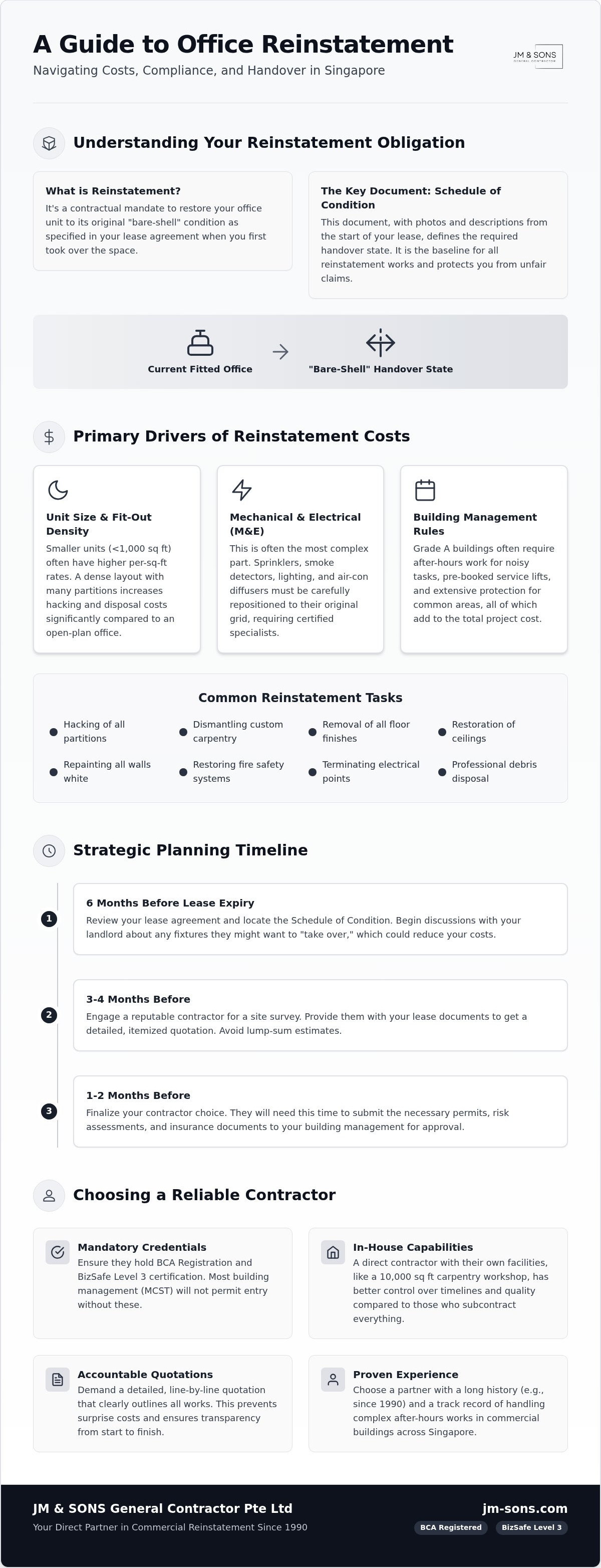
Reinstatement isn't just a courtesy; it's a contractual mandate. Most commercial tenancies in Singapore operate under a Leasehold Estate framework. This means you're legally bound to return the space in its original state. Failing to do so can lead to legal disputes or the landlord withholding your security deposit. It's about closing the gap between your current vibrant office and the empty shell you first walked into. This is a non-negotiable obligation for almost every tenant.
The most important document in this process is your Schedule of Condition. It's the photographic and descriptive record of the unit's state at the start of the lease. This document defines your financial liability. If the floor was already scuffed when you moved in, you shouldn't be paying to polish it now. We always advise clients to dig this out early. It's the baseline for every honest office reinstatement works project. Without it, you're essentially guessing at the landlord's expectations.
There is a significant difference between minor touch-ups and full structural reinstatement. Minor works might involve patching a few holes in a wall. However, most Singapore landlords expect a full restoration. This includes hacking down every partition wall and removing every piece of custom furniture. If your office has complex glass walls or heavy-duty industrial shelving, the labor involved increases significantly. It's a technical process that requires more than just a general handyman.
The Handover Condition: Bare Shell vs. Partially Fitted
A "bare shell" handover usually means cement screeded floors, white-washed walls, and basic mechanical and electrical (M&E) points. If you took over a partially fitted unit from a previous tenant, your reinstatement obligations might actually be more complex. You might be responsible for removing their old fixtures too. High-quality site photos from day one are your best defense against inflated claims. They ensure you only pay for the restoration you're actually responsible for.
Common Reinstatement Tasks Involved
Reinstatement goes beyond a simple clean-up. It involves structural and technical restoration that requires professional coordination. The specific tasks will dictate your office reinstatement cost Singapore budget more than the square footage alone. These typically include:
Hacking and disposal of gypsum, glass, or timber partitions.
Dismantling custom carpentry like pantry cabinets, built-in wardrobes, and reception desks.
Removing floor finishes such as carpet tiles, parquets, or vinyl to expose the original cement screed.
Restoring fire protection systems, including relocating sprinklers and smoke detectors to their original grid positions.
Terminating electrical wiring and restoring the original lighting layout to meet building management standards.
Key Variables Determining Your Total Reinstatement Expenditure
Relying on a simple "per square foot" estimate is often the first mistake tenants make. Your office reinstatement cost Singapore is a product of specific site conditions rather than a commodity price. Small offices under 1,000 sq ft often carry a higher unit rate because fixed costs like site insurance, permit applications, and mobilization are spread over a smaller footprint. The density of your fit-out also matters. A space packed with private glass offices requires much more careful hacking and a higher volume of debris for disposal than a simple open-plan setup.
Logistics in Grade A buildings add another layer of cost that many businesses overlook. Most building managements (MCST) require noisy works to be done after-hours. This means paying for night-shift labor and booking service lifts well in advance. Protecting common areas and lift lobbies with temporary floor protection is also vital. It prevents accidental damage that could lead to your landlord deducting from your security deposit. To get a better sense of your specific site requirements, send us your floor plan for a preliminary assessment.
The Impact of Mechanical and Electrical (M&E) Works
Mechanical and electrical (M&E) works are frequently the most complex variable in any restoration project. Landlords expect every sprinkler head, smoke detector, and air-con diffuser to be returned to its original grid position. This isn't just a cosmetic fix; it's a technical requirement for building fire safety compliance. For large-scale industrial or commercial projects, following the BCA's Conditions of Contract ensures that these technical restorations are handled with the necessary accountability. Air-conditioning systems also require careful balancing and capping of ducting to ensure the building's central system remains unaffected after you vacate the unit.
Disposal and Site Clearing Logistics
Site clearing involves more than just throwing items away. In Singapore, waste disposal costs are rising, and all debris must be handled by licensed collectors to comply with NEA regulations. If your office features heavy custom carpentry, dismantling it safely takes significant man-hours. Our experience with our own 10,000 sq ft local carpentry facility has shown us that built-in units are often more stubborn to remove than modular furniture. You'll also need to budget for the following logistical steps:
Dismantling and hauling of heavy built-in cabinets and reception desks.
Safe removal of glass partitions which require specialized handling to prevent breakage.
Disposal of carpet tiles or vinyl flooring which can be bulky and heavy.
Protection of lift interiors and common corridor flooring during the moving process.
Final site cleaning to ensure the unit is "broom clean" for the landlord's inspection.
Navigating Building Management (MCST) and Regulatory Compliance
Compliance isn't a suggestion in Singapore's commercial real estate sector; it's the gatekeeper to your exit. Most building managements (MCST) enforce strict entry requirements. If your contractor lacks BCA registration or BizSafe Level 3 certification, they won't be allowed past the loading bay. This is a critical factor in your office reinstatement cost Singapore because uncertified contractors might bid lower, only to be rejected by the building manager, causing expensive delays.
A delay in handover isn't just an inconvenience. It often triggers 'Liquidated Damages' clauses in your lease. You could end up paying double the daily rent for every day the unit remains un-reinstated. Accountability from your contractor is the only way to avoid these penalties. We've seen projects stall because a contractor didn't understand the specific fire safety submissions or the technical requirements for a particular building type. Integrity in the process means getting these approvals right the first time.
Working Within Building Management Rules
MCSTs require a reinstatement deposit before any hacking begins. This sum is held to cover potential damage to common areas. We prioritize protection. We cover lift lobbies and corridors with proper padding and floor protection to ensure your deposit is returned in full. Working hours are another hurdle. Noisy works like floor hacking or partition removal are usually restricted to after 7:00 PM on weekdays or Saturday afternoons. Managing your office reinstatement cost Singapore effectively means hiring a team that works within these windows without missing deadlines.
Fire Safety and Authority Coordination
Even a bare unit must remain fire-safe. SCDF regulations require that the sprinkler grid and smoke detectors remain functional throughout the process. You may need to coordinate with the building's nominated fire contractor for final testing. This is standard practice in many CBD buildings. For those in more specialized spaces, understanding F&B Renovation Fire Safety Requirements Singapore can provide additional context on how authorities view commercial safety standards. Clear communication with building management ensures that all fire protection systems are capped and restored according to the original approved plan.
Strategic Planning to Manage End-of-Lease Restoration Expenses
Planning starts exactly six months before your lease expires. Waiting until the final month is a recipe for stress and inflated quotes. By reviewing your lease agreement early, you can identify exactly what needs to go and what might stay. This foresight is the most effective way to control your office reinstatement cost Singapore budget. It gives you the leverage to negotiate rather than just react to a landlord's demands. It's about being proactive rather than defensive.
We always recommend obtaining a detailed, itemized quotation. A lump-sum estimate is often a red flag. It lacks the transparency needed to track where your money is going. You should see specific costs for hacking, disposal, and M&E restoration. This level of detail ensures accountability. It also prevents "hidden costs" from surfacing halfway through the project. A clear timeline is equally vital. You don't want to overstay your lease and face heavy penalties because a contractor didn't plan their labor properly.
Negotiating with the Landlord
Not every fixture needs to be ripped out. Some landlords prefer to keep high-quality items like air-conditioning units, ceiling tiles, or even certain partitions if they help re-market the space to the next tenant. Be a straight-shooter. Arrange a joint walkthrough with the landlord or building manager to confirm these "take-over" items. If the scope is still too large, ask about a "Cash-in-Lieu" option. This involves paying a negotiated sum to the landlord instead of performing the physical works yourself. It's often a cleaner exit for both parties when timelines are tight.
Checklist for a Smooth Handover
A successful handover requires more than just an empty room. You'll need to ensure the space is broom-clean and free of all debris. Testing all M&E points in the presence of the building manager is a step you shouldn't skip. It proves that the sprinklers and electrical points are in working order before you sign off. For a deeper dive into the regulatory side, see our Singapore Reinstatement Works: 2026 Tenant Compliance Guide. Managing these final details carefully prevents the landlord from withholding your security deposit or claiming damages later.
Ready to plan your exit strategy? Share your floor plan with us for a detailed site assessment.
Choosing a Reliable Partner for Accountable Reinstatement Works
Selecting a partner for your restoration is a decision that impacts your final handover more than any other factor. A straight-shooter approach to site assessment ensures your office reinstatement cost Singapore remains predictable from the first day to the final inspection. We believe in providing clarity where there is often confusion. Since 1990, JM & SONS has operated as a second-generation family contractor built on the values of hard work and personal accountability. We don't just hack down walls; we manage the entire transition so you can focus on your new premises.
Our in-house capabilities are a significant advantage for our clients. Having a 10,000 sq ft local carpentry facility means we understand the technicalities of dismantling complex built-in units without damaging the surrounding structure. This direct control over labor and equipment allows us to streamline the process, reducing the risk of timeline slippage. We take pride in being a hardworking team that remains humble despite our decades of experience in Singapore's commercial landscape.
The JM & SONS Commitment to Integrity
Integrity in this industry means showing up when you say you will and delivering exactly what was quoted. Our BCA registration and BizSafe Level 3 certification are essential credentials that grant us access to high-security and Grade A office buildings across the island. We're well-versed in the complex coordination required for night works, ensuring that noisy activities never disrupt other tenants. When you receive a quotation from us, it is detailed and transparent. We aim to eliminate the "handover surprises" that can lead to disputes with building management.
BCA Registered Contractor for professional accountability.
BizSafe Level 3 Certified to meet strict workplace safety standards.
Specialized in complex project coordination and after-hours works.
Detailed, itemized quotations that respect your budgeting needs.
Getting Started with Your Restoration
The first step toward a successful handover is an accurate assessment of your current fit-out. We recommend sharing your original floor plans and recent site photos with us as early as possible. This allows our team to identify potential M&E hurdles or structural challenges before they become expensive problems. We offer non-obligatory site visits to walk through the space with you, providing a seasoned perspective on what the landlord will likely require. It's a low-pressure way to start a dialogue about your specific needs.
Taking the stress out of your office move requires a partner you can trust. Contact JM & SONS for a detailed reinstatement assessment and let our family-led team guide you through a smooth, honest handover process.
Securing Your Peace of Mind for the Final Handover
Reinstatement doesn't have to be a source of stress or financial shock. By engaging with your landlord early and focusing on the specifics of your Schedule of Condition, you can manage your office reinstatement cost Singapore effectively. Technical compliance, especially regarding fire safety and building management rules, is the key to getting your security deposit back without delay. A successful exit is built on early planning and a clear understanding of your contractual obligations.
At JM & Sons, we've been helping Singapore businesses navigate these transitions since 1990. As a BCA registered and BizSafe Level 3 certified contractor, we bring the accountability needed for complex project coordination and after-hours works. Our 10,000 sq ft local carpentry facility allows us to handle dismantling and restoration with precision. We pride ourselves on being straight-shooters who value honesty and detailed communication above all else.
We invite you to share your floor plans or site photos with us for a transparent, itemized assessment. Request a Detailed Reinstatement Quote from JM & SONS to ensure a smooth exit from your current space. We're here to help you move forward with confidence and clarity.
Frequently Asked Questions
What is the typical timeline for an office reinstatement project in Singapore?
Most projects span between two and four weeks depending on the unit size. A small office under 2,000 square feet might be completed in seven to ten days, while larger units with high-density partitions or complex fire protection systems require more time. This timeline includes site protection, hacking, M&E restoration, and final cleaning. Starting your procurement early prevents the risk of overstaying your lease and incurring heavy financial penalties.
Can I leave certain fit-outs like air-conditioning or flooring behind?
You can only leave fixtures behind if you obtain explicit, written approval from your landlord. While most leases demand a bare-shell handover, some landlords accept high-quality air-conditioning units, ceiling tiles, or premium flooring if these items help attract a new tenant. It's best to conduct a joint site walkthrough six months before your lease expires to identify which assets might be exempted from the hacking scope.
Why do I need a BizSafe certified contractor for reinstatement?
Most building managements (MCST) in Singapore strictly require a BizSafe Level 3 certified contractor for site entry. This certification proves that the contractor has established robust risk management protocols for high-risk activities like hacking and heavy debris disposal. Hiring a certified partner ensures your project complies with the Workplace Safety and Health Act, protecting your business from legal liabilities and ensuring the building management allows the works to proceed.
What happens if my reinstatement work is not completed by the lease expiry date?
Failing to hand over by the lease expiry date usually triggers a liquidated damages clause. This often results in you paying double the daily rent for every day the unit remains un-reinstated. In some cases, the landlord may hire their own contractor to complete the works and deduct the expenses from your security deposit. This often increases your total office reinstatement cost Singapore since you lose control over the procurement and labor rates.
Are disposal fees included in the reinstatement quote?
A transparent, itemized quotation from an ethical contractor should always include disposal and haulage fees. These costs cover the labor for site clearing and the charges from National Environment Agency (NEA) licensed waste collectors. Since 2026 has seen a rise in operational costs for waste management, it's vital to ensure your quote specifically accounts for the volume of debris generated by hacking partitions, built-in carpentry, and floor finishes.
Do I need to apply for any permits for hacking works in a commercial building?
Yes, you must obtain a Work Permit from the building's management office before any hacking begins. This application typically requires your contractor to submit their BCA registration, BizSafe certification, and a detailed method statement. For works involving structural changes or fire safety systems, you may also need to coordinate submissions with the SCDF or BCA. We handle these administrative hurdles to ensure your project stays compliant with building rules.
What is the difference between reinstatement and renovation?
Reinstatement is the process of returning a space to its original bare shell state, whereas renovation involves building a new interior fit-out. While renovation focuses on aesthetics and functionality for your team, reinstatement focuses on demolition, hacking, and restoring the unit to meet the landlord's Schedule of Condition. It's about undoing the work you previously installed, requiring a different approach to labor, waste management, and site protection.
Can the landlord keep my security deposit if the reinstatement is not satisfactory?
Your landlord has the right to withhold or deduct from your security deposit if the reinstatement does not meet the agreed standards. This usually happens if there is damage to the landlord's original fixtures, leftover debris, or if the M&E systems aren't restored to their original grid positions. Using a straight-shooter contractor who provides a detailed project management plan ensures the final inspection goes smoothly and your full deposit is returned.


Comments