
Retail Fit-Out Contractor Singapore: 2026 Tenant Guide

A stunning store design won't help your bottom line if the doors stay locked because of a delayed Fire Safety Certificate. In 2026, the success of your shop depends less on the aesthetics and more on the technical precision of your retail fit out contractor Singapore. We understand that for most tenants, the real pressure isn't just about picking finishes. It's about navigating the rigid requirements of mall management and ensuring every partition meets the latest SCDF Fire Code amendments.
You've likely felt the frustration of waiting on approvals while your rent clock is ticking. It's a common pain point that often leads to unexpected costs and missed opening dates. This guide is designed to give you peace of mind by explaining the essential compliance steps, coordination strategies, and carpentry standards required for a smooth handover. We'll walk you through the practicalities of BCA submissions and how to choose a partner who treats your investment with the honesty and integrity it deserves.
Table of Contents
What is a Retail Fit-Out and Why Does the Contractor Choice Matter?
A retail fit-out is the process of taking a "shell and core" or "Cat A" unit and making it ready for business. It's more than just painting walls or buying furniture. It involves installing everything from lighting and flooring to bespoke display units that reflect your brand identity. This industry, often referred to as Shop fitting, requires a deep understanding of how a physical space influences consumer behavior. Choosing the right retail fit out contractor Singapore is critical because your shop's layout directly impacts how efficiently your staff works and how long customers stay in your store.
In Singapore, the stakes are higher than in many other markets. Most retail spaces are located within malls managed by strict MCST (Management Corporation Strata Title) rules. These entities dictate exactly when you can bring in materials and when noisy work must stop. You'll often find that construction only happens during "silent hours" or late at night. A contractor who lacks experience with these specific mall manuals can easily lead to heavy fines or project stoppages that eat into your rent-free period.
Retail Fit-Out vs. General Renovation
While a renovation might focus on refreshing the look of an existing space, a fit-out is a technical transformation. It requires precise MEP (Mechanical, Electrical, and Plumbing) planning to handle high foot traffic and specific operational needs. For instance, a boutique's lighting requirements differ vastly from a lifestyle cafe's kitchen exhaust needs. Retail spaces demand higher technical precision because every square foot must be functional, durable, and safe for the public. A specialized retail fit out contractor Singapore understands that these elements aren't just aesthetic choices; they're the backbone of your business operations.
The Role of the Main Contractor in Singapore
Your main contractor acts as the anchor for the entire project. They manage the "invisible" infrastructure like fire protection systems and electrical load balancing. At JM & Sons, we've approached this role with a sense of moral responsibility since 1990. We don't just pass off work to subcontractors and hope for the best. We stay accountable for every joint and wire. This grounded, family-oriented approach ensures that the person you speak to at the start is the same one responsible for the final handover. It creates a single point of contact, which significantly reduces the risk of coordination gaps between designers and builders.
Navigating Singapore Regulatory Compliance: SCDF, BCA, and Mall Rules
Compliance is the foundation of every successful project. In 2026, the SCDF Fire Code remains the most critical hurdle for retail tenants. A professional retail fit out contractor Singapore doesn't just build cabinets; they ensure your shop is legally allowed to operate. This process starts with securing a Temporary Fire Permit (TFP) or a Fire Safety Certificate (FSC). You can't open your doors to the public without these documents, even if your inventory is ready on the shelves. These permits prove that your sprinklers, smoke detectors, and exit signs are positioned correctly and function as intended.
Beyond government regulations, you must also satisfy your Mall Management (MCST). Every mall has a specific fit-out manual that dictates everything from the type of hoarding you use to the specific insurance coverage required. They often demand a renovation deposit and strictly enforce work hours to prevent noise from disturbing other tenants. Managing these overlapping rules requires a contractor who understands the subtle differences between major landlords like CapitaLand or Frasers Property.
Fire Safety and SCDF Submission Coordination
Your contractor must work closely with a Qualified Person (QP), usually an architect or engineer, to handle the SCDF plan approval. This coordination is vital because even small changes to a floor plan can affect fire protection coverage. Common pitfalls include blocking exit paths with display racks or using non-rated materials for partitions. If you're moving into the food and beverage sector, the requirements become even more stringent. You should review the F&B Renovation Fire Safety Requirements Singapore to understand the additional layers of protection needed for kitchen exhausts and grease traps.
If you're repurposing a unit, you'll likely need a "Change of Use" permit. This is mandatory if a standard retail shop is converted into a service like a hair salon or a cafe. The original systems weren't designed for the heat or water usage of these businesses. If you're unsure about your unit's current compliance status, you can ask us to review your floor plan for potential fire safety issues before you sign a lease.
BCA Requirements and Professional Certification
BCA registration is a baseline requirement for commercial works in Singapore. It serves as proof that the contractor has the technical expertise and financial standing to complete the job. Another essential credential is BizSafe Level 3 certification. This ensures that the contractor has a robust risk management plan in place for their workers on your site. While we provide guidance based on our experience, we always recommend that you verify the latest regulatory details with the relevant authorities or your building management to account for any site-specific rules.
Evaluating a Retail Fit-Out Contractor: 3 Essential Criteria
Choosing a partner for your shop front requires looking beyond a glossy portfolio. You need a retail fit out contractor Singapore who understands the granular details of mall operations. Every major landlord, from CapitaLand to Frasers Property, has distinct administrative cultures and technical requirements. A contractor who knows these nuances can anticipate administrative hurdles before they become costly delays. They won't just follow a drawing; they'll proactively flag potential issues with mall management rules early in the planning stage.
Transparency in quoting is the second non-negotiable criterion. We believe in a "straight-shooter" approach where every line item is clearly defined. Avoid "lump sum" estimates that leave room for hidden costs later. A detailed quotation protects your budget and ensures that both parties have a clear agreement on the scope of work. This technical literacy extends to regulatory steps too. A reliable partner ensures all technical drawings are ready for the BCA Building Plan submission well before your lease starts. This foresight prevents the rent clock from ticking while you wait for paperwork.
The Advantage of In-House Carpentry
Many contractors outsource their fabrication to third-party workshops, which can lead to quality gaps and scheduling conflicts. We operate our own 10,000 sq ft local carpentry facility to maintain direct control over every joint and finish. This setup allows us to manufacture your bespoke fixtures off-site while site preparation is still underway. It significantly reduces lead times and gives you the peace of mind that the materials used meet your brand's specific standards. When we control the workshop, we control the timeline. There's no waiting on a middleman to prioritize your project.
Accountability and Family-Owned Heritage
Reputation is personal for us. As a second-generation family business established in 1990, we don't view projects as one-off transactions. We see them as a continuation of a decades-long commitment to integrity and hard work. This heritage means you're dealing with a team that values long-term relationships over aggressive corporate expansion. You can learn more about our journey and our values on our About JM & SONS page. We've grown through manual effort and personal accountability, ensuring that the physical result of your store reflects the same honesty we bring to our initial handshake.
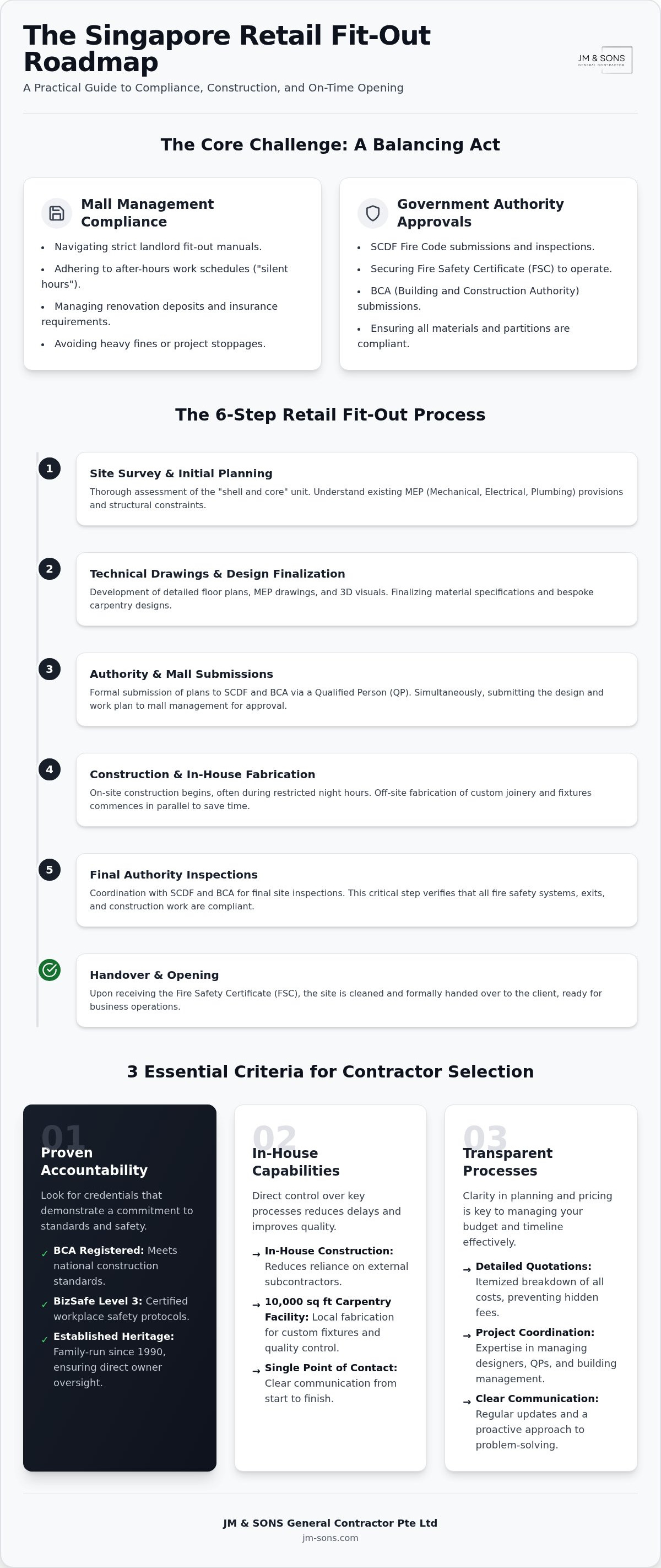
The Step-by-Step Retail Fit-Out Process: From Site Survey to Handover
The physical transformation of your store is a disciplined march through five distinct stages. It doesn't happen by chance. A professional retail fit out contractor Singapore ensures each phase overlaps correctly to protect your opening date. This journey begins long before the first partition is erected. We break the process down into manageable milestones to maintain clarity and accountability.
Phase 1 starts with a site survey and a deep dive into the mall's fit-out manual. Phase 2 moves into technical drawings and MEP planning, where the QP prepares submissions for BCA and SCDF. Phase 3 involves procurement and off-site carpentry fabrication in our local workshop. Phase 4 is the heavy lifting of on-site construction, often happening while the rest of the city sleeps. Finally, Phase 5 covers testing, commissioning, and the official handover after final inspections.
Site Preparation and Technical Coordination
A thorough site survey is the most important step in the entire process. We identify existing MEP constraints, like the location of floor traps or electrical distribution boards, which might conflict with your design. Failing to spot these early leads to costly change orders mid-construction. We use this data to build a realistic timeline that respects the mall's specific working hours and administrative deadlines. For a deeper look at mall-specific requirements, you should consult our Singapore Mall Fit-Out Guide. It's about spotting the technical hurdles before they stop your progress.
Construction Phase and Night Works
Most retail construction in Singapore happens at night. Managing noise and dust in an operational mall is a logistical challenge that requires constant supervision. Our site supervisors coordinate multiple trades, from electricians to floor layers, ensuring they don't get in each other's way during the limited "silent hours." This phase is also where our in-house carpentry shines. Because we fabricate bespoke units off-site, on-site time is spent on precise installation rather than raw construction. We perform rigorous quality checks on custom finishes to ensure the physical store matches your brand's vision exactly. We don't leave things to chance; we verify every joint and surface.
If you're feeling overwhelmed by the technical requirements of your lease, send us your mall's fit-out manual for a practical review of the construction timeline.
Managing Costs and Timelines for Your Retail Project
Managing a retail project's budget requires a balance between your brand's vision and the technical realities of the site. A professional retail fit out contractor Singapore understands that your floor area is only one part of the equation. MEP complexity, such as specialized HVAC systems or high-load electrical requirements for digital displays, often drives the final figure more than the square footage itself. We prioritize material choices that offer durability for high-traffic environments, ensuring your investment stands up to thousands of visitors without premature wear.
You can avoid common "hidden costs" by insisting on an itemized quotation from the start. Many tenants are surprised by mall-imposed costs like hoarding fees, renovation deposits, or the price of after-hours security coordination. A transparent partner flags these logistical expenses early. Meeting tight mall handover deadlines is only possible when your contractor manages these administrative details alongside the physical build. We believe in being a "straight-shooter" with our numbers, so there are no difficult conversations when the final invoice arrives.
Budgeting for Commercial Quality
It's tempting to look for the lowest price, but "cheap" often leads to non-compliance and expensive rework. In the strict Singapore retail environment, using non-rated materials or cutting corners on electrical infrastructure can lead to SCDF inspection failures. These delays cost you more in lost revenue than you saved on the initial quote. We advise allocating a realistic budget for essential fire safety and high-grade electrical components. Using commercial-grade materials is a long-term strategy that reduces maintenance costs and ensures your store remains safe for the public throughout your tenancy.
Final Handover and Reinstatement Considerations
Final inspections are the moment of truth for any tenant. We ensure all defects are cleared before your grand opening, allowing you to focus entirely on your customers and operations. It's also wise to think about the end of your journey before it even begins. The design decisions you make during the fit-out will eventually dictate the complexity of your reinstatement works when the lease expires. We build with the end in mind, helping you select installation methods that satisfy your current needs while simplifying future demolition requirements.
If you are ready to move from planning to execution, Contact JM & SONS to share your floor plan for a detailed consultation. We treat every project with the same integrity and accountability that has defined our family business since 1990.
Building Your Retail Presence with Technical Certainty
Opening your doors on time requires more than just a good design. It's about ensuring every sprinkler head and partition meets the strict 2026 SCDF and BCA standards. By choosing a retail fit out contractor Singapore that prioritizes technical compliance over marketing flair, you protect your business from costly delays and unexpected fines. We've seen how the right coordination with mall management can make or break a project's timeline.
Since 1990, JM & Sons has focused on providing this level of accountability. Our 10,000 sq ft in-house carpentry facility allows us to maintain quality where others might cut corners. As a BCA registered and BizSafe Level 3 contractor, we take the moral responsibility of your fit-out seriously. We're here to help you navigate the complexities of the Singapore retail landscape with honesty and transparency.
If you're ready to start your next project, we'd like to hear from you. Request a detailed retail fit-out quotation from JM & SONS to begin your journey with peace of mind. We look forward to building something lasting together.
Frequently Asked Questions
How long does a typical retail fit-out take in Singapore?
A typical retail fit-out usually takes between 8 to 12 weeks to complete. This timeline includes the initial site survey, design finalization, and the mandatory 2 to 4 weeks required for authority submissions like BCA and SCDF. Smaller units might move faster, but flagship stores with complex custom carpentry often require the full duration. We use our local workshop to fabricate fixtures off-site, which helps us stay on schedule despite strict mall working hours.
Do I need a permit for a retail renovation in a shopping mall?
You definitely need multiple permits before starting any work. Most shopping malls require a fit-out permit from their management (MCST) and proof of insurance. On a government level, you'll likely need BCA building plan approval and SCDF fire safety permits if you're altering the layout or fire protection systems. It's best to verify these requirements with your landlord early to avoid delays in putting up your hoarding.
What is the difference between an interior designer and a fit-out contractor?
An interior designer focuses on the aesthetics of your shop, while a retail fit out contractor Singapore manages the technical construction and regulatory compliance. While a designer provides the vision, a contractor like JM & Sons handles the structural integrity, electrical load balancing, and fire safety submissions. We act as the single point of accountability, ensuring that the design is actually buildable and meets all Singaporean commercial safety codes.
Can fit-out works be done during mall operating hours?
Most major renovation works must be conducted after mall operating hours to avoid disturbing shoppers. While quiet activities like painting or basic assembly might be allowed during the day, noisy works like hacking, drilling, and welding are strictly restricted to night shifts. Your contractor must coordinate these "silent hours" with mall security to ensure materials are brought in and waste is removed without disrupting daily business.
What is a 'Change of Use' submission and when do I need it?
A 'Change of Use' submission is required when you repurpose a unit for a different business type than originally intended. For instance, converting a retail boutique into a beauty salon or a cafe requires this permit. It ensures the space's ventilation, plumbing, and electrical systems can safely support the new operations. You should always check with the URA or your building management to see if your unit's current use class matches your business plan.
What are the common fire safety requirements for retail shops in Singapore?
Common requirements include the correct placement of fire sprinklers, smoke detectors, and illuminated exit signs that remain visible at all times. All partitions and ceiling materials must meet specific fire-rating standards set by the SCDF. If your layout changes, you'll need a Qualified Person to submit new drawings for approval. These systems are tested during the final inspection before you receive your Fire Safety Certificate to open.
Why is BizSafe certification important for a renovation contractor?
BizSafe Level 3 certification is a mandatory requirement for most commercial landlords in Singapore because it proves the contractor has a robust risk management system. It shows that the team has been trained to identify and mitigate site hazards, from electrical safety to working at heights. Choosing a BizSafe certified contractor protects you as a tenant from legal liabilities and ensures that the work is performed under the highest safety standards.
What documents should I prepare before contacting a retail fit-out contractor?
You should prepare your unit's floor plan, the mall's fit-out manual, and a list of your specific operational needs. Having site photos and your lease agreement's handover date ready will also help in getting a more accurate quotation. As a retail fit out contractor Singapore, we use these details to provide the transparent, itemized pricing we've been known for since 1990. Providing clear documents helps us identify potential technical hurdles early.


Comments