
Warehouse Reinstatement Singapore: The 2026 Tenant's Checklist

Your security deposit isn't just a line item on your balance sheet; it's a significant capital asset that could be forfeited by a single overlooked sprinkler head or an unapproved partition wall. Most industrial tenants in Singapore find that the final weeks of a lease are the most demanding. You're likely balancing the logistics of your new facility while trying to decode ambiguous "bare shell" clauses and strict MCST rules for hacking hours and debris disposal. It's a high-stakes transition where even a minor oversight can lead to costly delays or double-rent penalties.
This guide provides a professional roadmap to warehouse reinstatement Singapore, ensuring you meet every technical requirement from SCDF fire safety to M&E restoration. We've built our reputation at JM & SONS General Contractor Pte Ltd on transparency and accountability since 1990, and we know that a smooth handover requires more than just manual labor. You'll learn how to navigate the 2026 compliance standards, manage complex authority submissions through CORENET-X, and follow a clear checklist to help you pass your final joint inspection on the first try. We've simplified the technical complexities so you can focus on your next chapter with complete peace of mind.
Table of Contents
Understanding Warehouse Reinstatement Works in Singapore
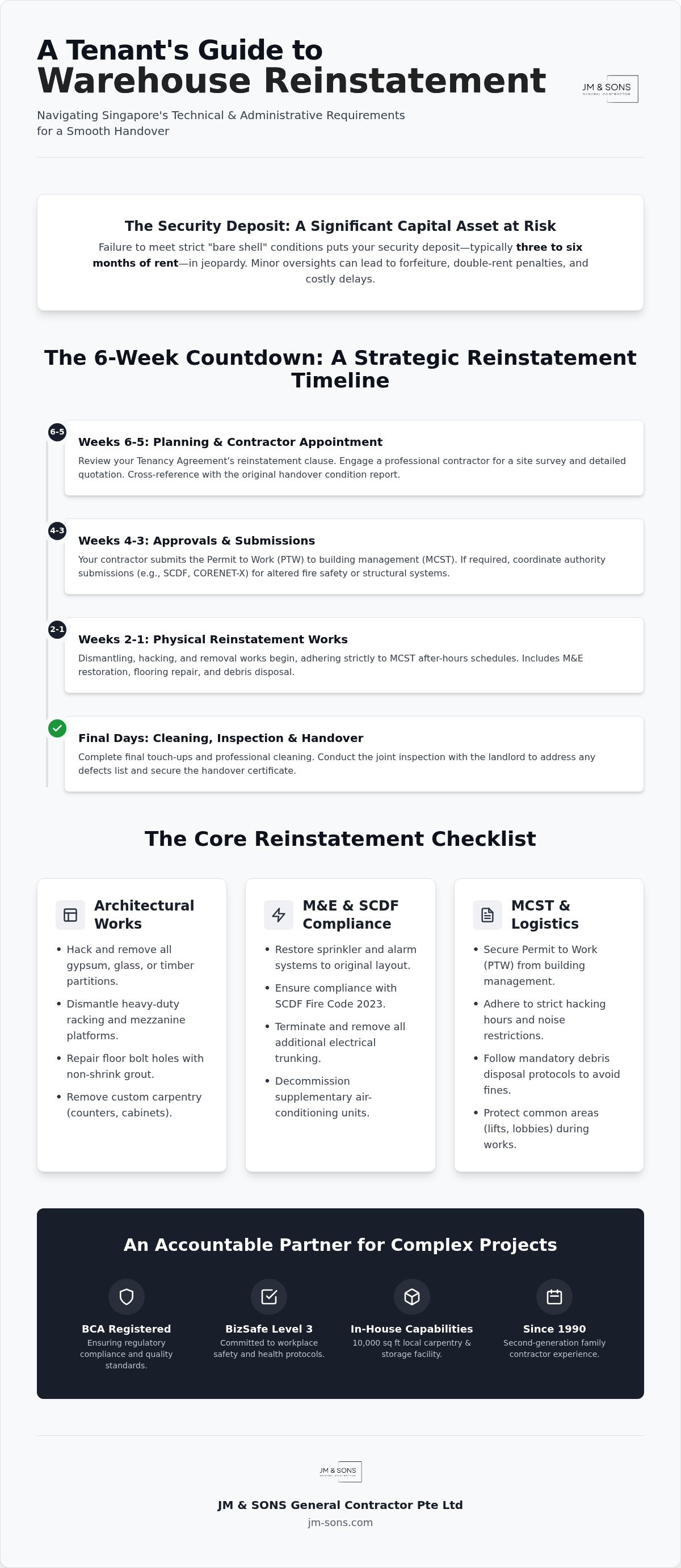
In Singapore's industrial sector, the process of warehouse reinstatement Singapore isn't just about cleaning up. It's a technical restoration of your unit to the exact "bare shell" state described in your lease agreement. For most tenants, this means removing every modification made during the tenancy, from gypsum office partitions to heavy duty racking systems. Failing to meet these standards doesn't just invite a stern email; it puts your security deposit, which typically ranges from three to six months of rent, at direct risk.
By 2026, the requirements for warehouse reinstatement Singapore have become more stringent. A simple "broom-clean" handover is no longer enough to satisfy landlords or building management. Several factors now dictate a successful exit:
Fire Safety Compliance: All sprinkler and alarm restorations must align with the Fire Code 2023.
Digital Accountability: Any structural changes may require digital submission through the CORENET-X platform.
Waste Management: Strict adherence to MCST disposal protocols for industrial debris is mandatory to avoid fines.
If you've modified fire protection systems or added complex electrical trunking, these must be professionally reverted and certified to ensure the landlord can re-lease the space immediately.
The Difference Between Wear-and-Tear and Damage
Distinguishing between fair wear and tear and actual damage is a common point of friction during inspections. Generally, minor scuffs on a floor from pallet jack use might be considered wear, but holes drilled into the concrete slab for racking anchors are classified as damage that requires professional repair. Structural additions, such as mezzanine levels or internal offices, must always be removed unless the landlord explicitly agrees to retain them in writing. Your best defense is the original Handover Condition Report. We always advise clients to cross-reference their current site state with those initial photos to ensure no unnecessary work is performed while still meeting every contractual obligation.
Timeline: Why You Should Start 6 Weeks Early
Timing is everything when ending a tenancy. We recommend beginning the planning process at least six weeks before your handover date. This window allows for the necessary Permit to Work (PTW) approvals from the MCST and coordinates SCDF inspection windows if fire safety systems were altered. Delaying the start often leads to "holding over" penalties, where you might pay double rent for every day the unit remains un-reinstated. To avoid these hidden costs, you should contact JM & SONS for a site survey well before your notice period ends. Our team has helped businesses since 1990 navigate these transitions with the accountability you'd expect from a BCA Registered and BizSafe Level 3 certified contractor.
The Architectural Checklist: Partitions, Floors, and Racking
Returning a warehouse to its original state requires a methodical teardown of every architectural addition. In the context of warehouse reinstatement Singapore, this involves more than just clearing out inventory. You'll need to hack and remove all temporary gypsum, glass, or timber partitions used for office pods or staff areas. It's vital to ensure that the removal doesn't damage the existing ceiling grid or perimeter walls. Any custom-built carpentry, such as reception counters or pantry cabinets, must also be dismantled. The Building and Construction Authority provides the framework for these works, ensuring that even temporary structures are handled with technical competence and safety.
Industrial Racking and Mezzanine Removal
Heavy-duty racking systems and mezzanine platforms are the backbone of logistics operations, but they're a major hurdle during handover. Dismantling these structures requires experienced teams who understand load-bearing safety. When racking is removed, it leaves behind numerous floor bolt holes that can't simply be ignored. These must be filled and "made good" using non-shrink grout to ensure the floor slab remains structurally sound and visually consistent. If you're struggling with where to move these materials, we utilize our 10,000 sq ft local carpentry and storage facility to help coordinate disposal or temporary staging. This keeps your site compliant with MCST fire path requirements during the work and ensures a clean environment for the landlord's inspection.
Flooring Restoration and Grinding
Industrial landlords are particularly strict about floor conditions. If you've added vinyl tiles, carpet, or epoxy coatings, these must be hacked to reveal the original cement screed. Removing the top layer is only half the battle; the adhesive residue left behind often requires industrial-grade grinding to achieve a smooth, uniform finish that meets the "original condition" clause. In office annexes, matching original floor tiles can be difficult if replacements aren't readily available. We focus on a "straight-shooter" approach, identifying these flooring issues during our initial survey so there are no surprises during the final joint inspection. If you're worried about the state of your warehouse floor, share your site photos with us to see what restoration is actually necessary.
Restoring wall finishes is another critical step. After partitions are removed, the remaining walls often have holes, glue marks, or mismatched paint. We ensure all surfaces are patched, sanded, and repainted to the original color specified in your tenancy agreement. This level of detail is what separates a successful handover from one that leads to deposit deductions. By handling the architectural restoration holistically, we help you avoid the stress of managing multiple sub-contractors while ensuring every square foot of the unit is returned to its bare shell state.
M&E and Fire Safety (SCDF) Reinstatement Requirements
While architectural work changes the look of the space, M&E restoration ensures its safety and legality. In warehouse reinstatement Singapore, this is often where the most technical disputes happen. Landlords expect every electrical circuit and water point to be exactly where they were on day one. You'll need to terminate and make safe all electrical wiring, data points, and trunking that were added during your stay. This isn't just about cutting wires; it's about restoring the Distribution Board (DB) to its original circuit configuration so the next tenant inherits a clean slate.
Plumbing and climate control also require careful handling. Any water points added for pantries or toilet extensions must be professionally capped off. Similarly, Air-Conditioning Fan Coil Units (FCUs) and ducting that were moved to accommodate your office layout must be relocated to their original positions. These tasks require coordination to ensure that no leaks or electrical faults are left behind, which could lead to claims against your security deposit months after you've moved out.
Fire Safety Compliance and SCDF Standards
SCDF regulations are non-negotiable. If you moved fire sprinklers to fit your racking or office partitions, they must be reset to their original grid height and spacing. It's a precise task that requires technical knowledge of the Fire Code 2023. Added smoke detectors must be removed, and the entire fire alarm system must be tested to ensure functionality. For those transitioning from specialized spaces, understanding F&B renovation fire safety requirements Singapore can provide a useful perspective on how strict these standards are, even if you're now dealing with industrial warehouse units.
Electrical Restoration and LEW Certification
As part of your warehouse reinstatement Singapore, all surface-mounted conduits and socket outlets installed for your machinery or workstations must be removed. Original lighting fixtures, often high-bay lamps in warehouse settings, must be reinstalled and verified as working. This process involves stripping back everything to the original points of supply provided by the landlord to ensure the electrical load remains balanced.
Most industrial building managements in Singapore require a Licensed Electrical Worker (LEW) to inspect the work and provide a final certification of safety. This LEW endorsement is your proof that the electrical system is safe and compliant. At JM & Sons, we've handled these complex project coordinations since 1990, ensuring that every wire and pipe is accounted for before the final joint inspection. We focus on clear communication so you're never left wondering about the status of your M&E handover.
Navigating Building Management (MCST) and Site Logistics
Successfully completing warehouse reinstatement Singapore involves more than just physical labor. It requires careful coordination with the Management Corporation Strata Title (MCST). Before a single hammer is swung, your contractor must apply for a Permit to Work (PTW) and place a renovation deposit. This deposit serves as security against any damage to common property. Building managers in industrial parks are particularly vigilant about protection. You'll need to install lift padding, floor protection along corridors, and proper hoarding to contain dust and noise during the teardown.
Industrial hacking hours are strictly enforced to avoid disrupting neighboring businesses. Noisy works, such as hacking floor tiles or dismantling the racking systems mentioned earlier, are usually restricted to after 6 PM on weekdays or during weekends. Managing these after-hours shifts requires a contractor who can handle complex logistics and maintain site security without constant supervision. We've coordinated these sensitive schedules since 1990, ensuring that the work progresses steadily without triggering complaints from building management.
Insurance and BizSafe Requirements
Your contractor must carry comprehensive Public Liability Insurance, typically with a minimum coverage of S$1 million. This protects you from financial liability arising from accidental damage to the building's structure or third-party injuries. For high-specification warehouses, building managers often mandate BizSafe Level 3 certification as a baseline for on-site safety. This ensures that the team follows strict risk management protocols while handling heavy machinery or working at height. If you're also managing an office move, our Office Interior Fitting Out Singapore: The 2026 Contractor’s Guide provides more detail on these essential safety credentials.
Debris Disposal and Environmental Responsibility
Bulky industrial waste, such as old racking components, timber pallets, or hazardous materials, cannot be left in the building's common bins. MCSTs will fine tenants heavily for unauthorized dumping in shared areas. All reinstatement debris must be removed via approved routes using specialized bins provided by the contractor. We ensure that every piece of waste is hauled away to licensed disposal facilities, leaving the unit in a "broom-clean" state. This thoroughness is vital for a successful final walk-through with the landlord. If you're worried about meeting strict building management rules, message us today to discuss your site logistics.
Effective waste management also includes the removal of any signage or branding from the exterior of the unit. This often requires the use of boom lifts or scaffolding, which must be coordinated with the building's loading bay schedules. By handling these logistical hurdles professionally, we ensure that your warehouse reinstatement Singapore project stays on track for a timely handover, protecting you from late-exit penalties.
The Final Handover: Joint Inspection and Deposit Recovery
The joint inspection is the final hurdle in your warehouse reinstatement Singapore project. It's a formal session where you, the landlord, and the managing agent walk through the unit to verify that every contractual obligation has been met. This isn't just a casual look around; it's a technical validation of the work we've completed. If the unit is truly back to its bare shell state, this process should be straightforward. However, any discrepancies found during this walk-through will be documented in a "defects list," which can delay the release of your security deposit.
Once the landlord is satisfied, we provide you with a formal Certificate of Completion (COC). This document serves as your proof that the reinstatement is finished to professional standards. With the COC in hand and a signed-off inspection report, you can formally request the release of your security deposit. In Singapore's industrial market, landlords typically have a set period, often 14 to 30 days, to return these funds once the handover is finalized. Ensuring a clean handover on the first attempt is the only way to avoid the stress of prolonged negotiations or double-rent penalties.
Preparing for the Joint Inspection
Success at the final inspection starts before the landlord arrives. We conduct a thorough pre-inspection walk-through with our project manager to catch minor issues early. We'll ensure all utilities, such as water and electricity, are functional so the landlord can test the restored points. It's also the time to have your original Handover Report and site photos ready. These photos are your best evidence if a landlord claims a pre-existing stain or floor crack was caused by your operations. By being proactive, we help you manage the defects list effectively and handle any minor remedial works immediately on-site.
Why Choose an Ethical Contractor like JM & SONS?
Choosing a partner for warehouse reinstatement Singapore requires looking beyond the lowest quote. As a second-generation family business founded in 1990, we prioritize accountability and transparency. Our BCA registration and BizSafe Level 3 certification aren't just badges; they're a commitment to professional standards and site safety. We provide detailed, "straight-shooter" quotations that avoid the "hidden" variation order surprises that often plague industrial projects. For a broader look at meeting your obligations, refer to our Singapore Reinstatement Works: 2026 Tenant Compliance Guide.
We believe in building relationships through honesty and hard work. Our 10,000 sq ft local carpentry facility and in-house teams allow us to control the quality and timeline of your project directly. We understand the pressure of a lease exit and aim to provide the peace of mind that comes from knowing the job is done right. WhatsApp us your floor plan for a transparent reinstatement quote and let our team handle the complexities of your warehouse handover.
Securing a Seamless Industrial Handover
Exiting an industrial lease is a technical project that demands precision and strict adherence to timelines. Success depends on restoring your unit to its true bare shell state, from resetting SCDF fire sprinkler grids to grinding floor slabs back to their original finish. By coordinating with your MCST early and managing the joint inspection with clear documentation, you protect your capital and avoid the risk of late-handover penalties.
Since 1990, JM & Sons has operated as a second-generation family business built on accountability. As a BCA Registered Contractor with BizSafe Level 3 certification and a 10,000 sq ft local carpentry facility, we provide the practical expertise needed for warehouse reinstatement Singapore. We don't believe in hidden costs or marketing fluff; we focus on "straight-shooter" service that helps you pass your final inspection on the first attempt. Let us handle the complexities of your reinstatement so you can focus on your next facility with complete peace of mind.
Ready to start your handover?WhatsApp JM & SONS at +65 8913 2620 to share your site photos and get a transparent quote. We look forward to helping you secure your full security deposit.
Frequently Asked Questions
Do I need to reinstate if the next tenant wants my current warehouse fit-out?
You're usually still required to reinstate unless the landlord provides a written waiver or a tripartite agreement is signed. The "bare shell" clause in your lease is a legal contract between you and the landlord, not the incoming tenant. If the landlord prefers a clean slate for the next occupant, you must proceed with the restoration regardless of the next tenant's interest in your racking or partitions.
How much does warehouse reinstatement cost per square foot in Singapore?
Costs vary based on the complexity of your M&E systems and the volume of racking or mezzanine levels to be removed. Factors like ceiling height and the extent of fire safety restoration heavily influence the final figure. We don't provide generic per-square-foot estimates as they often lead to surprises. Instead, we provide detailed, transparent quotations based on your specific floor plan and original handover photos.
Can I hire office movers to handle the hacking and demolition works?
Hiring general movers is risky because they often lack the technical expertise for M&E and fire safety compliance. A successful warehouse reinstatement Singapore project requires a BCA Registered contractor who understands structural safety and SCDF codes. Using unqualified labor can lead to accidental damage to the building's infrastructure or violations of MCST safety protocols, which directly puts your security deposit at risk.
What happens if I cannot complete the reinstatement before the lease expires?
Failing to finish on time often triggers "holding over" clauses, where you may be charged double the daily rent for every day the unit remains un-reinstated. Landlords can also claim for loss of income if a new tenant's move-in is delayed. It's vital to start the process at least six weeks early to account for MCST permit approvals and the physical restoration of the space.
Who is responsible for SCDF fire safety submissions during reinstatement?
The tenant is responsible for ensuring that all fire safety systems, including sprinklers and alarms, are restored to their original configuration. This work must comply with the Fire Code 2023 and often requires coordination with a Qualified Person for official submissions. We handle this coordination as part of our service, ensuring that all fire protection systems pass the final joint inspection without technical hitches.
Does 'broom-clean' condition include professional floor scrubbing?
While "broom-clean" sounds simple, industrial landlords expect the removal of all oil stains, tire marks, and adhesive residue. If your operations left heavy marks on the concrete, professional scrubbing or industrial grinding might be necessary to meet the "original condition" standard. Refer to your initial Handover Condition Report to see the exact state of the floor when you first took possession of the unit.
Can the landlord deduct from my deposit for original paint fading?
Landlords shouldn't deduct for natural paint fading, as this is typically classified as "fair wear and tear" under Singapore law. However, if you've added partitions or left holes from mounting equipment, you're responsible for patching and repainting those specific areas to match the original wall color. We focus on these details during our pre-inspection walk-through to ensure your handover is fair and your deposit is protected.
Is BizSafe certification mandatory for reinstatement contractors in Singapore?
Most industrial building managements (MCSTs) mandate BizSafe Level 3 certification as a baseline for any on-site works. This ensures the contractor follows strict risk management protocols while handling heavy demolition or working at height. At JM & Sons, our BizSafe Level 3 status and BCA registration reflect our commitment to safety and accountability, allowing us to work in high-spec warehouses with full management approval.


Comments