
Carpentry Quotes Singapore: How to Compare Scope, Materials and Contractors

The lowest carpentry quote can be the hardest one to compare. In Singapore, carpentry quotes may cover very different scopes: one contractor might price a complete set of cabinets, while another includes only basic joinery. Even quotes using the same measurement basis can differ in board materials, finishes, hardware and installation. That makes it difficult to know whether you’re comparing like for like.
If you’re reviewing carpentry quotes Singapore contractors have prepared, the total alone won’t tell you what’s included. Clear descriptions of the work, specifications, exclusions and variation process help prevent misunderstandings once fabrication and installation begin.
This guide explains what to look for in a commercial carpentry quotation and how to compare proposals consistently. You’ll learn how to check measurements and scope, assess material and hardware descriptions, and clarify what happens when requirements change. We’ll also cover coordination with landlords, building management and other trades, so custom joinery fits into the wider project plan. The aim is to help your team make a clear decision before work starts, not simply choose the lowest figure.
Table of Contents
Why Carpentry Quotes in Singapore Can Be Difficult to Compare
A carpentry quote should describe the work proposed for a particular project, the materials and finishes specified, the measurements or drawings used, any assumptions, and the commercial terms. Without those details, two figures can look comparable while covering different work.
A residential price list may provide a starting point for common items, but it rarely defines the full carpentry scope of a commercial fit-out. An office may need workstations, pantry storage or reception joinery. A retail unit may require display fixtures and counters, while an F&B space may need service counters and back-of-house storage. Each brief has its own layout, use and site constraints.
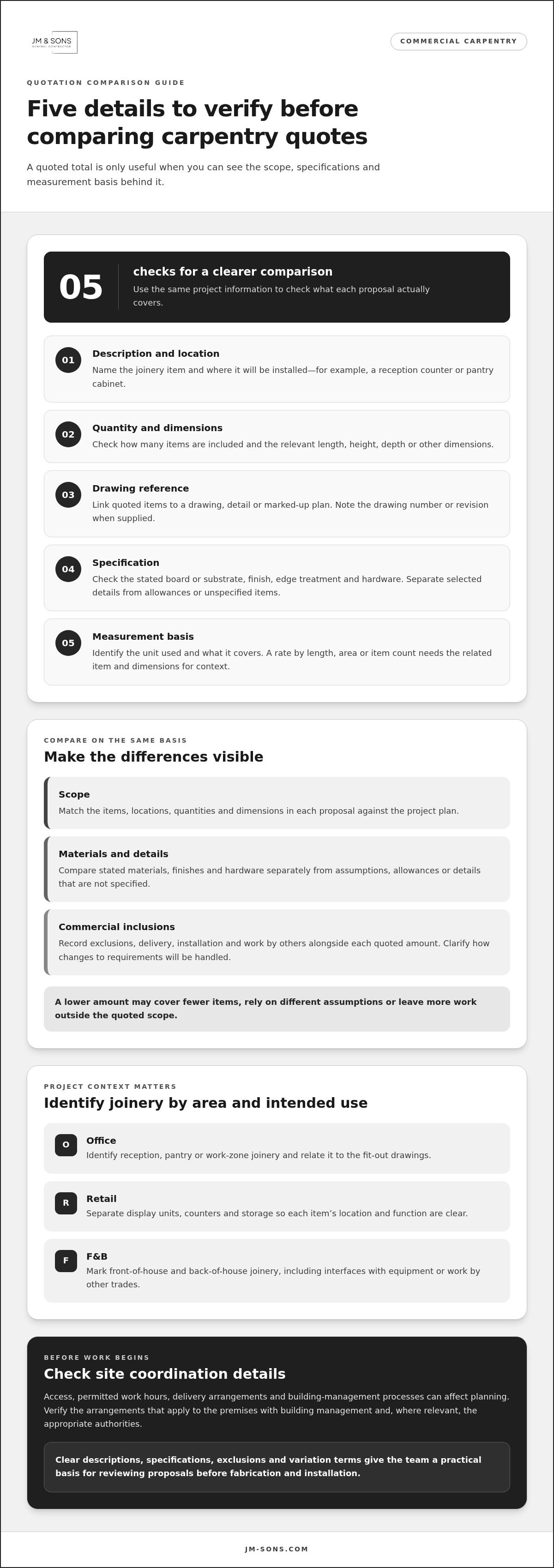
Quotations are comparable only when their scopes align. A lower amount may cover fewer items, rely on different assumptions or leave more work outside the quoted scope. For a fair comparison, first establish what each proposal includes.
What a commercial carpentry quote is meant to clarify
A scoped quotation connects each joinery item to its location and role in the wider project. It should explain what will be fabricated or installed, how quantities and dimensions were determined, and which drawings or written specifications the price follows. General information about Carpentry explains the breadth of the trade, but a project quote needs to define the specific work for the site.
A rate card gives general pricing information, while a preliminary estimate may rely on incomplete details. Drawings, measurements and written specifications give both parties a clearer basis for discussion. If a detail is undecided, the quote should identify it as an assumption or allowance, rather than imply that a final selection has been made.
Why a Singapore commercial site changes the brief
The same joinery item can require different coordination depending on the premises. An office pantry, for example, may need to be sequenced alongside other fit-out work. A retail display unit must be planned around the shop layout and installation access, while an F&B service counter may need to interface with equipment or work by other trades. These differences affect planning, even when the item descriptions sound similar.
Site access, permitted work hours, delivery arrangements and building-management processes can also affect the programme and coordination. Requirements vary by premises, so verify the applicable arrangements with building management and, where relevant, the appropriate authorities before work begins.
Office: Identify joinery by area, such as reception, pantry or work zones, and show how it relates to the fit-out drawings.
Retail: Separate display units, counters and storage so the location and intended function of each item are clear.
F&B: Mark out front-of-house and back-of-house joinery, including interfaces with equipment or work by others.
These distinctions explain why carpentry quotes Singapore businesses receive should be reviewed against the project brief, not just a general schedule of rates. A clear scope gives the team a practical way to identify gaps before fabrication, installation and coordination are under way.
What to Look for in a Carpentry Quote: Scope, Materials and Measurements
Once you have the project scope, check whether each quoted line refers to a specific piece of joinery and a clear specification. A useful line item connects a defined item to its quantity and details. If the quote says only “cabinetry” or gives a lump sum for several areas, it may be difficult to tell what has been allowed for.
For each item, look for:
Description and location: Identify what is being made and where it will be installed, such as a reception counter or pantry cabinet.
Quantity and dimensions: State how many items are included and the relevant length, height, depth or other dimensions.
Drawing reference: Link the item to a drawing, detail or marked-up plan where available.
Specification: Record the stated board or substrate, finish, edge treatment and hardware, as relevant to the item.
Measurement basis: Identify the unit used and what that unit covers.
This structure helps you review carpentry quotes Singapore contractors prepare without mistaking a unit label for a complete specification. A price by length, area or item count only makes sense alongside the item it describes and the dimensions or drawing that define it.
Drawings, dimensions and quantities
Drawings and site measurements provide context for cabinetry, counters and other custom joinery. For example, compare a pantry run shown on the plan with the quoted location, length and configuration. Note the drawing number or revision if supplied, so the quotation and project documents refer to the same version.
Compare like with like. If one quote measures a counter by length and another prices it as a complete item, clarify what each basis includes before comparing the amounts. Check that quantities and dimensions cover the same areas, and record any differences for discussion.
Materials, finishes, hardware and assumptions
Material descriptions should distinguish the selected option from a general allowance. The same applies to visible finishes and hardware. A line that says “finish to client’s selection” signals an open decision; it is not equivalent to a quote naming the agreed finish. List unspecified items separately instead of treating them as confirmed selections.
Written assumptions make decisions easier to track as the brief develops. Note what is provisional, which selections are outstanding, and whether a stated specification applies to all items or only some of them. NUS’s study of the Singapore carpentry trade provides local context. For your project, the quotation should still record the agreed choices clearly.
Before settling on a proposal, mark unclear descriptions and have them clarified in writing against the relevant item. For a commercial joinery brief, share your drawings or specifications with JM & SONS General Contractor Pte Ltd to frame the quotation around the project information available.
How to Compare Carpentry Quotes Fairly Before Choosing
Put each proposal into the same comparison format before weighing the amounts. This makes differences visible without assuming that a lower or higher total reflects better value. For carpentry quotes Singapore businesses receive, separate what is included from what remains outside the quoted scope.
Start with one row for each joinery item, then add separate rows for shared responsibilities and commercial terms. Use “not stated” where information is missing, rather than assuming it is included.
Keep the comparison neutral: record each difference, then seek written clarification. Industry bodies such as Singapore Contractors Association Limited (SCAL) provide context on Singapore’s construction sector, but your project decision should rest on the actual scope and terms in each proposal.
Check inclusions, exclusions and responsibilities
Check whether the quoted carpentry includes supply, fabrication, delivery and installation. Identify any work assigned to another trade or party. Include removal, making good or disposal only where relevant to your brief, and state who is responsible. If one proposal includes an interface task and another excludes it, record the difference before comparing totals. Clarify unclear responsibilities in writing.
Understand changes, approvals and quotation revisions
A change to the design, material selection or quantity can alter the agreed scope. Look for a process to document the request, describe its effect on the quotation and obtain approval before the revised work proceeds. Keep the original and revised versions together so the decision trail stays clear. This helps align expectations between the client, contractor and other project parties.
Before choosing, review both the item-by-item comparison and the terms for managing changes. A consistent record supports a practical discussion with the project team. If you have competing proposals or a marked-up scope, share the quote details for a carpentry discussion with JM & Sons.
Singapore Commercial Carpentry: Assess Site Coordination and Contractor Fit
A carpentry quotation should make sense alongside the full fit-out plan. Joinery may meet partitions, flooring, electrical points or equipment supplied by another trade. If these interfaces are not planned together, the team may need to resolve details on site, affecting the sequence of work and creating uncertainty about who is responsible for each task.
Commercial carpentry quotes Singapore businesses review should therefore cover more than the joinery items themselves. Consider how the contractor will communicate with the wider project team, manage hand-offs between trades and account for the site’s working arrangements.
Coordinate carpentry with the wider commercial fit-out
Consider where the joinery meets other work. A built-in counter may need to align with a partition and finished flooring. A cabinet may need an electrical point in a planned location. In an office, retail unit or F&B space, coordinate these details with the relevant drawings and trade sequence rather than leaving them until installation.
Agree the order of work with the project team. Confirm when surrounding finishes will be ready, which party is responsible for preparing service points, and how access to the installation area will be arranged. A clear sequence gives each trade a defined hand-off. For wider planning context, refer to the office fit-out guide where available.
Access arrangements, permitted work hours and submission processes depend on the site and project. Verify applicable requirements with building management and relevant authorities before finalising the programme. Include confirmed arrangements in project coordination so they are not mistaken for standard assumptions.
Review relevant capability and accountability
Assess whether the contractor’s role is limited to supplying joinery or sits within a broader fit-out scope. JM & SONS has in-house construction capabilities and a 10,000 sq ft local carpentry facility. This supports coordination across fabrication and site work, while the quotation and agreed responsibilities should still define the work, interfaces and approvals for the specific project.
Look for practical signs of accountability: a clear point of contact, written scope details, recorded decisions and a process for communicating changes. Relevant company credentials include BCA registration and BizSafe Level 3 certification.
JM & SONS provides commercial carpentry and custom joinery services as part of commercial fit-out and renovation work. For a joinery scope with interfaces to other trades or site requirements to plan around, discuss your commercial carpentry scope with the team.
Prepare Your Carpentry Brief and Request a Clear Singapore Quote
A clear brief gives the quotation a sound starting point. It helps the project team understand what the joinery needs to do, where it will be installed and how it connects with the wider fit-out or reinstatement work. Useful information makes it easier to discuss scope and identify open decisions before work proceeds.
Prepare a useful carpentry project brief
Gather the information you already have. You don’t need a complete design package to start the discussion. Current drawings, photos and written notes can explain the requirements and highlight details that need attention.
Describe the premises and purpose. Note whether the project involves an office, retail unit or F&B space, and explain whether the work is a new fit-out, an alteration or part of reinstatement.
List the required carpentry. Identify the items and their locations, such as reception joinery, pantry storage, display units or counters. Mark requirements that are still being considered.
Share available plans and dimensions. Include floor plans, marked-up drawings and measurements. Label preliminary dimensions so they aren’t mistaken for confirmed site measurements.
Add site photos and material references. Photos can show existing conditions and access points. Include reference images or written preferences for materials and finishes, distinguishing ideas from final selections.
Attach relevant project documents. Share scope notes, fit-out or reinstatement documents, and building-management information that may affect coordination. Verify site-specific access, work-hour or submission requirements with building management or relevant authorities.
This preparation makes it easier to review carpentry quotes Singapore businesses receive against the actual brief, rather than relying on a general description of the work.
What happens after you share the brief
The next step is to discuss the requested items, available drawings, dimensions, specifications and interfaces with other trades. If a detail is unclear or a selection is outstanding, record it as an assumption for discussion instead of treating it as settled. This gives both sides a clearer record of what the quotation describes.
A detailed quotation and clear communication support accountable project discussions. Line items tied to the brief make it easier to review what is included, while written assumptions distinguish confirmed requirements from matters still to be decided. Before agreeing, compare the quotation with your documents and raise any differences in writing.
JM & SONS is a second-generation family contractor whose roots date back to 1990. Its family-run background is reflected in a practical approach to the work and clear working relationships.
Have a project in planning? Share your project brief with JM & SONS, including the floor plans, site photos and fit-out or reinstatement documents you have available, to begin a discussion about the carpentry scope.
Move Forward With a Clear Carpentry Scope
Before approving a proposal, make the final agreed scope the working reference for everyone involved. Keep it with the current project documents and ensure the people responsible for procurement and delivery are using the same version. This helps prevent an earlier draft from being treated as the approved scope.
Set a clear point for internal sign-off. Record who approves the scope and how later decisions will be documented, so the project team can follow the agreed process as work progresses. A sound choice among carpentry quotes Singapore contractors submit is one your team can understand, document and carry forward with confidence.
JM & SONS approaches commercial carpentry as part of the wider fit-out process. Detailed quotations and clear communication support practical project discussions, while a well-managed agreement gives the team a reference as the project moves from planning into delivery.
With responsibilities and approvals clear, your team can move ahead with a shared understanding of the work and the decisions still to come.
Frequently Asked Questions
How much do carpentry works cost in Singapore?
Commercial carpentry costs vary with the project and the joinery required, so a general rate may not reflect your brief. For budgeting, separate essential items from optional elements, such as additional storage or upgraded finishes, and ask for those options to be shown distinctly. This helps your team make scope decisions without treating different specifications as equivalent.
How long does it take to receive a carpentry quotation?
There’s no fixed turnaround for every project. The time depends on the number of items, the detail required and whether the design is settled. If you have a procurement deadline or approval meeting, state it at the outset. This gives the project team a date to discuss and helps you plan internal review without assuming an unconfirmed turnaround time.
Can a contractor quote for custom carpentry using floor plans?
Yes, a floor plan can support an initial quotation, but it may not show construction details such as internal divisions, door configurations or how a unit meets an adjoining surface. For an early budget discussion, mark proposed joinery areas clearly. Label unverified dimensions as preliminary, and ensure the final scope reflects the drawings and decisions adopted for the project.
What should I send when requesting a commercial carpentry quote?
Alongside project documents, explain what matters most to your business: the intended use of each joinery item, which requirements are essential, and which selections remain open. Include your preferred approval contact and any procurement milestone that affects decision-making. This helps focus the discussion on your priorities instead of leaving the contractor to infer how your team will assess the proposal.
Are carpentry quotations valid for a specific period?
Check the quotation for an expiry date or other stated validity terms, rather than assuming a universal period. If no validity is stated, have the applicable term recorded before relying on the proposal for internal approval. A quotation may need review if its validity has passed or the basis of the proposal has changed. Keep the applicable version with your procurement record.
Can carpentry works be carried out after office hours in Singapore?
After-hours work may be possible, but it isn’t automatic for every commercial site. The building’s access arrangements and approved work schedule can affect whether and how installation is planned. Confirm the applicable conditions for your premises before fixing the work sequence. If your business operates during the day, include operational constraints in planning so the proposed arrangement can be considered early.
Should GST be shown separately in a carpentry quotation?
Ask the quotation to state whether its amount is inclusive or exclusive of GST and whether GST applies to the supplier and transaction. Singapore’s standard GST rate is 9% as of October 2026, but a quoted amount alone doesn’t establish the supplier’s GST status. For transaction-specific guidance, refer to IRAS or the supplier’s tax documentation before processing the invoice.
For a commercial carpentry quote tailored to your project, contact JM & SONS and share your floor plans, site photos or joinery specifications.



Comments