
Direct Contractor Renovation in Singapore: What Businesses Should Know

What happens when the designer, builder and specialist trades each assume someone else is handling the next step? That’s a practical concern when planning commercial works, and it’s one reason businesses consider direct contractors renovation arrangements, with one main contractor coordinating the agreed scope.
A direct contractor can provide a central communication route for construction, procurement and specialist trades, but the responsibilities still need to be clear from the start. The arrangement does not mean every trade is carried out in-house. Before work begins, agree who is responsible for each part of the scope, how changes are approved and how building management requirements will be addressed.
This article explains what direct contracting can involve in Singapore, how responsibilities connect across a commercial renovation, and what to look for in the quotation, work schedule and handover process. JM & SONS General Contractor Pte Ltd provides commercial fit-out and renovation services for offices, retail units and F&B establishments, as well as commercial reinstatement works. The company manages projects from site preparation to handover, helping businesses understand how the agreed scope and site work fit together.
Table of Contents
What does a direct contractor mean for a Singapore renovation?
How direct renovation contracting connects scope, construction, and handover
Direct contractor versus separate project appointments: what changes?
Planning a direct contractor renovation in Singapore: scope, access, and coordination
How JM & SONS delivers commercial renovation and fit-out projects
What does a direct contractor mean for a Singapore renovation?
A direct contractor is a main contractor engaged by the business to coordinate and deliver an agreed renovation scope. The contractor is the primary point of contact for the work covered by that agreement, connecting the client’s requirements with site activities and the people carrying them out. This does not automatically mean every trade is employed in-house. Specialist work may involve separate trades or subcontractors, depending on the project and how responsibilities are arranged.
A direct contractor takes responsibility for coordinating an agreed project scope, but that does not mean every trade is directly employed by the contractor. In this context, the term is closely related to the role of a general contractor, who oversees construction work and may coordinate specialist subcontractors. The key question for a business is not simply who performs each task. It is who is responsible for making the agreed scope, procurement and site coordination work together.
For an office, retail unit or F&B premises, the scope should describe what is included, which specialist work is required, and how decisions or changes will be handled. Procurement arrangements can also differ. Some items may be supplied through the contractor, while others may follow a separate arrangement. Clear descriptions help prevent assumptions about who is sourcing materials, coordinating trades or resolving a mismatch between drawings and site conditions.
The phrase direct contractors renovation is most useful when it describes a clear responsibility structure, not a promise that one company personally performs every task. Before site work begins, the business should understand who leads communication, how work is coordinated and which deliverables are included.
Direct contractor versus a chain of separate appointments
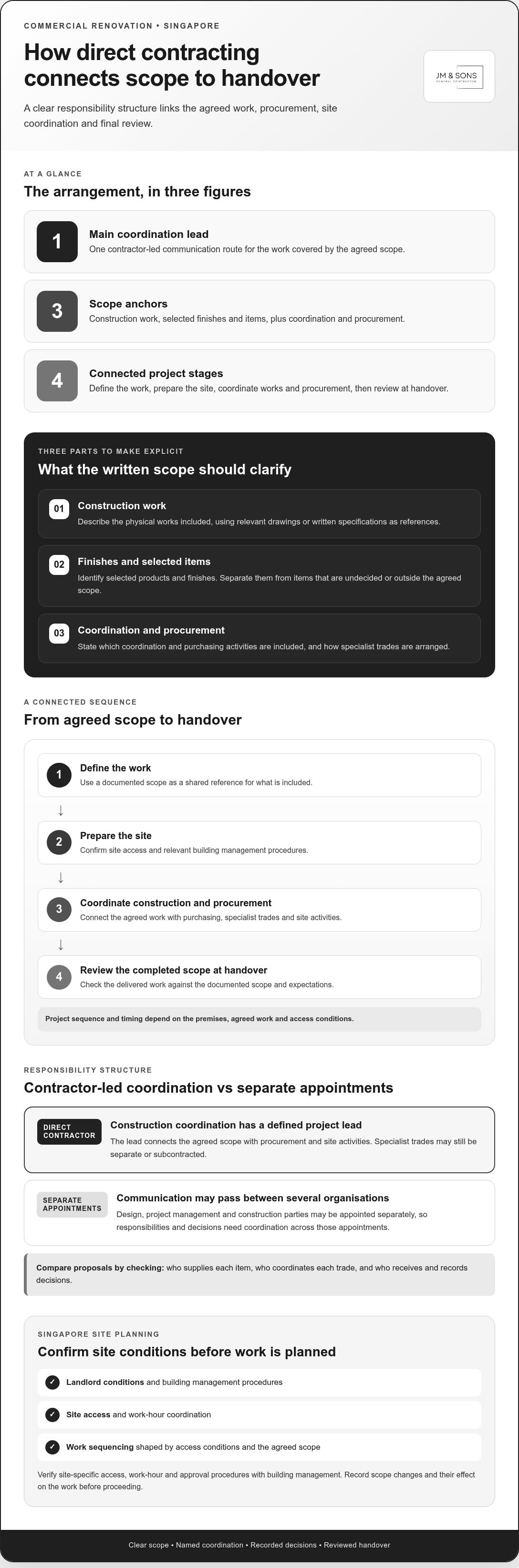
When a business appoints design, project management and construction parties separately, communication can pass between several organisations. That may suit the project, but responsibilities and decisions then need to be coordinated across those appointments. In a contractor-led arrangement, construction coordination sits with a defined project lead, who connects the agreed scope with procurement and site activities.
The exact setup varies. The written scope should state how design input, specialist trades and purchasing responsibilities are arranged rather than leaving them to assumption. A business can compare proposals by checking who supplies each item, who coordinates each trade and who receives and records decisions.
Why commercial renovation needs a clear point of responsibility
Consider an office refurbishment where work must be sequenced around staff access, or a retail fit-out where deliveries and installation need to align with site access arrangements. F&B establishment works may also involve several specialist activities that need to be coordinated. In each case, a named project lead gives the business a clear route for questions and decisions, while the agreed scope identifies who is coordinating each part.
Before work is planned, verify site-specific access, work-hour and approval procedures with building management. These conditions can affect the sequence of work and how site coordination is arranged. A clear responsibility structure helps the business discuss those requirements with its project lead and plan the work accordingly.
How direct renovation contracting connects scope, construction, and handover
A commercial fit-out moves through connected stages: define the work, prepare the site, coordinate construction and procurement, then review the completed scope at handover. The sequence and timing depend on the premises, the agreed work and any access conditions. A documented scope gives the project lead and business a shared reference as plans become site tasks and selected items are ordered.
A documented scope supports accountability because it gives the client and project team a shared record of what is to be delivered, coordinated and reviewed. It should connect drawings and specifications to practical work, so both parties can identify what is included and where a decision or change needs to be recorded. The value of direct contractors renovation lies in making those links clear, not in assuming every project follows the same procurement or trade arrangement.
What a clear renovation scope should make understandable
A useful scope separates the main parts of the proposal in plain language:
Construction work: Describe the physical works included, using the relevant drawings or written specifications as references.
Finishes and selected items: Identify the finishes or products selected for the project, and distinguish them from items that remain undecided or are outside the agreed scope.
Coordination and procurement: State which project coordination and purchasing activities are included, and how responsibilities are arranged for specialist work.
A detailed quotation should help the business understand the proposed scope and cost structure without relying on assumptions about standard inclusions. If a drawing, finish selection or site condition changes, record the agreed adjustment and its effect on the work before proceeding. For work that may involve building requirements, consult the relevant authority and building management. BCA’s guidance on the Building Control Act is a useful reference point.
How coordination carries work from site preparation to handover
Once the scope is agreed, the project team can plan site preparation, procurement and construction as connected activities. For example, access arrangements and work timing may affect when materials can be delivered or particular tasks can be carried out. These details are project-specific, so the sequence should reflect the premises and applicable building procedures rather than a generic schedule.
JM & SONS manages commercial projects from initial site preparation to final handover. Its commercial fit-out services cover office, retail and F&B premises. For commercial fit-out work, the project scope can set out how construction, procurement and any specialist trades are coordinated.
At handover, review the completed work against the documented scope. This gives the parties a practical way to identify completed deliverables and any items that still need attention. If you have floor plans or a written scope, share your renovation documents with JM & SONS to discuss the work.
Direct contractor versus separate project appointments: what changes?
The main difference is how project responsibility and communication are organised. A contractor-led arrangement places construction coordination under a defined project lead. With separate appointments, the business engages different parties for parts of the project, such as design, project management or construction. Neither structure is automatically right for every commercial renovation. The suitable arrangement depends on the services required, the appointment scope and the conditions of the premises.
This comparison describes typical differences, not a fixed rule. A contractor-led appointment can still involve specialist trades, while a separately appointed team may have clear coordination processes of its own. For businesses considering direct contractors renovation, the useful test is whether the proposed arrangements make responsibilities, communication and change records understandable before work proceeds.
Where a contractor-led arrangement can simplify communication
A defined project lead gives the business a clear route for construction-related questions, decisions and updates. That can make it easier to connect a requested change with its effects on the agreed work or procurement. When comparing a proposal, look for a clear description of the work, its cost structure and the process for recording changes. These details help the business understand how decisions will be managed as the project develops.
What the direct contractor label does not automatically guarantee
The label alone does not define which trades are included, who procures each item or how specialist work is arranged. Those responsibilities come from the written scope and project appointments. Building management procedures and any relevant authority requirements also depend on the premises and proposed works. Verify applicable requirements with building management and the relevant authorities, then make sure the project arrangements reflect them clearly.
Planning a direct contractor renovation in Singapore: scope, access, and coordination
A well-prepared project starts with useful information and clear decisions. For businesses considering direct contractors renovation, planning means more than agreeing on the physical works. The tenant, contractor, landlord and building management may each have information or procedures that affect access, timing and coordination. Set out the steps early, then confirm site-specific requirements before finalising the work schedule.
A practical sequence is:
Share available project documents. Provide floor plans, site photos, existing specifications and any landlord or building management instructions. These help the project team understand the premises and the planned changes.
Define the scope and open decisions. Record what work is proposed, which selections are outstanding and how changes will be agreed. This gives the quotation and work planning a shared reference.
Coordinate access and timing. Discuss site entry, delivery arrangements and work-hour procedures with building management. Set a schedule that reflects the premises’ actual conditions.
Agree on handover expectations. Identify what will be reviewed at completion and, if a tenancy is ending, what reinstatement requirements the tenant must meet.
These steps connect project documents to the way work will be organised on site. They also give the tenant a practical basis for discussing constraints before they affect sequencing or procurement.
Documents and decisions that help define the project
Floor plans show the intended layout, while site photos can help explain existing conditions that may not be obvious from a drawing. For end-of-tenancy work, share the landlord’s reinstatement checklist or relevant lease requirements so the proposed scope can be compared against them. JM & SONS’ guidance on Singapore commercial reinstatement works can help tenants frame the work they need to discuss.
Keep related decisions together. A marked-up plan, a list of selected finishes and written notes on landlord instructions can help distinguish agreed work from items that still need a decision. This is especially useful if several people in the business are providing input.
Building coordination, work timing, and technical submissions
Access, permitted work timing and technical submission needs vary by site and project. JM & SONS coordinates commercial fire safety and authority submissions where relevant. The tenant should verify current requirements with building management and the relevant authorities, since the building conditions and proposed works determine what applies.
Before settling the schedule, identify who will communicate with building management, who will coordinate any required submissions and how updates will be shared with the project team. Confirming these practical points alongside the scope helps everyone work from the same information. For a project discussion, send JM & SONS your floor plans, site photos or reinstatement checklist.
How JM & SONS delivers commercial renovation and fit-out projects
JM & SONS supports Singapore businesses with office renovation and fit-out, retail and F&B works, commercial project management, and commercial reinstatement. Each type of project has different demands. An office may need work coordinated around business operations, while retail and F&B premises can involve specialist tasks and site requirements that need to be planned together. The company manages projects from initial site preparation to final handover, with the work organised around the agreed scope.
For businesses assessing direct contractors renovation arrangements, the practical value is knowing how the proposed scope, quotation and site coordination fit together. Before appointing a contractor, compare the proposal with the drawings and confirm what is included, which items are excluded, how specialist trades are arranged and how changes will be recorded. These points make responsibilities easier to understand as decisions are made.
A Singapore contractor with established project capabilities
JM & SONS General Contractor Pte Ltd is a Singapore-based, family-owned business founded by Mr. Jamaludin Bin Masood and managed by his sons. Its commercial services include fit-outs for offices, retail shopping malls and F&B establishments, as well as reinstatement works to restore commercial spaces to their original condition.
Project coordination can connect construction activities, procurement and specialist work. The precise arrangement depends on the agreed scope and premises. Businesses should review the quotation and project discussions to understand what is included, who is responsible for each part and how communication will be managed.
JM & SONS provides commercial project management and reinstatement as well as fit-outs for offices, retail units and F&B premises. This range is relevant when a business is moving into a new space, changing its layout or preparing to return leased premises. The company’s commercial renovation and fit-out services connect these project needs with construction delivery.
Start a practical conversation about your renovation
Useful information to share includes the type of premises, the project’s purpose, floor plans and current site photos. For lease-end work, include the reinstatement checklist or relevant documents supplied to the tenant. These materials help frame a discussion about scope, access, coordination and handover, even if some project details are still being decided.
Include any known building management procedures or timing considerations. JM & SONS can discuss the project scope and coordination needs with you. You do not need a polished brief to begin. Available documents and a straightforward explanation of your plans provide a useful starting point.
Give your renovation a clear starting point
Before moving from an idea to a project brief, agree internally on what the new space needs to support. Identify operational priorities, decisions that still need approval and who in your organisation will make those decisions. This gives renovation discussions a practical focus and keeps business requirements visible as the work is developed.
The value of direct contractors renovation is not in the label alone. It comes from setting out responsibilities in a way that suits your premises and project, then keeping decisions clear as work progresses. A straightforward discussion about your priorities can help establish whether the proposed scope and coordination approach fit your plans. You do not need to have every detail resolved before taking the first step.
Share your project requirements with JM & SONS to discuss what comes next for your commercial space. Start a WhatsApp conversation about your renovation with your floor plans, site photos or reinstatement documents.
Frequently Asked Questions
What is a direct contractor for renovation?
A direct contractor is appointed by the business itself, rather than being engaged through another project party. For a renovation, the appointment should make clear which construction outcomes the contractor is responsible for delivering. Before signing, compare the written scope with the plans and note any exclusions or items that depend on separate appointments. This makes the term useful in practice, not just a label used in a proposal.
Is a direct contractor the same as a design-and-build contractor?
Not always. “Direct” describes how the contractor is appointed, while “design-and-build” describes a project arrangement that combines design and construction responsibilities. A direct appointment could cover construction only, or it could include design-and-build work if that is part of the agreed scope. Check who is responsible for design decisions, drawing revisions and construction information, especially if your business has its own designer or workplace planning team.
Can a direct contractor handle an office renovation in Singapore?
Yes. JM & SONS provides office renovation and fit-out in Singapore. The scope can be planned around the company’s operational requirements, such as whether work needs to be phased around staff using the premises. Discuss which areas need to remain accessible, how business operations may be affected and what decisions must be made before work starts. Building-specific procedures and applicable authority requirements should also be considered.
How do direct contractors manage commercial renovation coordination?
Coordination is organised around the responsibilities in the project appointment. In practical terms, a project team can use agreed drawings, quotation documents and written decisions to keep the work aligned as details develop. For a business, it helps to identify who can approve changes and how approvals will be recorded. If the premises have landlord or building management procedures, include their communication and review steps in the project plan.
Do direct contractors carry out every renovation trade themselves?
No. A direct appointment does not necessarily mean the contractor directly employs every specialist trade. Depending on the project arrangements, specialist work may be carried out by other trades or subcontractors. The useful distinction is between who performs a task and who has responsibility for coordinating it under the agreed appointment. Review the scope for specialist work, exclusions and any separate appointments so there is a shared understanding before the project proceeds.
What documents should I prepare before discussing a commercial renovation?
Start with the documents that show the space and the business’s requirements: current floor plans, site photos and any drawings or specifications already prepared. If you are ending a tenancy, include the reinstatement checklist or lease documents that describe the landlord’s expectations. You can also note your preferred timing, operational constraints and decisions that are still pending. These details help focus the initial discussion without requiring a complete project brief.
Can commercial renovation work be scheduled after business hours?
After-hours work can be coordinated when it suits the project, but timing depends on the premises, the work involved and building procedures. Before agreeing on a schedule, confirm permitted work periods and access arrangements with building management. Also consider whether deliveries, noisy tasks or work requiring access to shared areas need separate coordination, as these details can affect how the programme is arranged.
Have a project in mind? Share your floor plans, site photos or reinstatement documents with JM & SONS on WhatsApp to start a practical discussion about your next steps.



Comments