
Fast Reinstatement Contractor Singapore: 2026 Handover

Could a faster strip-out actually delay your handover? Speed depends on more than how quickly a space is cleared. A fast reinstatement contractor needs to coordinate the lease scope, building management requirements and finishing work from the start. If details are missed, rework can put your deposit and handover date at risk.
If your lease is ending soon, you need a realistic view of how quickly the space can be restored. The timeline depends on the premises’ condition, the agreed reinstatement scope, site access and any approvals required by the landlord or building management. Rushing without a plan can lead to rejected work or additional rent under the lease.
This guide explains how to organise a commercial handover in Singapore, what to clarify with building management and how to reduce avoidable delays. JM & SONS General Contractor Pte Ltd is a second-generation family contractor founded in 1990, with BCA registration and in-house construction capabilities. Careful coordination, including after-hours work where permitted, can help keep the project moving while meeting the landlord’s requirements.
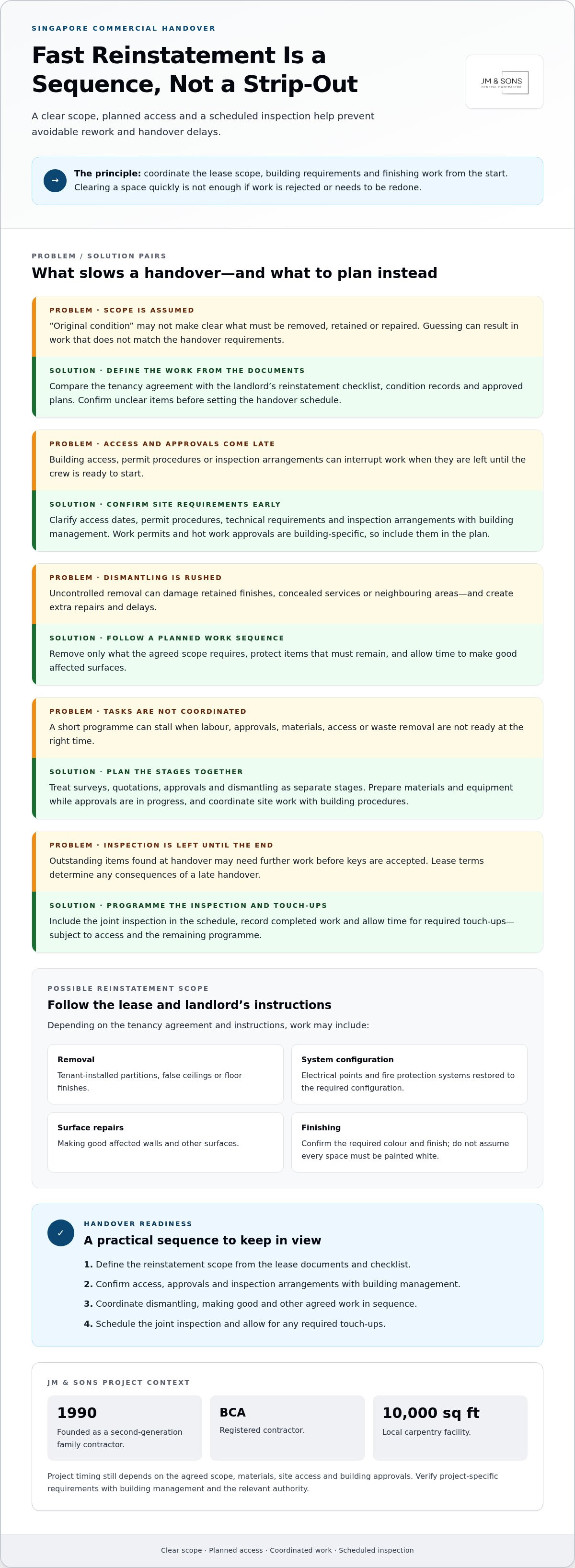
Use your tenancy agreement and the landlord’s reinstatement checklist to define the work before setting a handover schedule.
A fast reinstatement contractor can reduce delays by coordinating site work, building requirements and finishing tasks in a planned sequence.
Clarify building access, permit procedures and inspection arrangements early to avoid preventable interruptions.
Plan surveys, quotations, approvals and dismantling as separate stages, and confirm site-specific requirements with building management.
Request a detailed quotation that sets out the scope and assumptions, so you can resolve questions before work begins.
Table of Contents
What Is a Fast Reinstatement Contractor and Why Does It Matter?
A fast reinstatement contractor restores a commercial space to the condition required at the end of a tenancy, within the available lease window. Work can include removing tenant-installed partitions and finishes, making good affected surfaces, and preparing the premises for the landlord’s handover inspection. The goal is not simply to clear the space quickly. It is to plan and complete the work in the right order so the premises are ready for inspection against the agreed scope.
Reinstatement is part of the wider construction industry, where trades and work stages need to be coordinated. A Construction industry overview provides general background, but your project’s requirements come from your lease documents and the building’s procedures.
Start with the tenancy agreement (TA). It may specify what must be removed, what must remain and the condition in which the premises should be returned. Use those details to define the work, identify points that need clarification and plan around access or inspection arrangements. Don’t guess what “original condition” means. Compare the TA with condition records, approved plans and any reinstatement checklist for the unit.
Fast doesn’t mean rushed. Uncontrolled hacking or dismantling can damage retained finishes, concealed services or neighbouring areas, creating extra repairs and delays. A planned sequence helps the crew remove only what is required, protect items that must remain and allow time to make good affected surfaces. The work may look similar from one commercial space to another, but the approved scope is specific to each tenancy.
Common Reinstatement Requirements in Singapore
Depending on the TA and the landlord’s instructions, reinstatement may involve removing temporary partitions, false ceilings or tenant-installed floor finishes. It may also include restoring electrical points and fire protection systems to the required configuration, then repairing and repainting affected walls. Don’t assume every space must be painted white. Confirm the required colour and finish with the landlord or building management. Before work starts, clarify access rules, permits and technical requirements with building management.
The Cost of Delay: Why Speed Is a Financial Strategy
A late handover can have financial consequences. Some tenancy agreements provide for additional rent if a tenant remains in occupation after the lease ends, and a rejected handover may require further work before keys are accepted. The exact terms depend on the agreement, so check how it defines the handover date, acceptance and any holding-over provisions. A contractor cannot calculate a universal “double rent” exposure without reviewing those terms.
Include the joint inspection in the programme rather than treating it as a final formality. The landlord or building management can identify outstanding items, giving the team an opportunity to address them before the agreed handover deadline, subject to access and the remaining schedule.
A well-coordinated reinstatement project follows the documented scope, records completed work and allows time for required touch-ups. This cannot guarantee a particular deposit outcome, which depends on the lease and the landlord’s assessment. Clear scope, careful workmanship and timely communication give both tenant and landlord a more reliable basis for handover.
Key Capabilities That Drive Rapid Reinstatement
A short programme works only when each task is ready to start as the previous one finishes. Speed comes from coordinating labour, approvals, materials, access and waste removal as one plan, not simply adding more workers to the site. With in-house construction capabilities, site issues can be raised with the project team and decisions coordinated directly, helping keep the tenant informed as work progresses.
JM & Sons combines in-house construction capabilities with a local carpentry facility of 10,000 sq ft. This provides a local resource for project-specific carpentry adjustments as part of the agreed work. The programme still depends on the reinstatement scope, materials, site access and building approvals.
There is no responsible one-size-fits-all promise for how quickly a team can mobilise after a permit is issued. Readiness also depends on approved access dates, the work sequence, crew availability and whether materials and equipment are prepared. Plan these details while approvals are in progress to avoid losing time once the required permissions are in place.
Project Coordination: The Silent Engine of Speed
Some projects involve several requirements at once. If reinstatement affects fire protection systems or other fire safety measures, the work may need coordination with SCDF requirements. Building or structural work may also involve BCA considerations. The Singapore Building and Construction Authority publishes information on building and construction matters. Verify project-specific requirements with the relevant authority and building management.
Work permits and hot work approvals are building-specific processes, so include them in the plan before the crew is due on site. A coordinated team can prepare the required submissions and sequence work around building approval and access procedures. Clear communication between the supervisor and tenant also matters. One named point of contact can share progress, flag decisions that are needed and reduce avoidable waiting.
Logistics and Debris Management
Removal work generates debris. If it blocks access routes or accumulates in active work areas, it can hinder other tasks and make a final inspection harder to arrange. Plan collection and disposal alongside dismantling, using appropriate waste arrangements and facilities in Singapore. Keep work areas orderly and accessible so the supervisor can check completed items and prepare the space for inspection.
Building rules may affect lift use, loading access, work hours and waste movement. Confirm these details with management before setting the site schedule. Where after-hours or weekend work is permitted, coordinate it with the building’s access procedures rather than assuming the usual arrangements apply.
A reinstatement checklist, floor plan or site photos provide a useful starting point for discussing scope, access needs and project coordination. JM & Sons offers a reinstatement project discussion for commercial premises.
Compliance and Safety: Non-Negotiables for Handover
A tight handover date doesn’t remove the need to meet building and safety requirements. Build these into the work plan because an unresolved approval or site condition can interrupt progress. JM & Sons is BizSafe Level 3 certified. This relates to workplace risk management, but it is not a universal prerequisite for every Grade A office or mall. Building owners may set their own contractor criteria, so confirm the requirements for your premises with management.
BCA-related requirements depend on the scope of work. Reinstatement that affects structural elements may involve approvals and plans submitted by a Qualified Person. Changes to fire safety measures, such as escape routes, compartmentation or fire protection systems, may require SCDF coordination. The work details determine the applicable steps. Confirm project-specific requirements with building management and the relevant authorities before work begins.
JM & Sons’ commercial reinstatement services include fire safety submission coordination where required by the project. Records showing the proposed work and affected systems help establish which approvals and coordination tasks belong in the project plan.
Navigating Building Management Rules
A building’s fit-out manual or reinstatement procedures may cover work access, deliveries, protection of common areas and inspection arrangements. Review these alongside the tenancy agreement, then clarify current site requirements with management. Find out what public liability insurance documents and coverage period are required for the works. In a retail environment, confirm hoarding specifications, placement and access arrangements early so they can be included in the work plan.
Safety Protocols in Active Buildings
Hacking and dismantling require controls suited to the work area and the people who may be nearby. Plan how dust, noise, debris movement and access routes will be managed, especially in occupied buildings. The site supervisor can brief the team on agreed controls, monitor conditions and raise issues promptly. These measures help reduce disruption without treating a short schedule as a reason to compromise safe work practices.
Keep management instructions, approvals, insurance records and risk assessments together so the project team can refer to the same information. This makes coordination clearer when requirements change or a decision is needed on site. For broader project management context, the Construction Management Association of America provides industry resources.
A building manual or reinstatement checklist can help define the work and site procedures for a project. JM & Sons provides a reinstatement discussion for commercial handovers.
The Timeline of a Rapid Reinstatement Project
Plan a reinstatement programme backwards from the agreed handover date. The stages below are a planning framework, not a guaranteed duration. The actual schedule depends on the premises, work scope, access, approvals and any materials that need to be sourced. A fast reinstatement contractor should identify dependencies early, so a delay in one task does not catch the tenant by surprise.
Days 1 to 2: Survey and preparation. Review the site, tenancy requirements and building procedures. Prepare a detailed quotation and submit permit applications in line with management’s process. Start work only when required approvals and access arrangements are in place.
Days 3 to 7: Removal and dismantling. Subject to the approved scope and schedule, remove partitions, furniture and other tenant-installed items. Sequence hacking carefully and arrange debris removal as work progresses, rather than leaving clearance until the end.
Days 8 to 12: Restoration and finishing. Allow for relevant electrical, air-conditioning and fire protection reinstatement, followed by making good and touch-ups. The work required depends on the original configuration and what the landlord expects to be restored.
Final stage: Inspection and handover. Complete internal checks, arrange the joint inspection with the landlord or building management, and address outstanding items before formal handover.
Pre-Project Planning
Give the project team the clearest records available: a floor plan, reinstatement checklist and photos showing the premises’ original condition. These help distinguish items to remove from features that must remain. Flag components that may need special sourcing, such as specific fire sprinkler parts, early in the planning stage. Agree on one communication channel and a regular update schedule so decisions and site changes are visible to the tenant.
Execution and Quality Control
Some activities can proceed in parallel if work areas are safely separated and the sequence allows it. For example, painting might begin in a cleared zone while dismantling continues elsewhere. The supervisor should check that earlier work is complete and protected before the next trade starts. Before the landlord’s representative arrives, carry out an internal walk-through against the agreed scope and record any touch-ups still needed.
JM & Sons’ commercial reinstatement services include planning work around the premises’ requirements. Approval processes and handover expectations can vary between properties, so include the relevant building procedures in the programme.
A floor plan, site photos or reinstatement checklist can help shape a practical work sequence for your premises. Share your reinstatement documents with JM & Sons.
Choosing JM & SONS: Accountability and Heritage Since 1990
Reinstatement calls for more than a crew that can remove fittings. The contractor needs to work to the agreed scope, coordinate site activity and communicate clearly when a decision is needed. JM & Sons is a second-generation family contractor with a hands-on approach to commercial work. Clear responsibility matters in a deadline-driven project, from the quotation through to final handover.
JM & Sons starts with a detailed quotation that sets out the proposed work, giving you a chance to review the scope and raise questions before work begins. If site conditions or landlord instructions call for a change, clear communication helps everyone understand its effect on the work and schedule. A fast reinstatement contractor should provide a realistic plan based on the premises and requirements, rather than an assurance detached from the project details.
Retail and F&B spaces can involve specific access, operating-hour and building-management considerations. The work sequence and site arrangements need to reflect the premises and the landlord’s instructions. JM & Sons carries out commercial reinstatement work for retail and F&B spaces, with the scope shaped around the project rather than a one-size-fits-all checklist.
Our In-House Advantage
In-house construction capabilities and a local carpentry facility give the project team a direct way to coordinate construction work and project-specific carpentry. This can be useful if an item needs adjustment as part of the agreed scope. Direct coordination also helps connect site priorities, labour planning and scheduling while keeping responsibility within the project team. Learn more about the people and values behind JM & Sons’ family business.
A Commitment to Ethical Service
A good working relationship begins with a clear agreement. Tenants, landlords and facility managers need straightforward updates, documented decisions and a shared understanding of the work. That approach supports effective coordination and helps prevent avoidable confusion during a handover. It does not remove the need to follow the lease or building procedures, but it makes responsibilities easier to discuss and manage.
JM & Sons’ work is rooted in practical effort and accountability. If you are planning an office exit, prepare your tenancy requirements, reinstatement checklist, floor plan and site photos. These give the project discussion a useful starting point and help define the scope for your premises.
JM & Sons carries out Office Reinstatement work for commercial premises. Share the project details to discuss the scope and next steps.
Set Up Your Handover with Confidence
Bring the tenancy requirements, building procedures and site information together before setting the work schedule. A floor plan, site photos and reinstatement checklist can clarify the scope and highlight decisions that need to be made early. With that groundwork in place, a fast reinstatement contractor can shape a practical sequence around your handover date, access arrangements and approval requirements.
JM & SONS approaches commercial reinstatement with clear communication and detailed quotations, so you can understand the proposed work before it begins. Share the documents you have, along with your target handover date, to start a focused discussion about the project.
Contact JM & SONS to discuss your reinstatement quotation and site survey. A well-prepared handover plan can help you move forward with greater clarity.
Frequently Asked Questions
How long does a typical office reinstatement take in Singapore?
There is no single duration that applies to every Singapore office. The schedule depends on the premises’ size and condition, the work listed in the tenancy agreement, building access, approval processes and whether replacement components are needed. A straightforward removal scope differs from one involving extensive ceiling, electrical or fire protection work. Set the handover date first, then have a fast reinstatement contractor assess the site and plan the sequence.
Is it possible to complete reinstatement after office hours or on weekends?
After-hours work may be possible, but the building’s rules and approved access arrangements determine when work can take place. Ask building management about permitted work periods, noise restrictions, lift bookings and any notice required for noisy activities. Weekend access should not be assumed. Share these constraints before agreeing on the schedule, especially if the unit is in an operating office, mall or F&B premises where neighbouring tenants may be affected.
What happens if the landlord rejects the reinstatement work?
Ask for the outstanding items in writing and compare each point with the tenancy agreement, reinstatement checklist and agreed scope. The contractor can then assess the corrective work required and coordinate access for it. Keep dated photos and records of instructions, completed work and inspection comments. If the parties disagree about what the lease requires or who bears a cost, refer to the tenancy terms and seek appropriate professional advice.
Do I need a permit from BCA for reinstatement works?
It depends on the work. Reinstatement involving structural elements may require a BCA permit and plans submitted by a Qualified Person before work starts. Removing non-structural finishes may have different requirements, but building management can still require its own approvals or permits. A contractor’s site assessment is not a substitute for approval. Describe the proposed work to building management and verify applicable requirements with the relevant authority or Qualified Person.
Can a reinstatement contractor help with fire safety (SCDF) compliance?
Yes. A contractor can coordinate fire safety requirements and SCDF submissions where the reinstatement scope affects fire safety measures. Changes involving sprinklers, detectors, compartmentation or escape routes may need specific review. The required steps depend on the work and the building’s arrangements. Identify affected systems early, and verify submission and approval requirements with building management and the relevant authority before altering or removing fire protection components.
What is the difference between reinstatement and a simple renovation?
Reinstatement prepares a commercial unit for return at the end of a lease, according to the tenancy agreement and landlord’s requirements. Renovation generally changes or upgrades a space for continued or new use. For example, removing tenant-installed partitions and repairing affected finishes may form part of reinstatement, while installing new workstations for an incoming office may be renovation. The lease and approved scope determine what work is required for your handover.
Why is bizSAFE Level 3 important for reinstatement contractors?
bizSAFE Level 3 indicates that a company has implemented workplace safety and health risk management processes. This is relevant to reinstatement, where tasks such as dismantling and material removal need planned controls. It is not automatically a prerequisite for every building or project. Landlords and building management may set their own contractor criteria, so check the site’s requirements and consider how the contractor plans to manage risks for the specific work.
How do I get an accurate quote for my reinstatement project?
Provide the tenancy agreement’s reinstatement clauses, the landlord’s checklist, a floor plan and clear site photos. Point out items you believe must remain, and share the target handover date and known access restrictions. A site survey helps clarify visible conditions and the work scope. Ask for a detailed quotation that separates the tasks and identifies assumptions, exclusions or approval-related dependencies, so you can resolve questions before the project is scheduled.



Comments