
HDB Resale Renovation Timeline: A Practical Singapore Guide

What if your move-in date depends less on a quoted number of weeks than on what your flat needs once work begins? With an HDB resale renovation timeline, that distinction matters. Two flats with similar layouts can follow different schedules if one needs more removal work, repairs, or custom carpentry. It’s reasonable to want a firm date before arranging deliveries, temporary accommodation, or movers. But a schedule is useful only when its dependencies are clear.
This guide explains the usual sequence, from defining the scope and checking approvals to site works, installation, and final checks. You’ll see how the flat’s condition, HDB requirements, material choices, and trade coordination can affect the plan. Requirements can change, so verify the details that apply to your renovation directly with HDB.
The aim isn’t to promise a universal completion period. It’s to help you build a realistic working plan, identify the information your renovation contractor needs, and account for factors that may shift the schedule. A clear scope and regular communication make it easier to coordinate work, deliveries, and moving arrangements.
Table of Contents
What shapes an HDB resale renovation timeline in Singapore?
An HDB resale renovation timeline is a project-specific sequence, not a standard number of weeks that applies to every flat. The work required, the home’s condition, approval steps, and the order in which trades can proceed all affect the schedule.
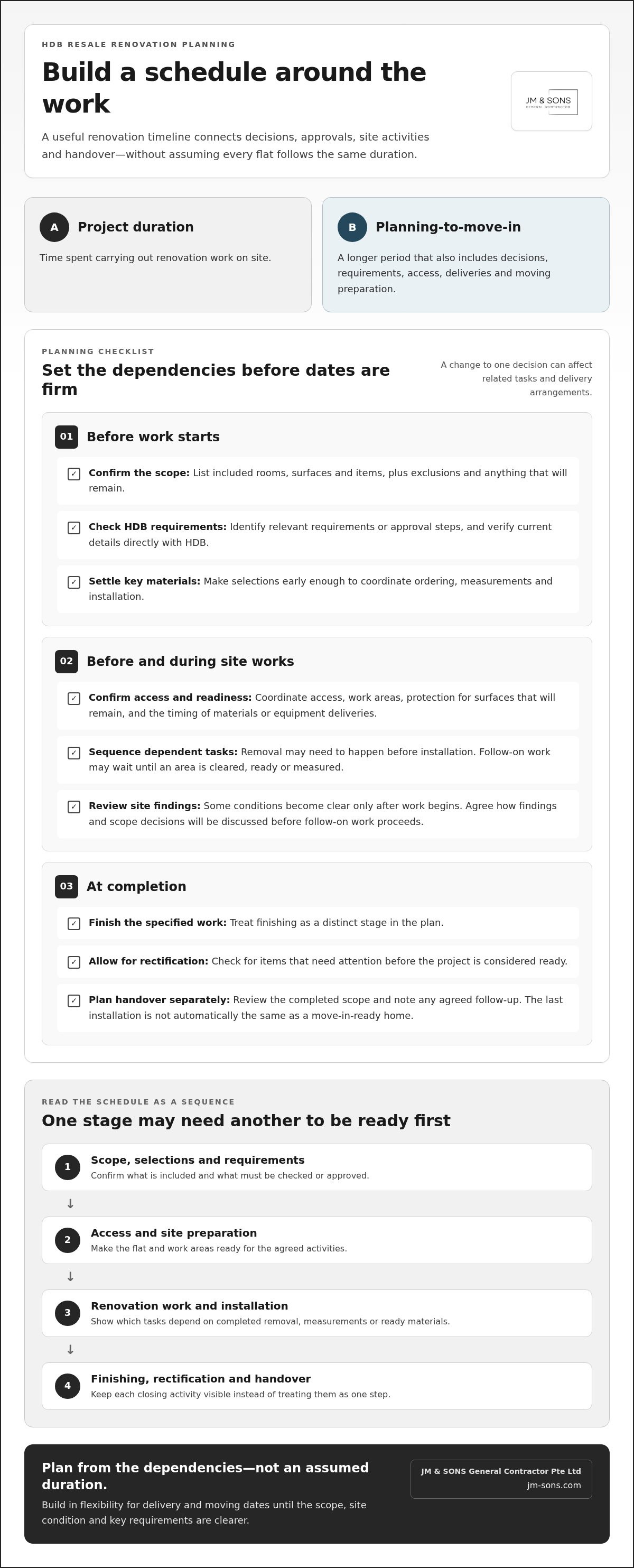
Project duration is the time spent carrying out renovation work. The planning-to-move-in period is longer: it also includes defining the scope, checking requirements, making material decisions, arranging access and deliveries, and preparing to move. Keep these periods separate so a site-work estimate isn’t mistaken for a move-in date.
This distinction matters even when the renovation appears straightforward. A project may involve little alteration but still require decisions or approvals before work starts. A broader renovation may have more stages, with some tasks dependent on earlier work. Build the schedule around those actual steps rather than relying on a one-size-fits-all estimate.
Why resale flat condition changes the schedule
Existing finishes and fittings help determine what to keep, remove, repair, or replace. Some conditions are visible during an initial site assessment; others may become clear only after work begins. A site review helps refine the scope, identify likely dependencies, and set out a workable sequence before dates are treated as firm.
For example, if a new installation depends on removing an existing finish, removal needs to happen first. If the condition beneath that finish affects the agreed scope, the next step may need to be reviewed before follow-on work proceeds. Agreeing how site findings will be discussed and approved helps keep decisions connected to the schedule.
Which timeline dependencies matter before work starts?
Before confirming a start date, make the main dependencies visible. These often include:
Scope: Record which rooms, surfaces, and items are included, as well as what is excluded or will remain.
HDB requirements: Identify whether the planned work has relevant requirements or approval steps. Verify current rules and application details directly with HDB.
Materials: Settle key selections early enough to coordinate ordering, measurements, and installation.
Site access: Confirm when the flat can be accessed for assessment, work, and deliveries.
Task order: Identify work that must be completed before another trade or installation can begin.
Not every task can run in parallel. A later stage may depend on completed removal, confirmed measurements, or materials being ready. If one decision changes, related tasks and delivery arrangements may need to shift too. Marking these links in the schedule makes the effect of a change easier to understand.
The Housing and Development Board (HDB) is central to Singapore’s public housing system, and its current renovation requirements are relevant to resale flat planning. Verify applicable requirements with HDB rather than relying on an old checklist or a schedule prepared for a different scope. A plan based on clear decisions, a site assessment, and verified requirements gives you a more useful basis for coordinating the work.
HDB resale renovation timeline: how the work usually progresses
A useful schedule shows what needs to happen next, what must be ready first, and which tasks can overlap. The sequence below is a planning guide, not a checklist every resale flat must follow. A home that needs no removal work, for example, may move from preparation to installation without the same early site activities as a larger renovation.
From scope confirmation to site preparation
Start by documenting the agreed work, key selections, and decisions still outstanding. Then identify which activities require HDB approval before they can begin. Verify current requirements and approval steps directly with HDB. While approval-dependent work is pending, other planning may continue, such as confirming materials or arranging access, provided those decisions don’t depend on an approval or measurement that is still outstanding.
Before site activities begin, confirm access arrangements and make sure the flat is ready for the agreed work. This can include deciding how to protect areas and surfaces that will remain, and coordinating the timing of materials or equipment arriving at the unit. An access issue, unresolved selection, or unready work area can affect the next task, so include these items in the schedule.
From renovation works to handover
The work order depends on the scope. If removal is included, follow-on installation may depend on the area being cleared and ready. Other tasks may be scheduled alongside it if they don’t obstruct one another. Show these links clearly so everyone understands what must be completed before the next trade or installation can proceed.
Finishing, rectification, and handover are separate closing activities. Finishing completes the specified work. Rectification checks identify items that need attention before the project is considered ready. Handover provides an opportunity to review the completed scope and note any agreed follow-up. Allowing for these steps helps avoid treating the last installation as the same thing as a move-in-ready home.
A practical sequence can be set out like this:
1. Confirm the scope: Record the work, selections, exclusions, and outstanding decisions.
2. Check requirements: Identify relevant HDB requirements and secure applicable approvals before dependent work begins.
3. Prepare the site: Coordinate access, protection, measurements, and readiness for the planned activities.
4. Carry out the agreed works: Schedule removal, repairs, installations, and other tasks in the order the scope requires.
5. Finish and review: Complete finishing work, check the result, and address agreed rectifications.
6. Handover: Review completed items and coordinate any remaining follow-up before arranging the move.
This order provides a framework, not a fixed duration. If a selection, approval, or site condition changes, the project team can identify which later activities are affected and revise the sequence. Sharing your renovation scope and site photos with JM & SONS for schedule planning can help clarify the proposed steps before you coordinate deliveries or moving arrangements.
Compare resale renovation scenarios before estimating your schedule
“Light”, “room by room” and “full renovation” are planning labels, not promises about how long a project will take. They describe the breadth of work. The schedule still depends on the flat’s condition, the selected works, which decisions are settled, and any approval steps that apply. Use these comparisons to clarify the scope before setting dates.
Lighter refresh
Scope: Limited replacement or finishing work, with existing fittings or areas retained where suitable.
Likely dependencies: The condition of retained surfaces and fittings, access to the work area, and readiness of selected replacement items.
Planning question: What is staying, and what needs to be removed, repaired, or replaced?
Room-by-room upgrades
Scope: Work concentrated in selected areas, such as updating one room while keeping other parts of the flat largely unchanged.
Likely dependencies: Whether tasks can be kept separate, how access is managed, and whether work in one area affects another.
Planning question: Which areas must be completed or cleared before the next one can be worked on?
Broader renovation
Scope: Work across several parts of the home, potentially involving more removal, replacement, and finishing decisions.
Likely dependencies: The order of work between areas, material selections, site findings, and any relevant HDB requirements or approvals.
Planning question: Which decisions and approvals must be settled before dependent work can begin?
A lighter refresh versus a more extensive renovation
A limited refresh may involve fewer work areas, but that doesn’t automatically make its schedule straightforward. A retained fitting may need assessment before surrounding work can proceed, and a surface that looks simple may have site conditions that affect the agreed scope. A broader renovation may create more links between tasks. For example, removal in one area may need to happen before installation or finishing there. More work can mean more coordination, but the effect depends on the specific scope.
Room-by-room work helps define boundaries, but it doesn’t always mean each area can be completed independently. Shared access, overlapping tasks, or a change to one selection may affect how the areas are sequenced.
How flat condition and decisions affect the comparison
Consider two plans for a resale flat: one retains serviceable fittings, while the other replaces them. The second plan adds work and requires replacement choices to be coordinated with measurements, installation, and related finishing. If a selection changes after those steps are planned, the schedule may need to be reviewed. The same applies when work reveals a condition that wasn’t visible during the initial review.
Before estimating, list what will be retained, replaced, or left undecided. Then review the flat on site and check current HDB requirements for the intended works. A site-specific assessment is needed to set a schedule that reflects the actual scope and its dependencies. Base the HDB resale renovation timeline on that assessment, not on a category label alone.
Plan your HDB resale renovation timeline around move-in
Start with your intended move-in date, then work backwards through the tasks that need to happen before the flat is ready for daily use. Treat that date as a target while approvals, selections, site readiness, and the work sequence are still being confirmed. A moving booking or appliance delivery arranged too early can create disruption if the relevant area isn’t ready.
Planning principle: confirm the dependencies before treating a target move-in date as fixed. This gives you a clearer basis for coordinating movers, furniture, and appliances without assuming every task will proceed exactly as first planned.
Build a practical schedule with checkpoints
Use a written schedule that connects decisions to site milestones. Record what is agreed, what remains open, and which tasks depend on approvals, completed work, confirmed measurements, or selected materials. When a decision changes, you can then see where it affects the plan.
Confirm the scope and decisions: Note what will be done, what will be retained, and which material or fitting choices are still outstanding.
Track approval dependencies: Identify planned work that can’t start until relevant requirements or approvals are addressed. Verify current HDB requirements directly with HDB.
Set site milestones: Mark preparation, key work activities, installation, finishing, and handover checks in the order they apply to your flat.
Coordinate deliveries: Schedule furniture and appliances for when the access route and installation area are ready, not simply for the first available delivery date.
Review updates: If a milestone shifts, promptly revisit the tasks and arrangements that depend on it.
For example, an appliance delivery may depend on the kitchen being ready for installation, while furniture may need to wait until finishing work and access arrangements are complete. Check delivery requirements with the relevant supplier and coordinate them against the project schedule. Keep a delivery date provisional until the necessary work and access conditions are clear.
Allow for uncertainty without inventing a buffer
A condition that becomes visible during work or a change to the agreed scope can affect later tasks. Rather than adding an arbitrary number of days, agree how the team will record a change, explain its effect, and update the schedule. A useful written update identifies the finding or decision, the affected work, and any move-in or delivery arrangements that need review.
Keep one current version of the scope and milestone plan, and share updates with everyone making arrangements around the flat. This reduces the chance that a mover or delivery service is working from an outdated date. It also shows which items are firm and which still depend on a decision or completed task.
If you have a floor plan, site photos, or a list of intended works, discuss your resale renovation timeline with JM & SONS. These details help make the conversation about the project sequence and move-in planning more practical.
How JM & SONS coordinates an HDB resale renovation project
A schedule is easier to understand when it shows more than a start date and a target finish. It should make clear what work is agreed, which decisions are still open, what each task depends on, and how updates will be shared. JM & SONS provides residential renovation services for HDB, BTO, and resale properties. Clear communication and accountability help homeowners follow the plan and understand when a change affects the next step.
JM & SONS is a second-generation family contractor with roots dating back to 1990. For a resale renovation, the practical starting point is to agree on the scope, record key decisions, coordinate the work, and communicate changes plainly. The schedule remains a working plan, since unexpected site conditions or changes can affect progress.
What clear project coordination should make visible
At the planning stage, document the agreed works, retained items, selections, and outstanding decisions. Then show how they connect to site activities, relevant approval dependencies, and milestones. If a selection is pending or an activity relies on another task being completed, record that dependency. This helps everyone see what can proceed and what needs attention first.
During the project, schedule updates should explain what changed, which work is affected, and whether connected arrangements need to be reviewed. This gives homeowners a clearer basis for coordinating move-in plans without suggesting that every target date will remain unchanged. Verify current HDB requirements and approval steps directly with HDB.
When the agreed scope includes construction work or custom joinery, those activities need to be coordinated with site measurements, installation, and other finishing tasks. The schedule should show where they fit in the sequence and what needs to be ready before each stage can proceed.
Start a conversation with useful project information
You don’t need a fully settled plan to begin a practical discussion. Share what you have and identify what is still undecided. Helpful starting information includes:
Available floor plans and site photos.
A draft scope showing intended works and items you hope to retain.
Your intended move-in window and priority areas.
Any selections, access details, or approval questions already in hand.
With this context, the discussion can focus on the project sequence, dependencies, and information needed to prepare a clearer schedule. If your plans are still taking shape, that’s fine. Share your resale flat renovation plans with JM & SONS for a practical conversation about the scope and coordination involved.
Take the next step toward a workable move-in plan
Before setting your renovation start or move-in date, turn your current plans into a clear working brief. Note your priorities, the areas you expect to change, the items you hope to retain, and any decisions still outstanding. This gives the schedule a practical starting point and makes it easier to see what needs to be settled before dates become commitments.
A useful HDB resale renovation timeline should help you make informed decisions as the project develops, not just mark a hoped-for completion day. Keep the plan open to updates when site findings or confirmed choices affect the order of work. Then you can adjust related arrangements with a clearer understanding of what has changed.
To discuss your HDB resale renovation, send JM & SONS your floor plan, site photos, or renovation checklist. These details provide a practical starting point for discussing the scope and schedule.
Frequently Asked Questions
How long does an HDB resale renovation take?
There’s no single duration that fits every resale flat. When reviewing an estimate, check what its start point means: is it based on site access, approval, or another agreed milestone? Clarify what the stated completion point includes, such as final checks or handover, and whether any items are excluded. These details make estimates easier to compare and help prevent different expectations about what “ready” means.
Does HDB approval affect a resale renovation timeline?
It may affect when work covered by an applicable approval can proceed. Keep the approved scope and related HDB correspondence with your renovation records. If you later consider adding or changing work, compare the revised scope with current HDB guidance before treating the change as ready to schedule. This creates a clearer record of what was considered and helps avoid relying on an approval discussion that related to different work.
Can I stay in my HDB flat during renovation?
It may be practical for some households, but assess how the planned work affects everyday needs before deciding. Consider whether you’ll have access to essential facilities, a place to rest away from work areas, and a way to keep personal belongings clear of the active site. If you work from home or have young children, discuss those needs early so day-to-day arrangements can be considered alongside the renovation plan.
When should I arrange furniture and appliance deliveries?
Before confirming a delivery, check that the item will fit through the flat’s access route and into its intended space. Confirm dimensions, installation needs, and whether packaging or old-item removal is included in the supplier’s arrangement. Keep these details with the order confirmation. This can help prevent an item arriving before it can be brought in or installed, even if the renovation area appears close to ready.
What happens if unexpected conditions are found during renovation?
Ask the project team to explain the finding and pause any decision that would change the agreed work until you understand the proposed response. A useful record includes a description or photo of the issue, the options discussed, and your approval of the chosen next step. Agreeing in advance who can approve changes also helps prevent instructions from different household members creating conflicting expectations.
Is a resale flat renovation timeline different from a BTO renovation timeline?
It can be, but the flat type alone doesn’t tell you how much work is involved. For a fair comparison, list the actual items included in each plan and note what is already present or intended to remain. For example, compare whether fittings are being retained or replaced rather than assuming every resale or BTO flat starts in the same condition.
Can I set a move-in date before the renovation schedule is confirmed?
You can choose a provisional date for household planning, but avoid making every related booking depend on it until the handover arrangements are clearer. Check the rescheduling terms for movers, storage, or temporary accommodation before committing. You can also prepare a short list of essentials to bring in first, while keeping larger deliveries tied to the confirmed readiness of their intended spaces.



Comments