
How to Apply for an HDB Renovation Permit: 2026 Guide

Updated: Aug 23
What if the vision of your open-concept dream home ends with a heavy fine and a compulsory order to rebuild a wall you just paid to hack? It's a scenario that keeps many HDB owners awake at night, especially when they aren't sure how to apply for HDB renovation permit approvals correctly. At JM & SONS General Contractor Pte Ltd, we've seen how easily a lack of clarity can turn a joyful milestone into a stressful legal battle. You want a beautiful home, but you also want the peace of mind that comes with knowing every brick and tile follows the law.
We agree that the paperwork shouldn't be the hardest part of your renovation. This 2026 guide provides a clear, practical roadmap to navigating regulations while avoiding common pitfalls like unauthorized works. Drawing on our heritage as a family-run contractor since 1990, we'll explain your responsibilities versus your contractor's duties. You'll learn about current 2026 timelines, wall hacking restrictions, and the exact steps to secure your permits without the stress. Let's ensure your renovation starts on a foundation of honesty and technical integrity.
Table of Contents
Understanding the HDB Renovation Permit Requirements
An HDB renovation permit is an official authorization issued to ensure that any changes made to a flat don't compromise the building's structural integrity. It isn't a mere formality. It's a safety measure. You must obtain written approval from the Housing & Development Board (HDB) before starting any work that could affect the load-bearing capacity or fire safety of the block. This oversight keeps the entire community safe by preventing haphazard modifications that could weaken the building over time.
Understanding how to apply for HDB renovation permit approvals begins with knowing the risks of skipping the process. If you proceed without a permit, you face serious consequences. HDB can issue a fine and a legal order to restore the flat to its original condition at your own expense. While HDB may occasionally allow unauthorized work to be retained upon payment of an administrative fee, this is never guaranteed. It's always better to proceed with the correct paperwork in hand. It protects your investment and your peace of mind.
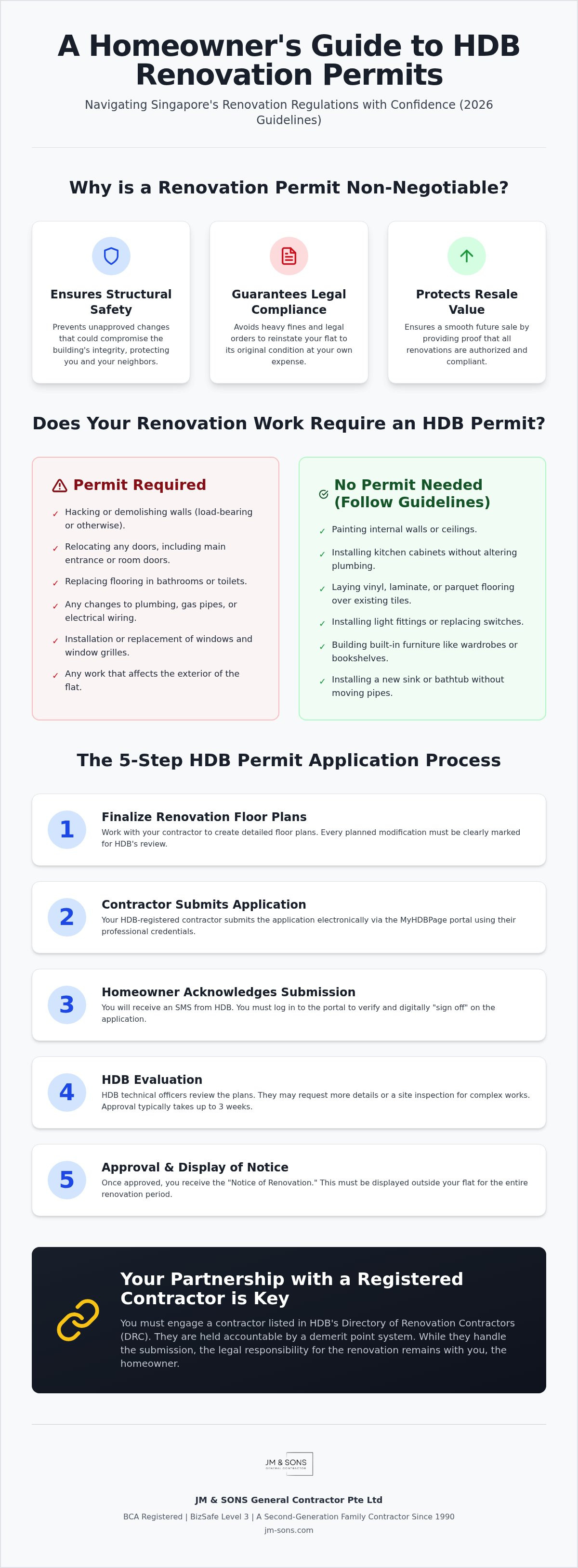
Not every job requires a permit. Simple cosmetic updates usually only require you to follow HDB's general guidelines. These include:
Painting walls or ceiling.
Installing kitchen cabinets without altering plumbing.
Laying vinyl or laminate flooring on top of existing tiles.
Installing window grilles.
However, for anything involving hacking, plumbing, or electrical extensions, a permit is mandatory. Even for works that don't require a permit, you're still required to use a registered contractor.
Why a Permit Is Mandatory for Structural Safety
Every flat is part of a larger ecosystem. Hacking a wall might seem like a minor aesthetic choice, but it can affect the weight distribution of the entire building. HDB monitors these changes to prevent structural failure. The permit also ensures fire safety compliance, protecting you and your neighbors from potential hazards. It serves as your legal shield. It proves that your home is safe, compliant, and ready for future resale without any legal "hidden surprises" regarding unauthorized works.
The Directory of Renovation Contractors (DRC)
You must engage a contractor listed in the Directory of Renovation Contractors (DRC). Hiring "freelance" workers who aren't registered is a significant risk. These workers often lack the technical knowledge required to navigate HDB's strict requirements. HDB regulates DRC members through a demerit point system. This system keeps contractors accountable for their quality of work and adherence to safety rules. Choosing a registered contractor ensures that the person handling your home is recognized by the authorities for their competence and ethics. For those who are still deciding between a resale flat and a private property, New Launch offers an in-depth look at Singapore's newest condominium developments to help you find a home that fits your lifestyle and renovation goals.
Applying for a permit isn't a task you do alone. In fact, HDB requires your registered contractor to handle the actual electronic submission on your behalf. Your journey begins with a clear conversation about your vision and ends with a physical notice displayed on your front door. Understanding how to apply for HDB renovation permit approvals ensures you don't miss critical steps that could delay your move-in date. This coordination is why choosing a contractor with a strong track record of accountability is so vital.
Step 1: Finalize your renovation floor plans. Your contractor needs these to show HDB exactly where changes will occur. Every planned modification must be clearly marked.
Step 2: Contractor submits the application. This is done electronically via the MyHDBPage portal using their professional credentials.
Step 3: Homeowner acknowledgement. You'll receive an SMS from HDB once the submission is live. You must log in to the portal to acknowledge and "sign off" on the application.
Step 4: HDB evaluation. HDB technical officers evaluate the details. They might request a site inspection or more drawings if the works are complex.
Step 5: Approval and display. Once approval is granted, you'll receive the "Notice of Renovation." You must display this document outside your flat throughout the entire renovation period to inform neighbors that the work is authorized.
The Homeowner’s Role in the Application
Even though the contractor clicks the submit button, the legal responsibility stays with you. You must verify that the proposed works on the application match your actual intent. If a contractor suggests hacking a wall that isn't on the approved plan, stop. Check your digital floor plan first. If you've lost yours, a copy can be purchased from HDB for S$5. Your final acknowledgement on the HDB portal is a formal declaration that you agree to the scope of work and will ensure its compliance.
Timeline and Approval Durations
Permit processing times vary based on the complexity of your project. Standard renovations usually take 2 to 5 working days. If your plans involve wall hacking or structural changes, expect a wait of 7 to 14 working days. Very complex projects can take up to 21 working days. We recommend discussing your floor plans with an experienced team early to account for these windows. Remember that permits have specific validity periods. For new BTO blocks, the permit is valid for 3 months. For existing resale blocks, you only have 1 month from the date of issuance to complete the works.
Which Renovation Works Require HDB Approval?
Identifying exactly which parts of your home require official clearance is the first step in understanding how to apply for HDB renovation permit approvals. You can't simply start hacking because you own the unit. HDB views the flat as part of a collective structure. Certain modifications require a permit to ensure the building remains safe for everyone. At JM & SONS General Contractor Pte Ltd, we've navigated these regulations since 1990. We know that transparency about what can and cannot be done is the only way to avoid legal headaches later.
Common works that require HDB approval include:
Demolition or hacking of internal partition walls.
Relocating or replacing bathroom floor and wall finishes.
Changing windows or external grilles.
Relocating plumbing fixtures like sinks or toilets.
Installing specific heavy air-conditioning systems.
Structural Works and Wall Hacking
HDB floor plans use specific symbols to distinguish between load-bearing and non-load-bearing walls. Load-bearing walls are usually shaded in bold black or grey. You are strictly prohibited from hacking these. Even for non-load-bearing partition walls, you must secure a permit before any demolition begins. Our team often advises clients to check the slab load too. HDB regulations state that the total thickness of new floor finishes and screed must not exceed 50mm. This prevents excessive weight on the floor slab. If you've just collected keys for a new BTO flat, remember that you cannot hack bathroom walls or floors for the first 3 years. This restriction exists to protect the waterproofing membrane and prevent leaks in the units below.
Window and Door Replacements
Windows are part of the building's external facade. You cannot change their design or color if it clashes with the rest of the block. All window installations must be carried out by a contractor registered with the Building and Construction Authority (BCA). This is a safety requirement. Casement windows must have stainless steel rivets; sliding windows must have safety stoppers to prevent them from falling. If you intend to enclose a balcony or change window frames, your contractor must ensure the new installations meet these specific safety and aesthetic standards. Understanding these requirements is essential before your contractor starts the process of how to apply for HDB renovation permit approvals for your specific unit.
Avoiding Common Pitfalls in the HDB Permit Process
Even when you know how to apply for HDB renovation permit approvals, small administrative oversights can stall your progress. We believe transparency is the best policy. Most project stalls don't happen because of bad intentions. They happen because of a lack of preparation. For instance, submitting outdated site photos or floor plans that don't reflect the current state of a resale flat is a frequent cause for rejection. HDB technical officers need to see the exact current layout to assess structural safety accurately. Knowing how to apply for HDB renovation permit correctly means ensuring every document is current and verified before hitting the submit button.
Another major pitfall is jumping the gun. Starting any hacking or structural work before the official approval is received is a serious violation. You might receive an SMS notification that the application is submitted, but that isn't an approval. Wait for the formal document. Proceeding early can lead to heavy fines and an immediate stop-work order, which will delay your move-in date far longer than the few days you tried to save.
Neighbor Etiquette and Town Council Rules
Your renovation doesn't happen in a vacuum. You're part of a community. HDB requires you to serve a written notice to neighbors at least 3 days before any work begins. This isn't just a courtesy; it's a requirement. You must also display the Notice of Renovation outside your unit throughout the project. General renovation works are restricted to 9:00 am to 6:00 pm on weekdays and Saturdays. Noisy works, like hacking and drilling, must follow these same hours. Work is strictly prohibited on Sundays and public holidays. Failing to respect these windows often leads to complaints, which can bring Town Council officers to your door and halt your project. We also recommend ensuring your contractor protects common areas with proper boarding to avoid damaging HDB property.
Handling Permit Rejections or Queries
Sometimes HDB will reject a wall-hacking request. This usually happens when they suspect the wall might be structural or if the slab load is a concern. Don't panic. You can often appeal or adjust your design. In complex cases, you may need to engage a Professional Engineer (PE) to provide structural calculations and endorsements. If you decide to change your layout mid-renovation, you can't just wing it. You must stop work and secure a new permit for the changes. Proceeding without this updated approval is a major risk that could lead to restoration orders later. If you're unsure about your floor plan's feasibility, contact our team for a detailed review.
The JM & SONS General Contractor Pte Ltd Approach: Accountability in HDB Renovations
Navigating the technicalities of HDB regulations requires more than just a certificate. It requires a partner who understands the weight of responsibility that comes with modifying a home. Since 1990, JM & SONS General Contractor Pte Ltd has operated as a second-generation family business built on the values of manual effort and personal integrity. We don't just provide a service. We provide a commitment to safety that stems from our long history in Singapore's construction landscape. When you're looking into how to apply for HDB renovation permit approvals, you aren't just looking for a submission; you're looking for accountability.
Our approach is built on transparency. We provide detailed quotations that itemize every aspect of the work. This ensures there are no hidden costs or surprises halfway through the project. As a BCA registered contractor with BizSafe Level 3 certification, we handle the complex coordination of authority submissions and site management in-house. This direct oversight means we maintain control over the timeline and the technical integrity of every wall hacked or window installed. We take the stress out of the paperwork so you can focus on the excitement of your new space.
30+ Years of Local Expertise
Three decades of experience allows us to anticipate and prevent common regulatory mistakes before they happen. We understand the nuances of different HDB block types, from older resale units to the latest BTO developments. Our 10,000 sq ft local carpentry facility gives us a unique advantage. We don't rely on external third parties for your custom joinery. This allows for strict quality control and ensures that every piece meets our rigorous standards. You get direct communication and accountability from the Jamaludin family, ensuring your home is treated with the respect it deserves.
Beyond Just Paperwork: Quality Execution
A permit is just the beginning. The real work lies in executing those plans to meet or exceed HDB and BCA safety standards. We take neighbor relations seriously. Our team manages noisy works with professional care, ensuring we adhere to time windows and minimize disruption to your community. We protect common areas and manage debris removal with the same diligence we apply to the construction itself. If you're ready to move forward with your project, we invite you to contact JM & SONS General Contractor Pte Ltd for a floor plan consultation. Let's discuss how to apply for HDB renovation permit approvals for your unit with the honesty and expertise your home deserves.
Securing Your Home’s Future with Confidence
A successful renovation starts with a foundation of technical integrity and legal compliance. You now understand that while your contractor handles the digital submission, your role in verifying floor plans and managing neighbor relations is vital. Knowing how to apply for HDB renovation permit approvals correctly isn't just about avoiding fines. It's about ensuring your home remains a safe, stable environment for your family for years to come.
At JM & Sons, we've spent over 35 years refining this process. Since our founding in 1990, we've combined our BCA registration and BizSafe Level 3 certification with the precision of our 10,000 sq ft local carpentry facility. We believe in accountability and straightforward communication from the first site visit to the final inspection. If you're ready to start your journey without the stress of regulatory guesswork, we're here to help.
Share your HDB floor plan with JM & SONS for a detailed consultation. Let's build your dream home on a foundation of trust and professional expertise.
Frequently Asked Questions
How long does it take for HDB to approve a renovation permit?
Approval times vary based on the work complexity. Standard renovations usually take 2 to 5 working days. If you're looking into how to apply for HDB renovation permit approvals for wall hacking or bathroom works, expect a wait of 7 to 14 working days. Complex projects involving structural endorsements can take up to 21 days. it's best to plan your timeline around these windows to avoid delaying your move-in date.
Can I apply for an HDB renovation permit myself without a contractor?
You cannot submit the application yourself. HDB requires all permit applications to be submitted electronically by a contractor listed in the Directory of Renovation Contractors (DRC). The contractor uses their professional credentials to file the request via the MyHDBPage portal. Your role is to provide the floor plan and acknowledge the submission via SMS notification or the LifeSG app once the contractor has successfully uploaded the details.
What happens if I renovate my HDB flat without a permit?
Renovating without a permit is a serious violation of HDB regulations. You risk receiving a heavy fine and a legal order to restore your unit to its original condition at your own expense. HDB may also mark the unit as having unauthorized works, which complicates future resale. It's always safer to secure official approval first. This protects your investment and ensures the structural integrity of the entire building remains intact.
Do I need a permit to change my HDB bedroom floor tiles?
Yes, you generally need a permit if you're hacking and replacing existing floor tiles. HDB regulates this to ensure the total thickness of the new screed and tiles doesn't exceed 50mm. This prevents excessive weight on the floor slab. If you're simply overlaying vinyl or laminate on top of existing tiles, a permit isn't required. However, you must still engage a registered contractor to ensure the work follows HDB's technical guidelines.
Is a permit required for simple painting or minor carpentry works?
No permit is required for cosmetic works like painting or installing kitchen cabinets. These are considered non-structural modifications. However, you must still ensure that your carpentry doesn't block access to service pipes or fire safety equipment. Even for these minor works, HDB mandates that you use a registered contractor from the DRC. This ensures that the workers are aware of block-specific rules and respect the permitted working hours.
Can I hack a wall in my BTO flat as soon as I get the keys?
You can hack non-load-bearing walls once you have received the official permit. Unlike bathroom tiles, there's no 3-year waiting period for internal walls. However, you must first verify which walls are structural. These are usually shaded in bold on your floor plan. Your contractor must understand how to apply for HDB renovation permit approvals specifically for your unit layout. Never start hacking until you have the physical notice to display.
Why did HDB reject my application to hack a wall?
Rejections often occur if HDB suspects a wall provides structural support or if the proposed change compromises the building's integrity. They may also reject applications if the submitted floor plans are inaccurate or if the unit has previous unauthorized modifications. If this happens, don't panic. You can often appeal by providing a Professional Engineer's endorsement. Our team at JM & Sons frequently helps clients navigate these technical queries to find a compliant design solution.
What is the "3-year rule" for BTO bathroom tiles?
The 3-year rule prohibits the hacking of bathroom floor and wall tiles in newly completed BTO flats. This restriction is in place to protect the waterproofing membrane installed by HDB. Hacking too early can lead to water seepage issues in the units below. If you wish to change the look of your bathroom before the three years are up, you can consider overlaying new tiles on top of the existing ones instead. To explore high-quality fixtures that can elevate your bathroom design, read more.


Comments