
How to Find a Good Reinstatement Contractor in Singapore

Choosing a good reinstatement contractor in Singapore takes more than comparing quote totals. Two quotations can cover different work, exclusions and coordination responsibilities, even when they look similar. A clear scope helps you understand what is included before the commercial space is returned.
If you’re preparing for a handover, start with the tenancy and handover documents. A missed landlord or building management requirement can lead to extra work or complicate an inspection. Site access, other contractors and ongoing business operations can also affect how the work is scheduled.
This guide explains how to compare contractors, clarify the reinstatement scope and plan communication before work begins. Use it to review your documents, identify questions to resolve and coordinate access and handover arrangements around the needs of your Singapore premises.
Table of Contents
What Makes a Good Reinstatement Contractor in Singapore?
Returning a commercial unit before lease handover can put pressure on tenants, facility managers and landlords. The work needs to reflect the agreed reinstatement requirements, while access, building management arrangements and business operations also need to be considered. Look for a contractor who can understand the unit, define the scope and coordinate the work through to handover.
A good reinstatement contractor turns handover requirements into a clear scope, coordinates the work responsibly and remains accountable for what has been agreed.
Use these four practical qualities to assess a contractor:
Scope clarity: Work items and responsibilities are stated plainly, so you can see what is included.
Coordination: Removal, hacking and site clearing are planned as connected parts of the job, rather than left as separate assumptions.
Communication: There is a clear point of contact for updates, decisions and site matters.
Workmanship: The completed space is prepared in line with the agreed handover requirements.
Which experience matters for commercial reinstatement?
Look for experience relevant to your type of premises. Offices, retail shops, F&B outlets and industrial spaces have different layouts and operating contexts. A contractor familiar with commercial reinstatement can discuss how removal, hacking and site clearing will be scoped and sequenced for your unit. Ask how the proposed work relates to your handover documents and site conditions, rather than relying on a broad list of unrelated services. JM & SONS undertakes commercial reinstatement works for these types of spaces.
How should credentials and accountability inform your choice?
Credentials are useful context, but they are only part of your assessment. JM & SONS holds BCA registration and bizSAFE Level 3 certification. The Building and Construction Authority (BCA) Singapore is a statutory board responsible for the building and construction industry. Verify current project-specific site and safety requirements with building management or the relevant authority.
Accountability also shows in everyday communication. A clear point of contact helps keep scope questions, decisions and coordination matters from becoming scattered across different parties. Before work starts, document the agreed scope and responsibilities, and agree how updates will be shared. JM & SONS is a Singapore-based, second-generation family contractor established in 1990 and managed by the founders’ sons. This background is useful context, while the project scope and communication arrangements remain central to your appointment.
How to Assess a Reinstatement Quote and Work Scope
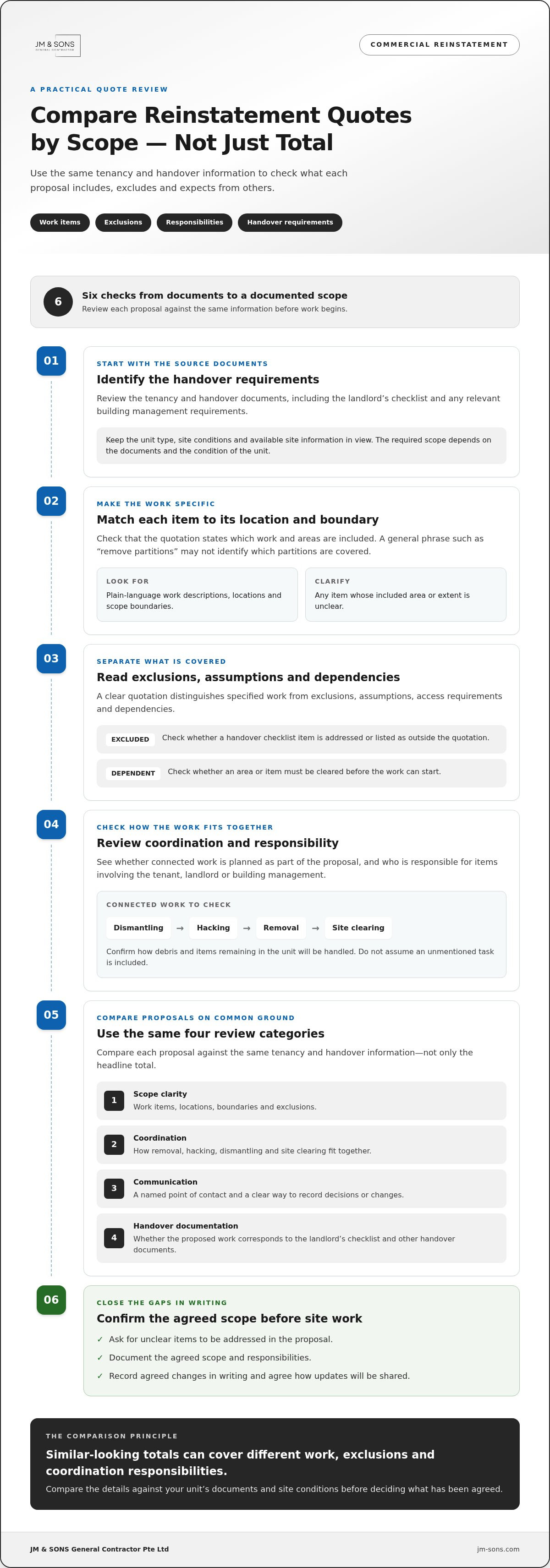
A quotation is useful only when it is clear what the price covers. Compare proposals against the same tenancy and handover documents, then check each item for the work, location and responsibility it describes. Headline totals can hide important differences: one proposal may include dismantling and site clearing, while another leaves some of that work outside its stated scope.
What should a detailed reinstatement quotation make clear?
Look for plain-language descriptions of the work and the areas where it applies. “Remove partitions” is less precise than identifying which partitions are included. A clear quotation should also distinguish specified work from exclusions, assumptions, access requirements and dependencies. For example, it should be clear if an area must be cleared before work can start.
Check who is responsible for items involving the tenant, landlord or building management. If a handover checklist calls for a particular condition, confirm that the quotation addresses it or lists it as an exclusion. JM & SONS uses detailed quotations to set out project scope and responsibilities, helping all parties understand what has been agreed before site work begins.
How do you compare contractor proposals fairly?
Review proposals side by side using the same categories. The checks below can help you spot gaps before appointing a contractor. For lease-related context, refer to Singapore Reinstatement Works: 2026 Tenant Compliance Guide alongside your own tenancy and handover documents. The required scope depends on those documents and the unit’s condition.
Scope clarity: Are work items, locations, boundaries and exclusions described clearly?
Coordination: Does the proposal explain how dismantling, hacking, removal and site clearing fit together, and identify dependencies?
Communication: Is there a named point of contact and a clear way to record decisions or changes?
Handover documentation: Does the proposed work correspond to the landlord’s checklist and other handover documents?
Pay close attention to removal and site clearing. Two quotations may both mention dismantling but differ on which items or areas are included, or how debris and remaining items are handled. Don’t assume an unmentioned task is included. Ask for unclear items to be addressed in the proposal, and record agreed changes in writing.
Site conditions can also affect the scope. Existing layouts, items left in the unit and access arrangements may differ from what the documents suggest. Give the contractor the relevant checklist and available site information when requesting a quotation. For a wider overview of Singapore’s construction-sector agencies, see the Ministry of National Development Singapore.
If you’re comparing proposals, share your quotation and handover checklist with JM & SONS to discuss how the listed scope relates to your commercial reinstatement work.
Choosing a Contractor for Your Unit, Lease, and Handover
A standard reinstatement package can miss details that matter in your unit. The work depends on the tenancy and handover documents, the space’s existing condition, and the landlord’s or building management’s arrangements. The contractor should consider these together rather than assume every commercial property needs the same work.
Set the reinstatement scope against the specific tenancy and handover documents, not a one-size-fits-all checklist.
How do office, retail, F&B, and industrial projects differ?
The type of premises shapes the planning discussion, but it does not determine a fixed scope. An office project may need to account for staff, remaining equipment or a move-out plan. A retail unit in a mall or managed commercial building may have access procedures and neighbouring occupants to consider. F&B and industrial spaces have their own layouts and operating contexts, so the contractor should review the actual site rather than infer requirements from its category.
Office: Consider how staff, furniture removal and business operations affect access to work areas.
Retail: Clarify building or mall procedures, access windows and coordination around neighbouring units.
F&B: Review the lease and handover documents alongside the unit’s existing condition and management arrangements.
Industrial: Explain the site context and operational constraints without assuming what machinery or compliance requirements apply.
For every unit, explain what must remain operational, when the site can be accessed and which parties need updates. This gives the contractor practical context for planning removal, hacking and site clearing, and helps avoid treating a generic service list as proof of project fit.
What should the contractor coordinate with landlords and building management?
Clarify site arrangements before agreeing on a work plan. These may include access procedures, management submissions, work timing, coordination with other parties and how the landlord expects the space to be presented for inspection. Requirements vary by property, so verify current, site-specific details with the landlord or building management and document the agreed responsibilities.
For retail or F&B units in managed buildings, include management procedures in the project discussion from the outset. Offices and industrial premises may require a different approach to access, surrounding occupants and ongoing operations. Base the schedule on the agreed work and available access, not on an assumed standard sequence.
JM & SONS coordinates commercial reinstatement projects, including complex work and after-hours coordination where needed to suit site arrangements. Clear communication between the tenant, contractor and management helps surface access or inspection questions early. Share the relevant lease extracts, handover checklist and site details during planning so the proposed work can be matched to the unit and its return requirements.
Planning Reinstatement Work and Handover in Singapore
A workable handover plan connects the documents and site conditions to the agreed scope, access arrangements and inspection process. Avoid relying on a generic timeline: the schedule depends on the work required, when the unit can be accessed and the landlord’s or building management’s procedures. Use the steps below as a planning framework and adapt them to your lease and building.
What information helps plan the work?
Gather the tenancy agreement, landlord instructions, reinstatement checklist and any available site records before discussing the work. Include site photographs and floor plans or layout information where available. These materials help clarify what the documents require and what is present on site, so planning can address the actual unit rather than rely on assumptions.
Review the handover documents. Identify reinstatement requirements, inspection expectations and any dates or conditions that affect the unit’s return. Note questions that need clarification with the landlord.
Record the existing condition. Photograph relevant areas and note known constraints, such as restricted access or spaces that remain in use. This gives the contractor useful context for discussing the work.
Share layout information. Provide available floor plans or marked-up layouts to show where work is expected. Identify areas or items that need particular attention, and distinguish known details from anything still to be confirmed.
Agree the work scope. Align the proposed work with the documents and site information. Record exclusions, responsibilities and dependencies so everyone can plan from the same understanding.
Coordinate access and communication. Confirm how site access will be arranged, who will communicate with building management and other parties, and how progress or decisions will be shared. If the business is still operating, discuss how work can be planned around operating hours and other activities.
Prepare for inspection and handover. Refer to the landlord’s stated expectations and confirm how the completed work will be reviewed. Keep a record of outstanding items and agreed actions so they can be addressed before handover.
How can you keep the handover process coordinated?
Give each party a clear role. The tenant can consolidate documents and provide access information; the contractor can coordinate the agreed site work and raise scope questions; the landlord or management can clarify property-specific procedures. Confirm current requirements with the relevant landlord or building management, since access arrangements and inspection expectations can differ between sites.
Use a focused reference such as End-of-Lease Reinstatement: A Step-by-Step Checklist to organise documents and preparation tasks, then adapt the checks to your lease and building process. A good reinstatement contractor should use the information you provide to develop a project-specific plan, communicate dependencies and explain how site activities will be coordinated.
Share your reinstatement checklist, floor plan and site photographs with JM & SONS to discuss a project-specific scope and handover plan. Send your reinstatement documents on WhatsApp.
Why JM & SONS Is a Practical Reinstatement Contractor to Consider
A practical appointment depends on how well the contractor’s capabilities match the unit, the agreed scope and the handover process. JM & SONS undertakes commercial reinstatement for office, retail, F&B and industrial spaces, including hacking, partition removal and site clearing. This gives the team a relevant foundation for planning the work as a coordinated project rather than a list of unrelated tasks.
JM & SONS is a Singapore-based, second-generation family contractor managed by the founders’ sons. Its history in the local construction industry dates back to 1990. This background provides context, but the useful measure for your appointment is whether the scope, responsibilities and communication plan are clear for your unit.
What does JM & SONS bring to a commercial reinstatement project?
JM & SONS has in-house construction capabilities to support coordination across the agreed reinstatement work. If the scope involves removing partitions and clearing the site, for example, these tasks can be considered together in the project plan. Clear communication and detailed quotations help establish what has been agreed and identify matters to discuss before work proceeds.
The company also has a 10,000 sq ft local carpentry facility. This is relevant when the project scope involves carpentry or custom joinery, rather than being a standard requirement for every reinstatement. Consider the company’s capabilities in relation to the work specified in the landlord’s documents and the condition of the space.
JM & SONS holds BCA registration and bizSAFE Level 3 certification. These credentials form part of the company’s background, but project-specific planning is still essential. A good reinstatement contractor should set out the agreed work, responsibilities and coordination arrangements in a way the client can understand.
What should you share to start a useful discussion?
Available documents make an initial project discussion more specific. Share the reinstatement checklist or landlord instructions, any floor plans or layout information, and site photographs showing the unit’s current condition. Include the unit type, handover context and known access considerations, such as operating hours or coordination with building management.
You can flag questions or unclear requirements even if every detail is not yet resolved. They can be considered against the documents and site information, keeping the discussion focused on the work required for your premises.
Share your available documents with JM & SONS to discuss commercial reinstatement for your unit. Share your reinstatement documents with JM & SONS on WhatsApp.
Set Up Your Handover for a Clear Start
Before appointing a contractor, bring the lease requirements, site information and handover expectations into one conversation. This gives everyone a practical basis for agreeing what needs to happen, what remains unclear and how the work can fit around access and business operations. A good reinstatement contractor should help turn those details into an agreed plan, with responsibilities understood before work begins.
You can start before every question is settled. A focused discussion can identify points that need clarification with the landlord or building management and the information needed to shape the project plan. Keep the conversation centred on your unit and its actual handover requirements.
Share your available floor plans, site photos or reinstatement checklist to begin a project-specific discussion with JM & SONS. Discuss your commercial handover on WhatsApp.
Frequently Asked Questions
What does a reinstatement contractor do in Singapore?
A commercial reinstatement contractor carries out work agreed for returning a leased business space, based on the lease requirements and the unit’s condition. The work may involve removing tenant-installed items or clearing the site. Clarify how the scope treats items that are damaged, altered or shared with other occupants. This helps prevent assumptions about what should stay or be removed from becoming a handover issue.
When should I engage a contractor for commercial reinstatement?
Begin planning once you have a handover date or landlord instructions. Early discussion gives you time to gather documents, arrange access and identify questions for the landlord. It is especially useful if the premises are still in use or another party is managing the move-out. Leaving scope decisions until the final stage can limit access and coordination options.
Does a landlord always require a commercial unit to be restored to its original condition?
No. The required condition depends on the tenancy terms and any later written agreement with the landlord. “Original condition” may need clarification if the unit has been altered or records of its initial state are incomplete. Compare the lease with the landlord’s instructions and request written direction on any differences. Don’t assume every fixture must be removed or every alteration can remain.
What documents should I provide for a reinstatement quotation?
Useful documents include the tenancy agreement or relevant reinstatement clauses, the landlord’s instructions, a handover checklist and any available floor plan. Site photographs can show current conditions, while building management information can explain access arrangements. If you’re unsure whether an item is included, mark it and raise it during the scope discussion. This makes it easier to see what the quotation covers and what needs clarification.
Can reinstatement work be carried out after business hours?
It may be possible, depending on the building’s arrangements, the work scope and the agreed schedule. Check permitted access and work periods with the landlord or building management before planning around evening work. Consider how the timing affects deliveries, other contractors and nearby occupants. JM & SONS coordinates after-hours work where needed to suit site arrangements.
What if the reinstatement checklist differs from the tenancy agreement?
Identify the items that differ and request written clarification from the landlord or property manager before confirming the work scope. For instance, the checklist may refer to a fitting that the lease describes differently. Share both documents with the contractor so the discrepancy is visible during planning. Keep the landlord’s response with the project records and confirm related site procedures with building management.
Preparing for a commercial handover? Share your floor plans, site photos or reinstatement checklist on WhatsApp to discuss the documents for your unit.



Comments