
Mall Reinstatement in Singapore: A Guide for Tenants

What if a retail unit looks empty, but the mall still won’t accept handover? In Singapore, mall reinstatement works involve more than removing fittings and clearing the site. The lease may specify what must be removed or retained, while mall management sets procedures for access, work hours, safety and moving materials.
When requirements sit across different documents and teams, it can be difficult to know where to start. A missed detail can lead to extra work or hold up handover. Bring the lease scope, mall procedures and handover expectations together before work begins.
This guide explains how to turn those requirements into a clear work scope, plan access and task sequencing, and prepare completion records. It also covers how an organised reinstatement process can connect the initial review, site works and final inspection.
Table of Contents
What Mall Reinstatement Works in Singapore Mean for Tenants
Mall reinstatement means returning a leased retail unit to the condition required for handover. This may involve removing tenant-installed items, restoring affected surfaces or leaving specified fixtures in place. The required end state depends on the tenancy and premises, so there is no single scope for every mall unit.
The lease is the starting point, but it may not be the only document that guides the work. Landlord instructions and mall management procedures can affect how the scope is carried out, including access to the unit and movement through shared areas. Bring these requirements into one plan so the completed work aligns with handover expectations.
Reinstatement is different from a fit-out. A fit-out prepares a space for business use, while reinstatement removes or restores elements as required at the end of a tenancy. The outcome is not necessarily a completely bare unit. It is the condition agreed for that specific handover.
How lease terms shape a mall reinstatement scope
Review the reinstatement clauses, relevant schedules and written landlord instructions before defining the work. A general overview of a Lease can explain the relationship between the parties, but the wording and records for your tenancy determine the practical scope.
Existing drawings, condition records and handover documents can help establish what was present at the start of the tenancy and what has changed. If it is unclear whether a partition, finish or fixture should be removed or retained, identify the specific item and request written direction from the landlord or mall management before work begins. Keep that response with the project records as a shared reference.
How mall reinstatement differs from a general commercial handover
A retail unit sits within an operating mall, so planning may need to account for approved access arrangements, loading routes, shared corridors and the effects of noise or material movement on nearby operations. Procedures differ between buildings. Confirm the current requirements for the specific site instead of assuming they match another mall.
Pay particular attention to the unit’s boundaries and interfaces with common areas. For example, removal work inside the tenancy may affect a shopfront edge or a shared corridor finish. Agree where the tenant’s scope ends and how adjacent areas should be protected or made good. Mall reinstatement works must connect lease requirements with the practical conditions of the building.
What Mall Reinstatement Works May Include: Removal, Retention and Clearing
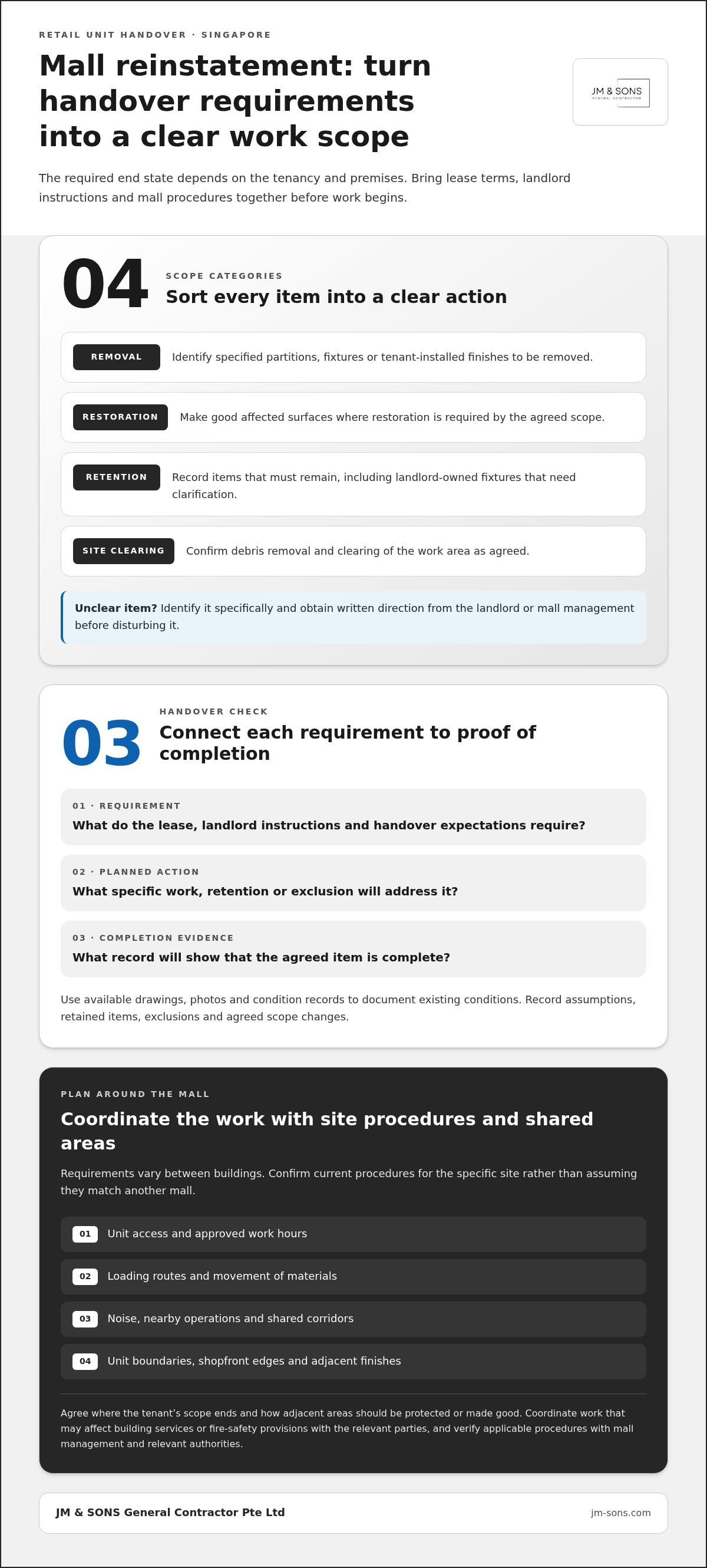
The scope should turn each lease requirement and mall instruction into a clear, itemised action. A retail unit may need removal work, surface restoration, coordination around building services or final site clearing. The required tasks depend on the agreed handover condition and what is present on site.
Separate confirmed work from open questions. For example, list a partition identified for removal as a defined task, but mark an unclear fixture or finish for written direction before work starts. This avoids assumptions leading to unplanned removal or repairs.
Which fixtures, partitions and finishes need to be removed?
Use the lease documents, landlord instructions and site records to identify tenant-installed items. An itemised scope might group work under:
Surface restoration: making good affected areas where required by the agreed scope.
Retention: items identified to remain, including landlord-owned fixtures that need clarification.
Site clearing: removal of debris and clearing the work area as agreed.
Photos and available drawings can record existing conditions and show where items sit in relation to the unit. If ownership or retention is unclear, get written direction from the landlord or mall management before disturbing the item. Hacking and partition removal should follow the documented scope and the site’s approved procedures.
How to handle services, interfaces and site clearing
Removal work may meet building services or affect the boundary between the retail unit and shared areas. Identify these interfaces before work begins and coordinate affected tasks with the relevant parties. If proposed work may affect fire-safety provisions or building systems, arrange a project-specific review. Verify applicable requirements and procedures with mall management and relevant authorities.
Close-out should reflect what was agreed, not just what looks tidy. Confirm whether debris removal, protection or restoration at the unit’s edges is included, then record completion against the relevant scope items. For wider context on property and facility management in Singapore, the Association of Property and Facility Managers (APFM) provides an industry reference point.
JM & SONS carries out commercial and retail reinstatement works. If you’re preparing a retail unit for handover, share your reinstatement scope to discuss the work involved.
How to Check Mall Reinstatement Scope Against Handover Expectations
A unit can look cleared and still fall short of its handover requirements. The landlord may expect a particular finish, retained item or record that is not obvious from a visual check alone. For mall reinstatement works, compare each written requirement with the planned task and the evidence that will show it is complete.
During a site review, compare the lease documents and landlord instructions with the visible condition of the unit. Record differences, assumptions, retained items and exclusions before work begins. If the scope changes during the project, document the agreed change and its effect on the work. This gives the tenant, project team and mall management a shared record.
How to compare the lease scope with the proposed work
A broad instruction such as “remove fittings” can be interpreted in different ways. Break it into specific items, such as a named partition or a particular finish, and assign responsibility and completion evidence to each one.
Lease requirement:
What the lease or written instruction says must be done.
Planned action:
The specific removal, retention or restoration task.
Responsible party:
The person or team coordinating and completing the item.
Completion evidence:
The record that will show the item has been addressed.
For example, if an instruction requires a partition to be removed, list its location, the planned removal and how completion will be recorded. Note assumptions or exclusions beside the relevant item instead of burying them in general wording. If the documents do not match the site condition, pause work on that item and request written direction from the landlord or mall management.
What to prepare for inspection and handover
Keep a practical handover file as the work progresses. It helps explain what was agreed and makes completed items easier to review during inspection.
Take dated progress and completion photos that clearly show the relevant areas.
Keep the approved scope, written clarifications and agreed changes together.
File completion records against the matching work items.
Confirm inspection arrangements and any additional records required with mall management.
Before the final inspection, check each item against the scope document rather than relying on a general impression that the unit is ready. Final acceptance criteria vary by tenancy and building, so confirm them with the landlord or mall management. Clear records do not replace the inspection, but they help show what was completed and resolve questions against the agreed scope.
How to Plan Mall Reinstatement Works Around Singapore Site Logistics
Mall reinstatement works must fit both the agreed scope and the building’s operating arrangements. Access windows, delivery routes, service-lift use and debris removal can affect the sequence, so confirm them before setting a site schedule. Early planning also helps align the reinstatement period with the tenant’s move-out and lease dates.
Use a connected sequence rather than treating each task as a separate booking:
Review documents: Gather the lease requirements, landlord instructions and relevant mall procedures.
Survey the unit: Record existing conditions and identify access points and work interfaces.
Agree the scope: Resolve unclear items and document what is included, retained or excluded.
Plan access: Confirm work hours, loading arrangements, service-lift use and applicable submissions or permits.
Carry out the works: Coordinate removal, affected services, surface restoration and debris movement.
Inspect and hand over: Arrange the inspection and provide the agreed completion records.
What to confirm with mall management before work starts
Building procedures vary. Confirm submission requirements, permitted work hours, site-specific safety procedures and how workers and materials can access the unit. Check delivery and loading-bay arrangements, service-lift booking and any restrictions affecting debris removal. If the scope touches fire-safety provisions or other building systems, identify the coordination and approval requirements for that work with mall management and relevant authorities.
How to sequence work and reduce avoidable delays
Some tasks depend on others. Removal may need to be coordinated around affected services, while surface restoration usually follows dismantling and clearing. Include coordination with adjacent units where shared boundaries, access routes or nearby operations may be affected. Record dependencies in a shared schedule, with named responsibilities, confirmed access windows and handover milestones. If a mall procedure or scope decision changes, update the schedule and inform the affected parties.
Allow time for any applicable survey, approvals or submissions, work execution and inspection. Do not use the lease end date as the only scheduling reference. The tenant’s move-out, the mall’s access arrangements and the handover inspection all need to fit together. JM & SONS coordinates retail reinstatement works with site logistics. To discuss your project, share your mall schedule and reinstatement details.
Choosing a Mall Reinstatement Contractor and Preparing for Handover
A clear scope and a clear point of contact help keep reinstatement, mall coordination and handover aligned. An itemised quotation should describe the work, identify assumptions and state exclusions. This gives the tenant a practical way to understand what is included and which items still need a decision from the landlord or mall management.
Coordination extends beyond the physical work. Agree who will manage site arrangements, communicate with mall management, record approved scope changes and organise completion evidence. If an item depends on access approval or input from another party, show that dependency in the project plan rather than leaving it until the last moment.
What accountable reinstatement coordination looks like
JM & SONS is a second-generation family contractor with roots dating to 1990. The company carries out commercial and retail reinstatement works, supported by in-house construction capabilities and experience coordinating mall procedures and after-hours work. Its credentials include BCA registration and BizSafe Level 3 certification.
Work timing and arrangements should suit the unit, agreed scope and mall management procedures. A detailed quotation sets out planned work items and assumptions before commencement. Clear communication gives the tenant and relevant building contacts a route for raising questions, recording decisions and tracking progress. For an overview of the service, see JM & SONS’ commercial reinstatement services.
What to share when requesting a project discussion
Useful project information grounds the discussion in the actual unit and its handover conditions. Share the available documents, including:
Floor plans and site photos showing the current condition.
The reinstatement checklist and relevant lease handover requirements.
Landlord or mall management instructions, including written clarifications.
The intended handover date and known access or work-hour arrangements.
These details connect the requested scope with site conditions and project coordination. They also provide a starting point for agreeing responsibilities for completion records, such as progress and final photos or other evidence requested for inspection. Final acceptance requirements are specific to the tenancy and should be confirmed with the landlord or mall management.
For a project discussion, send your floor plans, site photos and reinstatement checklist to JM & SONS. Include the handover requirements and intended date to keep the discussion focused on the work and coordination your mall unit needs.
Prepare Your Mall Handover with a Clear Plan
A smooth handover starts with a scope based on the lease and the landlord’s instructions, not assumptions about what a cleared unit should look like. Confirm which items must be removed or retained, coordinate access and work arrangements with mall management, and keep clear records of agreed changes and completed work.
Good coordination connects those details from the initial site review through inspection. JM & SONS is a second-generation family contractor with roots dating to 1990, BCA registration, BizSafe Level 3 certification, in-house construction capabilities and experience coordinating after-hours work.
Whether your mall reinstatement works are at the planning stage or approaching handover, share the relevant documents to focus the project discussion. Share your floor plan, site photos or reinstatement checklist with JM & SONS on WhatsApp. Include the handover requirements and intended date to help shape a clear plan for the work.
Frequently Asked Questions
What are mall reinstatement works?
Mall reinstatement works restore a leased retail unit to the condition required for handover. The required condition depends on the tenancy agreement, landlord instructions and relevant mall procedures. Work may involve removing tenant-installed items, restoring affected areas or retaining specified fixtures. The goal is not always to leave a completely bare space. Review the lease and handover records to understand what applies to your unit.
What do mall reinstatement works usually include?
The scope may include removing specified partitions, fixtures or finishes, restoring affected surfaces, coordinating work near building services and clearing debris. Not every task applies to every unit. A lease may require a partition to be removed but a particular fixture to remain, for example. Check the documented requirements and site conditions, then record unclear items for written direction before work begins.
Do I need mall management approval before reinstatement works?
Confirm the applicable process with mall management before work starts. Mall procedures may cover work access, permitted hours, deliveries, service-lift use, safety arrangements and submissions or permits. Requirements vary between buildings and according to the work involved. If the scope could affect fire-safety provisions or building systems, verify the relevant review and approval requirements with mall management and the appropriate authorities.
How long do mall reinstatement works take?
The duration depends on the agreed scope, the unit’s condition, access arrangements and coordination needed with mall management or parties responsible for building services. Removal, debris movement, surface restoration and inspection may also depend on one another. A site review and confirmed work schedule provide a more useful project timeframe than a general estimate. Include access approvals and handover inspection arrangements in the schedule.
How much do mall reinstatement works cost in Singapore?
There is no fixed cost for every retail unit. The price depends on the documented work scope, existing site conditions, removal and restoration requirements, and mall logistics. A quotation based on a site review can itemise the work and state assumptions or exclusions, helping you understand what is covered. Share the lease requirements, available plans and site photos to support a project-specific quotation.
Can mall reinstatement works be carried out after hours?
After-hours work may be possible, but timing depends on the mall’s procedures and arrangements for the specific project. Confirm permitted work periods, access, deliveries, noise controls and safety requirements with mall management before scheduling. JM & SONS has experience coordinating after-hours work. The project schedule should reflect the building’s requirements and dependencies between removal, services coordination and handover inspection.
What documents should I prepare before requesting a reinstatement quotation?
Prepare the lease’s reinstatement clauses, landlord instructions, any mall checklist, available floor plans and clear site photos. Include written clarifications about items to retain or remove, known access procedures and your intended handover date. These details help define the work scope and identify open questions. To discuss your project, share your floor plan, site photos or reinstatement checklist with JM & SONS on WhatsApp.
Comments