
Office Reinstatement Works in Singapore: Plan a Clear Handover

For office reinstatement works, the key question is not simply what to remove. It is what your lease and landlord require you to restore. In Singapore, reinstatement clauses vary between tenancies, so a standard checklist may not match the handover requirements for your premises. If a mismatch surfaces during the final inspection, you may need to resolve it before handover can be completed.
It can be difficult to determine whether partitions, fittings or services must be removed. The lease wording, building management procedures and current condition of the office all affect the work to be planned.
This guide explains how to define the scope and coordinate office reinstatement works towards handover. It covers document and site reviews, written clarification of unclear requirements, and access planning before work begins. A shared understanding of the required outcome helps you manage the project and prepare for inspection.
Table of Contents
Office Reinstatement Works in Singapore: What Triggers the Work?
A lease ending does not automatically mean every part of an office must be stripped back to bare shell. Office reinstatement works restore commercial premises to the condition required by the tenancy agreement and the landlord’s instructions. That may mean returning the space to its original handover state, meeting a condition specified in the lease, or following another condition agreed for the premises.
Reinstatement may be triggered by lease expiry, an early relocation, surrender of the premises or a change in occupancy. A tenant moving to another office, for example, may need to return its current space before the lease ends. When a new occupier is taking over, the landlord may specify which alterations should remain and which should be removed. The reason for the move starts the planning process, but the lease and project-specific instructions determine the scope.
Define that scope early. Removing every tenant-installed partition or fitting may add unnecessary work. Leaving an alteration in place without approval may result in an unresolved item at inspection. A written record of what is required gives the tenant and contractor a shared basis for planning work and arranging access.
What does an office reinstatement scope usually cover?
The scope may include removing tenant-added partitions, built-in fittings and other agreed alterations, then making good affected surfaces. The required work depends on the documented handover condition and the instructions for the premises. Reinstatement is not automatically the same as a general clean, routine repair or new fit-out. List those separately if they are part of the handover plan.
Record each alteration and mark whether it is to be removed or retained.
Describe the making-good work required after each removal.
Separate reinstatement tasks from cleaning and any other agreed work.
Why the lease and handover condition matter
Review the reinstatement clause alongside any schedules, condition records or handover documents in the tenancy agreement. Compare these with written instructions for the premises from the landlord or building management. If the wording is unclear or the records conflict, request written clarification before finalising the scope. A general checklist can organise questions, but it cannot replace project-specific requirements.
Keep the records together: lease extracts, handover photos, details of alterations and written clarifications. These give the tenant and contractor a shared reference when turning requirements into work items. For general context, building codes set requirements for buildings. For a Singapore project, verify applicable requirements with relevant authorities or building management. The lease and confirmed instructions remain central to defining what must be restored.
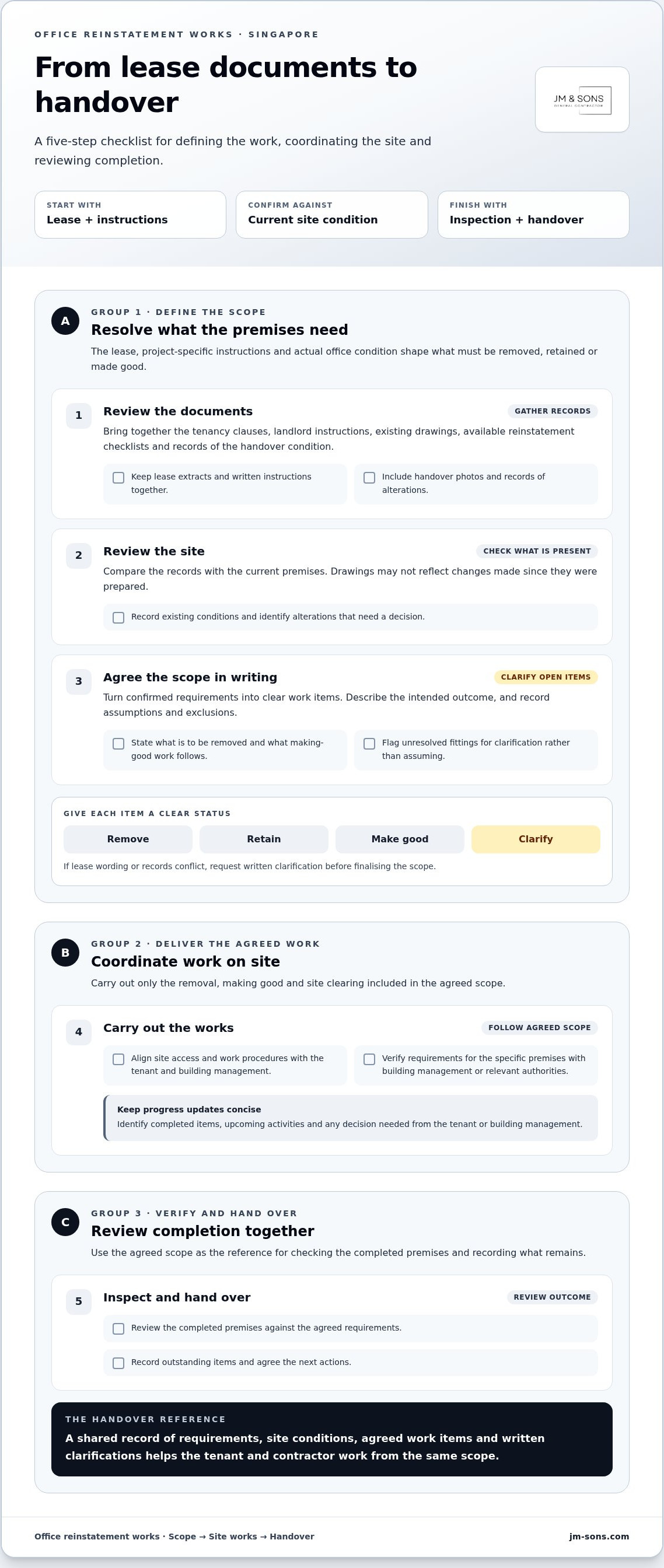
Before work begins, assign each item a clear status: remove, retain, make good or clarify. This turns a broad reinstatement clause into a practical scope without assuming that every fit-out element must go.
How Office Reinstatement Works Progress from Site Review to Handover
A clear process turns agreed requirements into work that can be scheduled, checked and handed over. For office reinstatement works, the tenant, contractor and building management need a shared understanding of the site activities and how completion will be reviewed. The process usually moves from document review to site review, scope agreement, works, inspection and handover.
From lease documents to an agreed work scope
Bring the relevant records together first: tenancy clauses, landlord instructions, existing drawings, available reinstatement checklists and records of the premises’ handover condition. A site review helps compare the documents with what is actually present. For example, a partition shown on a drawing may have been changed since the plan was prepared. Check the current site rather than assuming the drawing is complete.
The contractor can translate the agreed requirements into work items, such as removing a specified partition, making good the affected area or clearing items identified for removal. Each item should describe the intended outcome. Record assumptions and exclusions as well. If the status of a fitting is unresolved, flag it for clarification instead of silently treating it as included or excluded. Settling open points before work starts makes the scope easier to manage.
Review documents: Gather the lease information, instructions, drawings and available checklists.
Review the site: Record existing conditions and identify alterations that need decisions.
Agree the scope: Set out work items, assumptions and exclusions in a form everyone can refer to.
Carry out the works: Complete removal, making good and site clearing only where included in the agreed scope.
Inspect and hand over: Review the completed premises, record outstanding items and agree the next actions.
Site works, inspection and handover
Before work starts, align site access, work procedures and inspection arrangements with the tenant and building management. Building requirements may affect how work is scheduled and carried out. For authoritative information on Singapore’s building and construction sector, refer to the Building and Construction Authority (BCA) Singapore. Verify requirements for the specific premises with building management or relevant authorities.
Concise progress updates help the parties respond to changes while keeping the work aligned with the agreed scope. A useful update identifies completed items, upcoming activities and any decision needed from the tenant or building management. If site conditions differ from expectations, document the difference and agree how to proceed before adding work.
At inspection, compare the premises with the agreed scope. Record any outstanding items, who is responsible for them and the agreed follow-up. Keep the final record with the handover documents. If you have a floor plan, site photos or a reinstatement checklist, you can share them with JM & SONS as a starting point for discussing the scope and coordination.
Office Reinstatement or Office Refresh: How to Tell the Difference
Reinstatement and an office refresh can involve similar tasks, but they have different purposes. Reinstatement aims to return the premises to the condition required by the lease and landlord’s instructions. A refresh updates a space that will remain in use. A new fit-out changes or creates a workplace for an incoming or continuing occupier. Choose the scope based on the intended outcome, not simply on which work seems convenient.
The categories may involve similar physical work, but they are not interchangeable. Repainting a wall as part of a refresh does not necessarily meet a reinstatement requirement. Removing a partition to suit a new layout does not, by itself, mean its removal is required at lease end.
Reinstatement versus refresh or renovation
For office reinstatement works, the lease and project-specific landlord instructions determine which items need attention. A refresh may retain a tenant-added partition or fitting because it remains useful. Reinstatement may require the same item to be removed, depending on the agreed handover condition. Do not treat reinstatement as an opportunity to redesign the space, or assume a refresh fulfils lease obligations. Confirm the required outcome before committing to either scope.
A quotation should reflect the agreed work rather than bundle unrelated improvements into reinstatement. Check that it addresses:
Which areas and tenant additions are included for removal or retention
The making-good tasks required after specified items are removed
Access arrangements and building management procedures that affect coordination
Site conditions or unresolved decisions that could change the scope
How to resolve unclear or conflicting requirements
Pause before pricing or scheduling an item that is unclear. The lease, landlord instructions, drawings and observed site conditions may not align. For example, an instruction may call for removing a fitting that appears on a drawing as part of the original premises. Record the discrepancy, identify the affected area and request project-specific clarification from the landlord’s representative or building management.
Keep the response with the scope documents. Record what was agreed, which work item it affects and whether the quotation needs to change. This gives the tenant, contractor and landlord representative a traceable reference. It also keeps reinstatement distinct from optional refresh or fit-out improvements, so a decision about restoring the premises does not quietly become a design change.
Planning Office Reinstatement Works Around Singapore Building Requirements
Building management requirements can affect how work is carried out, even when the reinstatement scope is agreed. Access routes, deliveries, permitted work periods and inspection procedures may influence the sequence and timing. In a Singapore office building, confirm these arrangements with management before setting the programme. Do not assume that access for normal business operations also covers contractor entry or material removal.
Plan around the tenant’s move-out date and any business activity that will continue at the premises. If staff or equipment will remain on site, agree how work areas and access will be managed. For work planned outside standard business hours, coordinate timing with building management and the contractor in advance. Procedures vary between premises, so verify the applicable requirements with management and consult the relevant authorities where the work raises regulatory or technical questions.
Documents and coordination to prepare before work
Keep project information together so the tenant, contractor and building team can refer to the same records. This reduces the chance that an outdated drawing or a verbal instruction becomes the basis for a site decision.
Relevant lease clauses, landlord correspondence and reinstatement checklists
Available floor plans and current site photos showing the areas to be addressed
Building-management contacts, access procedures and inspection arrangements
Written scope clarifications, approvals and coordination records
Identify who can answer questions and who can approve a change to the agreed work. Clear responsibility helps prevent delays, particularly when an unexpected site condition affects the planned sequence.
Appointing a contractor for commercial reinstatement
A useful quotation links each item to the agreed scope and the observed site conditions. Check that removal, making-good and site-clearing tasks are described clearly, with assumptions and exclusions visible. If a document or site condition changes the scope, the revision should be explained before additional work proceeds. A detailed quotation gives the tenant a clearer basis for planning and coordination.
JM & SONS General Contractor Pte Ltd is BCA-registered and bizSAFE Level 3 certified. For office reinstatement works, the team’s commercial project coordination and construction capabilities support a defined scope and organised site process. Progress updates should identify completed work, upcoming activities and decisions needed from the tenant or building management.
Before appointment, align the proposed sequence with building access and inspection arrangements. Floor plans, site photos or a reinstatement checklist provide a practical starting point for discussing the scope with JM & SONS. Share your project information with the team.
Arrange Office Reinstatement Works with JM & SONS
JM & SONS General Contractor Pte Ltd carries out office reinstatement works in Singapore, including hacking, partition removal and site clearing where these tasks form part of the agreed scope. The work starts by understanding the premises and handover requirements, then setting out the items to be completed. A clear scope helps the tenant, contractor and building management stay aligned as the project moves towards handover.
A family contractor with commercial project capabilities
JM & SONS has roots dating back to 1990 as a family contractor. Its in-house construction capabilities support commercial project coordination, from defining work items to carrying them out on site. The company also operates a 10,000 sq ft local carpentry facility, which is relevant when the scope involves tenant-added carpentry that must be removed or coordinated with other reinstatement tasks.
Accountability matters throughout the process. A detailed quotation should make clear what is included, what is excluded and which site conditions may affect the work. Clear communication gives the parties an opportunity to resolve questions before they disrupt the agreed sequence or remain unresolved at handover inspection.
For a tenant, practical project coordination means having a clear reference for the agreed scope, the work in progress and any outstanding decisions. JM & SONS coordinates commercial construction work with these details in view, so reinstatement tasks can be planned against the handover requirements. If the building requires work outside standard operating hours, include that requirement when planning the project sequence.
What to share when discussing your reinstatement project
You do not need every detail resolved before starting a discussion. Available project documents can show the premises, the landlord’s stated requirements and the areas that need attention. Sharing them gives the team a clearer starting point for understanding the proposed scope and coordination needs.
Floor plans showing the current or previous office layout
Site photos of partitions, fittings or areas identified for reinstatement
A landlord reinstatement checklist or relevant written instructions
If requirements are still being clarified, include the relevant notes or correspondence. These documents help make the discussion specific to your premises. Final work items can then be aligned with the applicable instructions and agreed scope.
To discuss your project, send JM & SONS your floor plans, site photos or reinstatement checklist on WhatsApp. Start with the information you have and use the discussion to establish a practical next step for planning the work and handover.
Set Your Handover Plan in Motion
A smoother handover starts with turning the information you already have into a practical next step. Gather the lease clauses, landlord instructions and site records for your premises. Note anything that remains unclear, such as whether a particular fitting should stay or be removed. This gives the project discussion a useful focus before work is scheduled.
With office reinstatement works, early clarity keeps decisions tied to the required handover condition instead of assumptions. You do not need a complete project brief before reaching out. A few photos or a preliminary checklist can help start a focused conversation about the site and the work ahead.
Start a WhatsApp discussion with JM & SONS about your handover plans and share the project documents you have ready. Use the discussion to set a clear next step for organising the work and preparing to hand back the premises.
Frequently Asked Questions
Does office reinstatement in Singapore always mean returning the space to its original condition?
No. The required end condition is not automatically the original one. If the handover record is incomplete, dated photos, inspection notes or fit-out records can help establish what was present and what changed during the tenancy. For example, a surface may have been replaced after damage, which could affect how that area is assessed. Ask the landlord’s representative to clarify any uncertainty and keep the response with the project records.
Can a landlord require reinstatement even if the office fit-out was approved?
Fit-out approval and lease-end handover are separate project milestones. An approval may record what was permitted during the tenancy without stating whether an item can remain when the tenant leaves. Keep approval emails, drawings and completion records together with the handover instructions. If an approved alteration’s status at lease end is unclear, request a specific written decision about it.
What documents should I prepare before starting office reinstatement works?
Alongside the tenancy agreement and landlord correspondence, prepare the latest available floor plan and label site photos by room or area. Note when the photos were taken and flag differences between the plan and current layout. This makes it easier to discuss an item precisely, such as identifying which partition appears in a particular image. Keep one current set of documents so outdated versions are not circulated unnoticed.
Do office reinstatement works need building management coordination in Singapore?
Building-specific arrangements can affect contractor entry, service lift use, material movement and inspection access. Ask building management which arrangements apply to your premises, who handles access requests and how inspection appointments are made. A simple contact and responsibility list helps the tenant, contractor and management team direct questions to the right person, particularly if the usual site contact is unavailable.
Can office reinstatement works be carried out after business hours?
They may be scheduled outside business hours if the building’s access arrangements and project programme allow. Before choosing a work period, clarify applicable noise restrictions, access windows, supervision arrangements and inspection availability with building management. Then match the proposed sequence to those conditions. For example, if an inspection is needed before the next activity, include time to coordinate it rather than assuming it can take place at any time.
How do I avoid paying for reinstatement work that is outside the agreed scope?
Use the quotation as a working document, not just a total. Compare item descriptions and assumptions with your project records, and agree how proposed changes will be presented for approval before extra work starts. Keep written approval of each variation, including the affected item and revised amount. If two descriptions use different wording for the same area, resolve the difference before appointment so the intended work is clear.
When should I plan office reinstatement before a lease ends?
Work backwards from the lease-end and move-out milestones, allowing time for decisions that could affect the programme. For example, the scope cannot be finalised while the landlord is still deciding whether a fitting may remain. Map key dependencies, including document review, building-management arrangements, site access and inspection availability, then discuss a realistic sequence with the contractor. The appropriate start point depends on the premises and the work involved.



Comments